The Lion of Anshan: Cyrus Breaks the Medes
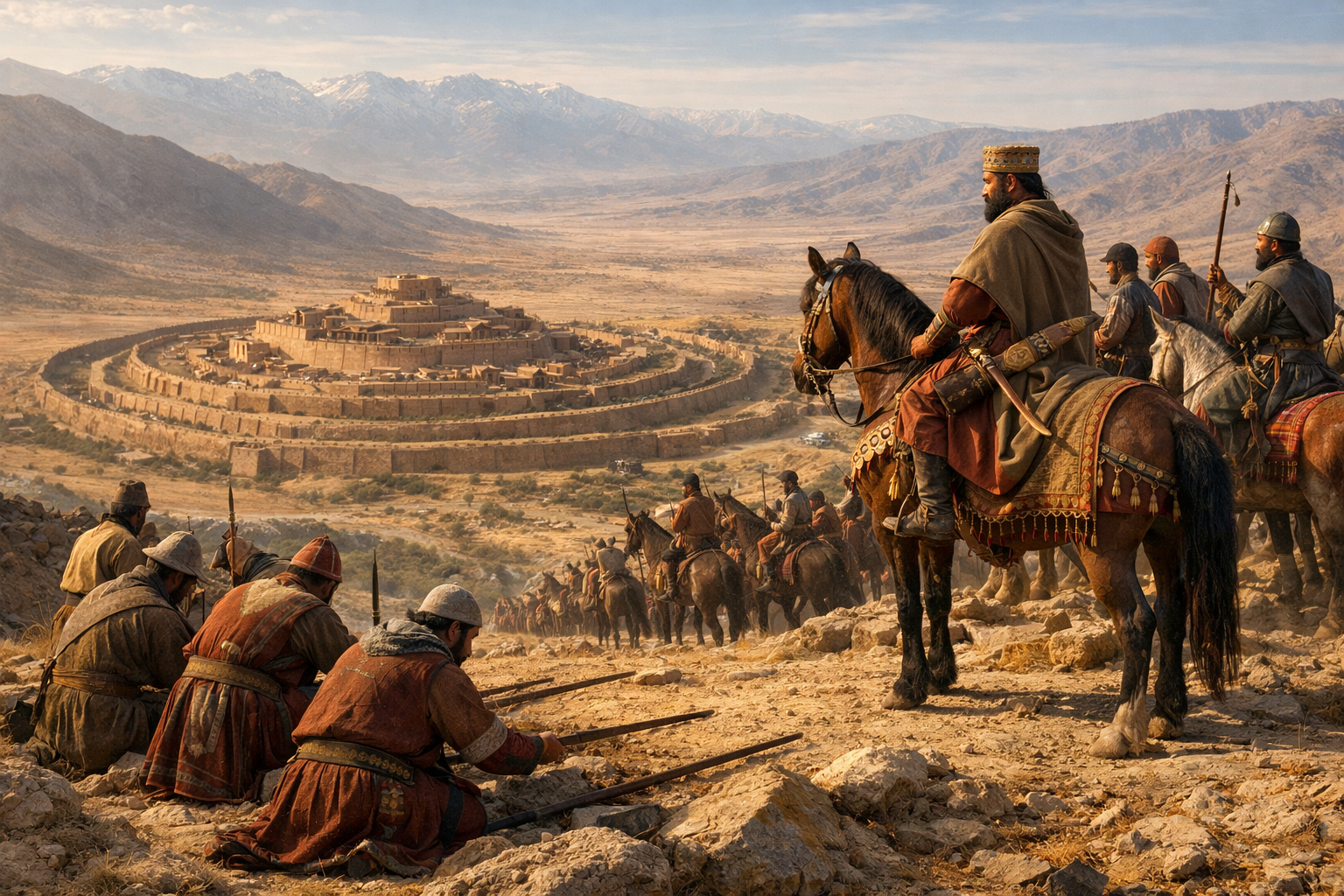
A World of Competing Empires
In the middle of the sixth century BCE, the Near East was a crowded stage. The Neo-Babylonian Empire under Nabonidus controlled Mesopotamia and the Levant. The kingdom of Lydia, ruled by the fabulously wealthy Croesus, dominated western Anatolia. Egypt, though weakened, remained a civilization unto itself. And stretching across the Iranian plateau from the Zagros Mountains to the edges of Central Asia sat the Median Empire—a loose but formidable confederation of Iranian tribes that had helped destroy Assyria in 612 BCE and had since held dominion over the peoples of the highlands, including a small but proud Iranian group known as the Persians.
The Persians occupied the region called Parsa—modern Fars province in southwestern Iran—and a secondary zone called Anshan, an ancient Elamite city-state whose name the Persians had absorbed into their own royal titulature. Their kings were vassals of the Medes, obligated to send tribute and soldiers northward to Ecbatana, the Median capital nestled in the cool mountain air near modern Hamadan. By most accounts, they were not a people anyone expected to remake the world.
The House of Achaemenes
The dynasty Cyrus belonged to traced its lineage to a figure named Achaemenes—Haxāmaniš in Old Persian—who is attested in later royal inscriptions but about whom almost nothing certain is known historically. Cyrus himself, in the famous Cyrus Cylinder composed after his conquest of Babylon in 539 BCE, identifies himself as "son of Cambyses, great king, king of Anshan; grandson of Cyrus, great king, king of Anshan; great-grandson of Teispes, great king, king of Anshan." The lineage is real in the sense that Achaemenid kings consistently claimed it, though modern scholars including Pierre Briant caution that the early genealogy may have been retrospectively elaborated to legitimize rule.
What is clear is that by approximately 600 BCE, the Persian highlands were divided between two Achaemenid lines descended from Teispes. One branch ruled Anshan; the other ruled Persia proper. Cyrus II inherited the Anshan branch from his father Cambyses I, likely around 580 BCE, and at some point consolidated both branches under his authority—though the exact mechanism and timing remain debated among scholars.
Astyages and the Conditions of Revolt
The Median king whom Cyrus overthrew was Astyages, who had ruled since approximately 585 BCE. Greek sources, particularly Herodotus writing in the fifth century BCE, preserve a dramatic origin story in which Astyages receives prophetic dreams warning that his daughter's offspring will supplant him. He gives her in marriage to the Persian vassal Cambyses I, hoping a Persian rather than Median child will dilute the threat—and from that union Cyrus is born. Herodotus then recounts how Astyages orders the infant Cyrus killed, how the order is disobeyed, and how Cyrus is raised by a herdsman before his true identity is discovered.
Modern historians treat this narrative with appropriate skepticism. It follows recognizable patterns of ancient hero-birth mythology found across the Near East—similar stories attach to Sargon of Akkad and, later, to Moses. The Babylonian chronicle known as the Nabonidus Chronicle, a contemporary administrative text, offers a drier but more reliable account: it records that in the sixth year of Nabonidus (550 BCE), "Cyrus, king of Anshan," marched against Astyages, that the Median army mutinied and handed Astyages over to Cyrus, and that Cyrus then occupied Ecbatana, carrying off its silver, gold, and goods to Anshan.
The mutiny of the Median army is the critical detail. It suggests that Astyages had lost the confidence of his own military aristocracy—possibly through harsh taxation, failed campaigns, or personal tyranny, though the sources do not specify. Herodotus adds that a Median general named Harpagus, who bore a personal grievance against Astyages, defected to Cyrus during the decisive engagement. Whether Harpagus was one man or a symbol for a broader noble defection is uncertain, but the structural point stands: Median imperial power was not defeated so much as it dissolved from within.
The Fall of Ecbatana
Ecbatana—Hagmatāna in Old Persian, meaning "place of assembly"—sat at an elevation of roughly 1,800 meters in the Zagros foothills. Herodotus describes it as a city of concentric walls painted in different colors, each ring higher than the last, with the innermost enclosure housing the royal treasury. Archaeology has confirmed substantial occupation at the site of modern Hamadan, though the legendary walls have not been excavated in a form matching Herodotus's description, and scholars including David Stronach have noted the difficulty of separating Median from later Achaemenid and Parthian layers at the site.
What the Nabonidus Chronicle confirms is that the city fell without a prolonged siege. Cyrus looted the treasury—a transfer of wealth that immediately funded further military operations—but crucially, he did not destroy the city or massacre its population. This restraint was not accidental. It was the first visible expression of a governing philosophy that would characterize Cyrus's entire reign: the absorption of conquered elites rather than their annihilation.
Median nobles who submitted were retained in administrative positions. Median military units were integrated into the Persian army. The Median language and certain Median court ceremonies continued in use. To many subject peoples watching from Babylon or Sardis, the new empire may have looked, at first, like a change of management rather than a change of civilization.
What Cyrus Inherited
The Median Empire was not a bureaucratic state in the Assyrian or later Persian sense. It functioned primarily through a network of tribal and regional loyalties bound to the Median king by tribute obligations and military service. There were no known satrapies in the Median system, no royal road, no standardized coinage. What the Medes had was territorial reach—their sphere of influence extended from eastern Anatolia (where they had agreed on the Halys River as a boundary with Lydia after a battle famously interrupted by a solar eclipse in 585 BCE) across the plateau into parts of Central Asia.
By defeating Astyages, Cyrus inherited all of this reach along with the legitimacy claims that came with it. He adopted Median royal regalia. He may have worn the Median tiara in certain ceremonial contexts—a detail preserved in Greek sources and discussed by scholars including Margaret Cool Root in the context of Achaemenid royal iconography. He presented himself not as a conqueror of the Medes but as a liberator restoring proper order, a framing he would use again and again.
The absorption of the Median military was particularly consequential. The Medes were renowned horsemen, and their cavalry traditions, combined with Persian infantry, created a combined-arms force that no regional power could yet match. Within a decade, Cyrus would use this force to conquer Lydia (547 BCE) and Babylon (539 BCE), but those campaigns were only possible because of the institutional and military capital captured at Ecbatana in 550.
The Watching World
The speed of the Median collapse sent shockwaves through the Near East. Herodotus tells us that Croesus of Lydia, who was either the brother-in-law of Astyages or at least his ally, consulted the oracle at Delphi about whether to attack the new Persian king while he was still consolidating power. The oracle's famously ambiguous reply—that if Croesus crossed the Halys River he would destroy a great empire—led Croesus to invade. The empire he destroyed was his own.
But that story belongs to Episode 2. What matters here is the perception of 550 BCE. The Babylonian court was watching. Egyptian diplomats were watching. The Greek cities of Ionia, already under Lydian suzerainty, were watching. A new power had emerged from the highlands with terrifying speed, absorbing rather than destroying, legitimizing rather than terrorizing. It was a model of conquest that the ancient world had not quite seen before, and no one yet understood how far it would reach.
The Meaning of Anshan
There is something symbolically important in the title Cyrus used even after defeating Astyages: "King of Anshan." Anshan was not a great city. It was a reference to an ancient Elamite heritage that gave the Persian highlands a claim to civilizational depth—a way of saying that this was not a barbarian uprising but the reassertion of an old and legitimate tradition. Cyrus was doing in 550 BCE what he would do in Babylon in 539: reaching back into local history to find a legitimizing identity that made his rule feel like restoration rather than conquest.
The Achaemenid Empire, which would eventually stretch from the Aegean to the Indus and govern perhaps forty percent of the world's population at its height, began in this act of ideological creativity as much as military force. A king from the highlands of Iran looked at the crumbling loyalty structure of the Median Empire and saw not an obstacle but a template—one he would immediately begin to improve upon.
The ancient world would not be the same.
Editor's Context
The fall of the Medes is often treated as a prologue to the 'real' Persian story, but it deserves recognition as a revolutionary event in its own right. Cyrus did not simply change the dynasty sitting atop an existing structure—he inherited Median administrative networks, military traditions, and vassal relationships and immediately redeployed them, demonstrating a pattern of institutional absorption that would define Achaemenid statecraft for two centuries. The speed of Median collapse also reveals a fragility common to tribute-extraction empires built on personal loyalty rather than codified governance, a lesson Cyrus appears to have internalized when constructing his own system.
Reviewed under the EmpiresDiary editorial workflow by Obadiah.
Sources & Further Reading
Episode source notes
Claim: The Nabonidus Chronicle records that in 550 BCE Cyrus marched against Astyages, the Median army mutinied, and Cyrus occupied Ecbatana carrying off its treasures
Source: Nabonidus Chronicle (British Museum tablet BM 35382); translated and discussed in A.K. Grayson, Assyrian and Babylonian Chronicles (1975) (primary)
Claim: Cyrus identifies his royal genealogy through Cambyses, Cyrus I, and Teispes in the Cyrus Cylinder
Source: Cyrus Cylinder (British Museum); Irving Finkel ed., The Cyrus Cylinder: The King of Persia's Proclamation from Ancient Babylon (2013) (primary)
Claim: The early Achaemenid genealogy may have been retrospectively elaborated to legitimize rule
Source: Pierre Briant, From Cyrus to Alexander: A History of the Persian Empire, trans. Peter Daniels (2002), pp. 15–21 (scholarly)
Claim: Herodotus recounts the dream prophecy of Astyages and the birth narrative of Cyrus, including the role of the general Harpagus in the Median defection
Source: Herodotus, Histories, Book I.107–130 (primary)
Claim: The Median-Lydian boundary at the Halys River was established after a battle interrupted by a solar eclipse in 585 BCE
Source: Herodotus, Histories, Book I.74; eclipse date corroborated in John Steele, 'The Babylonian Astronomical Diaries' discussion in Sacha Stern & Charles Burnett eds., Time, Astronomy, and Calendars in the Jewish Tradition (2014) (primary)
Claim: Archaeological difficulty in separating Median from later occupation layers at Ecbatana/Hamadan
Source: David Stronach, 'Ecbatana' in Encyclopaedia Iranica (1997) (scholarly)
Claim: Cyrus may have worn Median royal regalia including the tiara in ceremonial contexts, reflecting deliberate absorption of Median royal identity
Source: Margaret Cool Root, The King and Kingship in Achaemenid Art (1979), pp. 56–62 (scholarly)
Claim: Herodotus reports that Croesus consulted the Delphic oracle before attacking Cyrus, receiving the ambiguous response about destroying a great empire
Source: Herodotus, Histories, Book I.53 (primary)
Selected bibliography for this series
The New Cambridge Medieval History
Rosamond McKitterick and contributors, The New Cambridge Medieval History. Cambridge University Press reference volumes for late antique and medieval context. (reference)
The Cambridge Ancient History
A. K. Bowman, Peter Garnsey, Averil Cameron, and contributors, The Cambridge Ancient History. Cambridge University Press reference volumes for ancient Mediterranean chronology and institutions. (reference)
Drafted with AI. Edited and fact-checked by Obadiah before publication. See the workflow and editorial policy.