The Birth of New Rome
324 CE, Byzantium
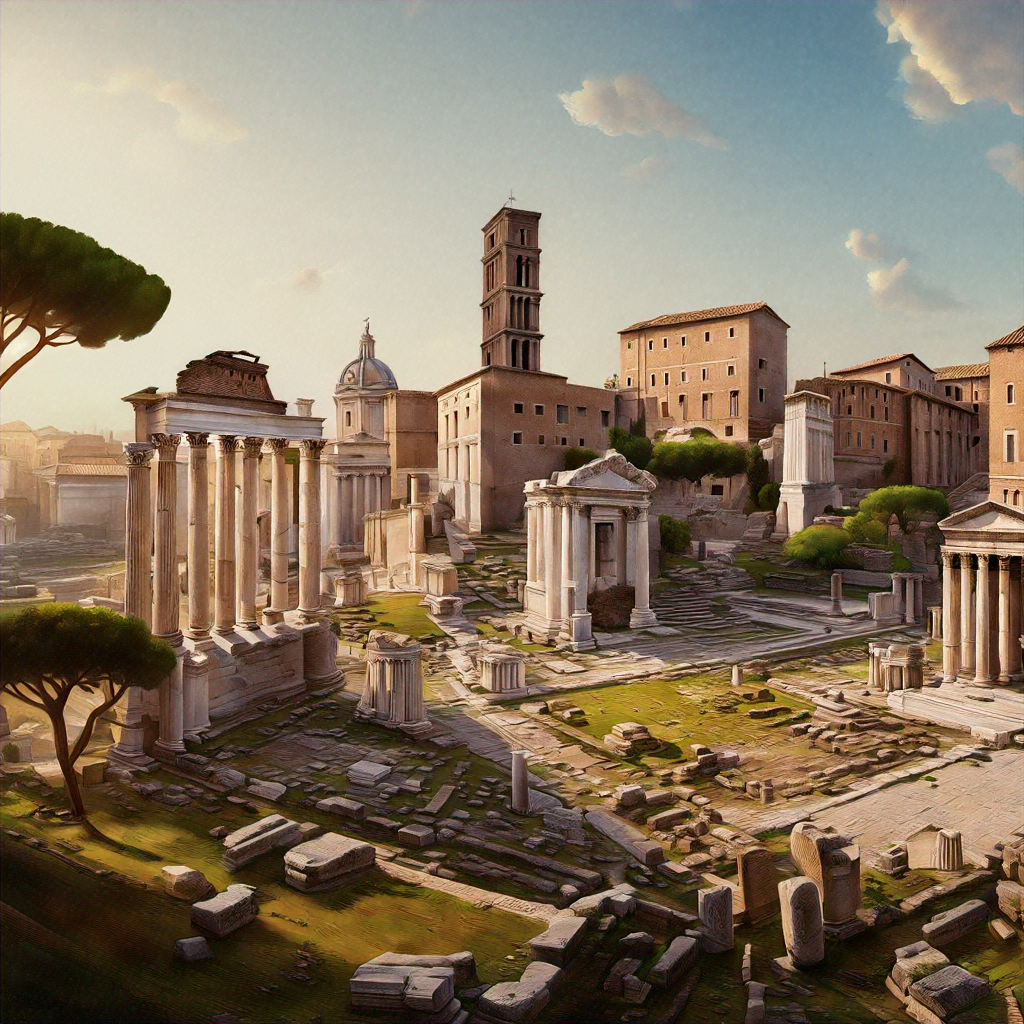
The autumn wind whipped across the Bosphorus Strait as Constantine stood at the edge of the ancient Greek settlement of Byzantium. Below him, fishing boats bobbed in the natural harbor known as the Golden Horn, while merchants' vessels from across the Mediterranean jostled for position at the crowded wooden docks. His purple cloak billowed behind him as he surveyed the seven hills rising from the peninsula, hills that reminded him of Rome itself.
What he saw in his mind bore little resemblance to what stood before him. He envisioned massive walls enclosing grand boulevards lined with marble colonnades, forums filled with bronze statues, and a hippodrome where the people would gather to cheer. At the highest point, a great church would glorify his newly embraced Christian faith.
His advisers had questioned the choice. Why abandon Rome, the eternal city? Why build a new capital in this distant corner of the empire? Constantine knew what they couldn't see. He stood at the crossroads of the world, where Europe met Asia and the Mediterranean met the Black Sea. From this position, an emperor could defend the empire's frontiers and control the vital trade routes that were its lifeblood.
As the sun began to set, Constantine took a spear and started walking, marking the line where the new walls would rise. When his attendants remarked that he had already encompassed an enormous area, the emperor replied, "I shall continue until the invisible guide who walks before me thinks it right to stop." He was laying out not just a city, but a vision that would endure for more than a millennium.
The Roman Empire of the early fourth century was a realm in transformation. The old system of government established by Augustus was straining under the weight of external threats and internal divisions. The Crisis of the Third Century had nearly torn the empire apart, and though Diocletian's reforms had restored stability, they had also formalized the empire's division into eastern and western spheres.
Constantine had emerged victorious from the civil wars that followed Diocletian's retirement, defeating his rival Licinius in 324 CE to become sole emperor. He inherited an empire facing mounting challenges. Germanic tribes pressed against the Rhine and Danube frontiers, while a resurgent Persian Empire threatened the eastern provinces. The traditional Roman religious system was being challenged by the rising tide of Christianity, which Constantine himself had embraced after his vision at the Milvian Bridge in 312 CE.
Rome lay far from these frontier challenges and from the empire's shifting economic center of gravity. The wealthy eastern provinces, with their Greek-speaking cities and ancient cultural traditions, had become increasingly important to the empire's survival. Constantinople would be a symbol of how the Roman Empire was reinventing itself for a new age.
The Great Building Project (324-330 CE)
The transformation of Byzantium into Constantinople was one of the ancient world's most ambitious construction projects. Thousands of workers descended on the site: architects, stonemasons, and artisans drawn from across the empire. The city's natural defenses were formidable, protected on three sides by water and easily defensible on the fourth, but Constantine's plans would make it virtually impregnable.
Architects and stonemasons drawn from across the empire raised the new walls and avenues at a forced pace, working under the emperor's direct supervision. Constantine himself walked the site regularly, pressing his builders to work faster and on a grander scale than any project most of them had previously attempted.
The city took shape around a central avenue, the Mese, which ran from the Golden Gate to the Forum of Constantine. That forum, marked by a massive porphyry column topped with a statue of the emperor in the guise of Apollo, would be the heart of civic life. Beyond it rose the Great Palace complex and the Hippodrome, designed to seat 100,000 spectators.
Helena, Constantine's mother, played a role in establishing the city's Christian character. She was a devoted supporter of the new faith, and tradition later credited her with bringing relics from Jerusalem to enrich the churches of the empire. The story connecting her directly to the discovery of the True Cross is a legend that developed later in the fourth century rather than a documented fact of the construction period. Churches rose throughout the new city as a testament to the empire's new faith, while Constantine was careful not to alienate those who still followed the old religious traditions.
People had to be drawn in as well. Constantine offered tax incentives and free bread to attract residents from across the empire. Aristocratic families were required to establish residences in the new capital, bringing their wealth and influence with them. Merchants arrived chasing the promise of new opportunities in what would become the empire's commercial hub.
Consequences and Legacy
The foundation of Constantinople marked a pivotal moment in world history. The city survived as the capital of the Eastern Roman (Byzantine) Empire for over a thousand years, long after Rome itself fell to Germanic invaders. Its strategic location and impregnable defenses preserved Greco-Roman civilization through the Dark Ages, and its wealth and sophistication shaped cultures from Venice to Baghdad.
Constantinople earned a cluster of distinctions that no other city could claim. It was the first truly Christian capital, the first planned imperial city since Alexander's Alexandria, and the first metropolis to systematically preserve and transmit classical learning through a network of schools and scriptoria. Its walls withstood twenty sieges over the centuries, yielding only to the Ottoman Turks' cannons in 1453.
The city's foundation also accelerated the empire's transformation. Greek gradually replaced Latin as the administrative language, while Christian theology became intertwined with imperial politics. Constantinople became the model for medieval cities across Europe and the Islamic world. Its architecture was copied, its ceremonies imitated, its luxury goods coveted.
Constantine dedicated his new city on May 11, 330 CE, with no way of knowing the full magnitude of what he had created. In our next episode, we'll explore how his successors dealt with the challenges of governing from this new capital, as religious controversies and political intrigues threatened to tear apart the newly unified empire. The stage was set for the dramatic reign of Theodosius I, who would make Christianity the empire's official religion and face the growing threat of Gothic invasions.
Editor's Context
Read this episode through the Byzantine habit of adaptation. The empire repeatedly survived by changing its military, fiscal, religious, and diplomatic tools while insisting that it remained Roman. The date markers (324 CE, 312 CE) are included because chronology is one of the easiest places for narrative history to become misleading. The episode's themes (history, empire, power) are the editorial lens for weighing cause and consequence rather than treating the story as isolated trivia.
Reviewed under the EmpiresDiary editorial workflow by Obadiah.
Drafted with AI. Accuracy review and corrections are ongoing — if you spot an error, please report it. See our workflow and editorial policy.