The Purple Plague
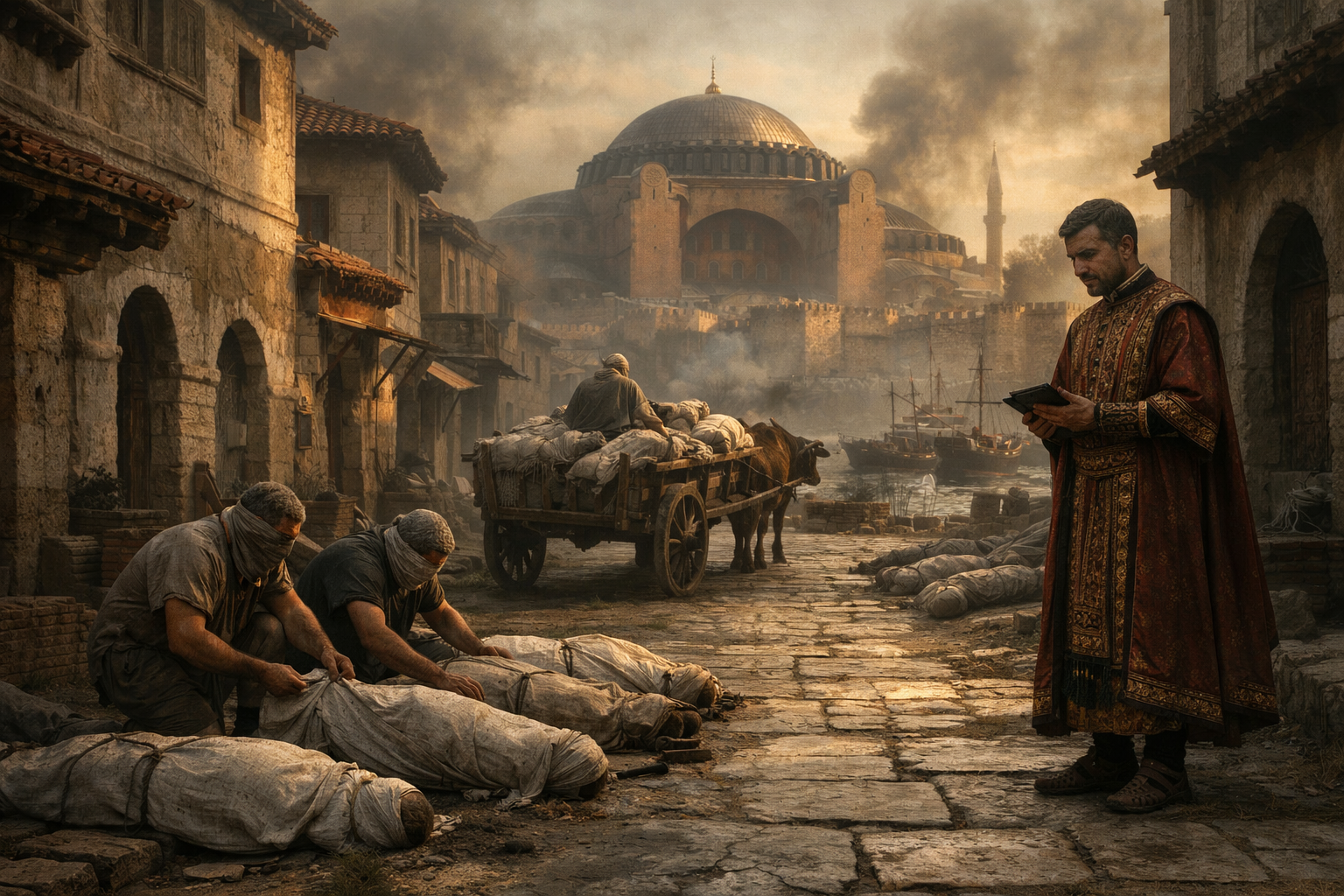
Constantinople, 542 CE
The stench of death hung over Constantinople like a shroud. What began as whispers from the ports had become a grotesque reality throughout the Queen of Cities. Bodies littered the streets, so many that the living could no longer keep pace with burying the dead. The historian Procopius, walking through the city's once-bustling forums, recorded the horrific scenes unfolding before him: victims seized by sudden fever, their skin erupting in black buboes, most dead within days.
Emperor Justinian himself lay stricken in his palace, hovering between life and death as the empire he had worked so hard to rebuild teetered on the brink. His wife Theodora, showing the steel that had helped her rise from circus performer to empress, took command of the government even as chaos engulfed the capital. The great domed cathedral of Hagia Sophia, completed just five years earlier, now served as both hospital and morgue.
Ships sat idle in the harbor, their crews dead or fled. The granaries began to empty as the complex machinery of feeding half a million citizens broke down. The dead were stacked in empty towers along the walls, thrown into the sea, or piled in mass graves outside the city. When traditional burial spaces were exhausted, workers dug enormous pits in the fields of Galata across the Golden Horn and filled them with thousands of corpses.
Procopius recorded that at the plague's height, 10,000 people died each day in Constantinople alone. The city's prefect, struggling to dispose of the mounting dead, ordered boats piled high with bodies to be towed out to sea. When even this proved insufficient, workers removed the tops from the massive defensive towers along the land walls and simply dropped corpses inside until they were filled.
The plague struck at the worst possible moment for Justinian's dream of reconquering the lost western Roman Empire. After reclaiming North Africa from the Vandals in 534 CE and making significant progress in Italy against the Ostrogoths, his forces were poised for a final push to restore Roman rule across the Mediterranean. The treasury was full, trade was flourishing, and new architectural marvels like Hagia Sophia showcased Byzantine power and prosperity.
The disease likely originated in Central Asia, traveling along trade routes through Persia before reaching the Egyptian port of Pelusium in 541 CE. From there, grain ships carried infected rats and their fleas throughout the Mediterranean. The plague, now known to be bubonic plague caused by the bacterium Yersinia pestis, found perfect conditions in the densely populated cities of the 6th-century Mediterranean world.
The Byzantine Empire of 542 was uniquely vulnerable. Its cities were the largest in Europe, its trade networks extensive, and its population concentrated in urban centers. Constantinople itself, with perhaps 500,000 inhabitants, was the world's largest city. The empire's sophisticated infrastructure, usually a strength, helped spread the disease rapidly along its roads and shipping lanes. Making things worse, the plague arrived during a period of climate disruption now known as the Late Antique Little Ice Age, triggered by volcanic eruptions in 536 CE. The resulting crop failures and famines had already weakened the population's resistance before the first infected flea ever reached the capital.
The Plague's Progress
The pandemic unfolded in three devastating waves. The initial outbreak in 542 CE was the most severe, but subsequent waves in 558 and 590 prevented any meaningful recovery. The disease struck all levels of society, from slaves to senators, farmers to merchants, soldiers to priests.
John of Ephesus, traveling through Asia Minor during the plague, left a haunting account of what he witnessed. He described villages and towns suddenly emptied of their inhabitants, the living unable to keep up with burying the dead, entire families found dead together inside their homes, dogs devouring unburied corpses, and children left as orphans with no one to care for them.
The military implications were catastrophic. Justinian's campaigns in Italy ground to a halt as armies were decimated not just by combat but by disease. Procopius estimated that a quarter to a third of the empire's population died, with some regions losing up to 60% of their inhabitants. Tax revenues plummeted as agricultural production collapsed and trade networks disintegrated.
Social order in Constantinople began to break down. The wealthy fled to their country estates while the poor had nowhere to go. Traditional funeral rites became impossible to maintain. Bodies were wrapped in sheets and thrown onto carts with no ceremony. The church struggled to provide comfort and explanation for a catastrophe that seemed to strike believer and non-believer alike, offering no pattern that anyone could discern.
Theodora proved crucial in maintaining some semblance of government function during the worst months. She organized care for the sick, requisitioned buildings as hospitals, and ensured that essential services continued even as civil servants died at their posts. When Justinian recovered, he found an empire fundamentally changed.
Lasting Impact
The Justinianic Plague marked a turning point in Byzantine and Mediterranean history. The empire's economy took generations to recover, if it ever truly did. The dream of reconquering the West became impossible as resources and manpower were depleted. Widespread abandonment of farmland followed, along with urban decay and a simplification of economic life throughout the Mediterranean basin.
The plague accelerated the transformation of the late antique world into the medieval period. Cities shrank. Trade declined. Society became more ruralized and localized, and the empire's tax base was permanently reduced, limiting its military capabilities just as new threats emerged from the Slavs in the Balkans and eventually the Arabs in the East.
Modern estimates suggest that the Justinianic Plague killed between 25 and 50 million people across the Mediterranean world, perhaps 40% of the population of the eastern Mediterranean. It would remain the deadliest pandemic in human history until the Black Death eight centuries later.
As the plague gradually subsided, Justinian's empire faced new challenges. The weakened Byzantine state would soon confront the rise of Islam and the loss of its eastern provinces. In our next episode, we'll explore how the empire adapted to these dramatic changes, transforming from a Mediterranean superpower into a more compact, militarized state fighting for survival. The age of Justinian's dreams of restoration was over. The age of survival had begun.
Editor's Context
Read this episode through the Byzantine habit of adaptation. The empire repeatedly survived by changing its military, fiscal, religious, and diplomatic tools while insisting that it remained Roman. The date markers (534 CE, 000) are included because chronology is one of the easiest places for narrative history to become misleading. The episode's themes (history, empire, power) are the editorial lens for weighing cause and consequence rather than treating the story as isolated trivia.
Reviewed under the EmpiresDiary editorial workflow by Obadiah.
Drafted with AI. Accuracy review and corrections are ongoing — if you spot an error, please report it. See our workflow and editorial policy.