The Price of Ambition
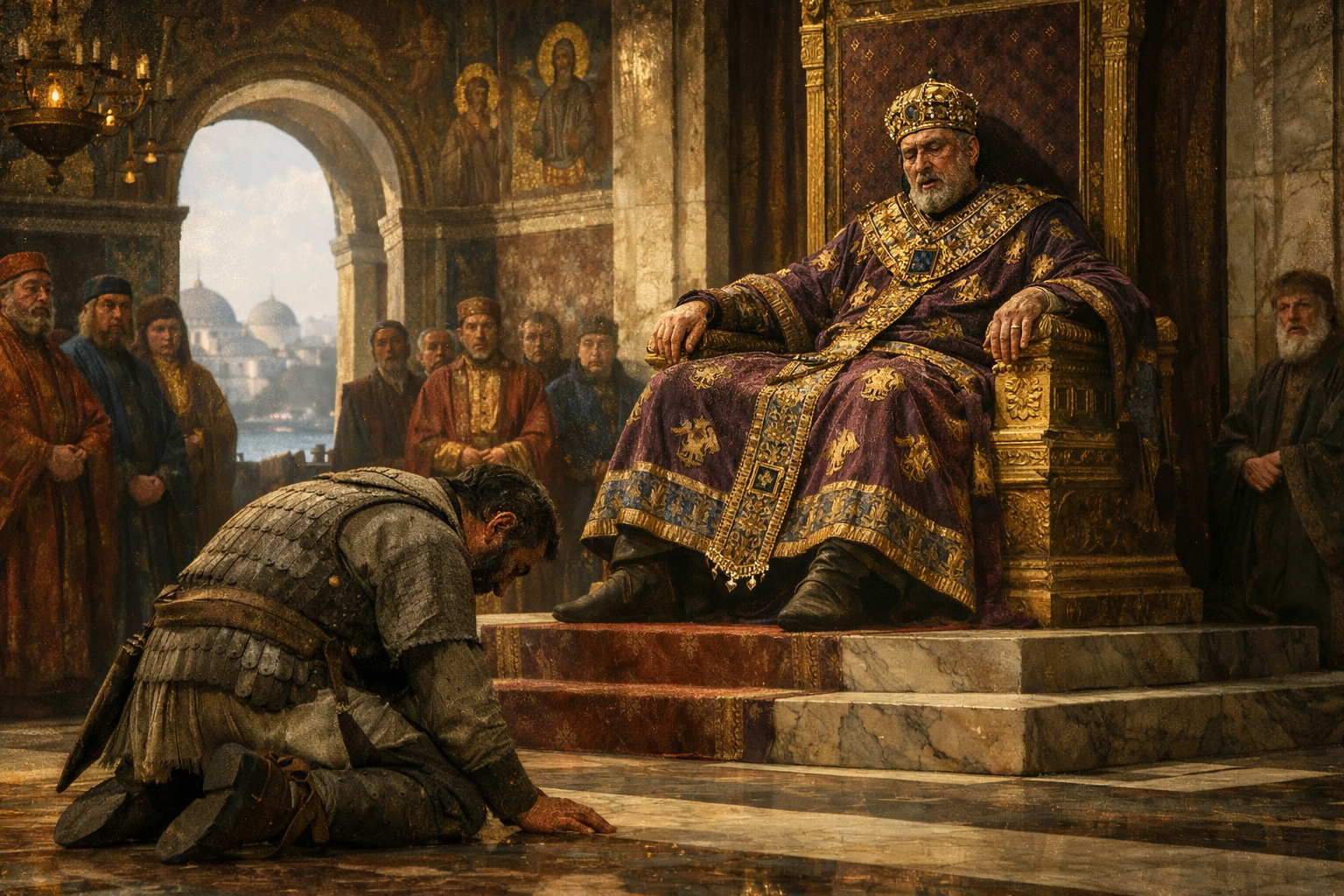
Constantinople, Spring 1176
The great hall of the Blachernae Palace fell silent. Emperor Manuel I Komnenos slumped in his golden throne, face ashen, as the messenger from Anatolia knelt trembling before him. The news was catastrophic. The Byzantine army, the greatest force Manuel had ever assembled, lay in ruins at the pass of Myriokephalon. Sultan Kilij Arslan II of the Seljuk Turks had trapped the imperial column in a narrow mountain defile and rained arrows down upon it until the proud Byzantine ranks broke in panic and fled.
Manuel's ornate purple robes seemed to weigh on his shoulders as he absorbed the scale of the disaster. The emperor who had spent his reign dreaming of restoring Byzantium to its former glory was now forced to confront a bitter truth: his ambition to reconquer Anatolia from the Turks lay shattered. The courtiers watched their once-vigorous emperor, now in his late fifties, appear to age years in a matter of moments.
Through the grand windows of the palace, the gleaming domes of Constantinople's churches caught the spring sunlight, a reminder of the empire's enduring majesty. But Manuel knew better than anyone that appearances could deceive. The empire's resources had been drained by decades of campaigning. The treasury was depleted, the army's best troops were dead or scattered, and the Turks would soon press their advantage.
As he dismissed the messenger, his mind drifted back through the decades of his reign. The grand plans, the diplomatic alliances, the victories and the defeats that had led to this moment. He had inherited an empire still counted among the most powerful states in the Mediterranean world. Now, facing the consequences of his overreach, he could not help but wonder whether his ambition to restore Byzantium's ancient greatness had instead helped seal its eventual doom.
The Empire Under the Komnenoi
When Manuel I ascended to the Byzantine throne in 1143, he inherited an empire substantially rebuilt by his grandfather Alexios I and his father John II. The Komnenian restoration, as historians would later call it, had arrested the decline that followed the disastrous Battle of Manzikert in 1071, which had opened Anatolia to Turkish invasion.
The Komnenoi had created a new military and administrative system built around powerful aristocratic families and professional soldiers. They stabilized the empire's borders, reformed its finances, and kept Constantinople the most magnificent city in the Christian world. The First Crusade, launched in 1095 by Pope Urban II in part responding to Alexios I's appeal for aid, had helped establish Byzantine influence over the Crusader states and temporarily pushed back Turkish power in Asia Minor.
Serious challenges remained, though. The Seljuk Turks still controlled much of the Anatolian plateau, the empire's traditional heartland. In the west, the Norman Kingdom of Sicily posed a constant threat to Byzantine interests in Italy and the Balkans. The Italian maritime republics, especially Venice, had extracted extensive trading privileges that steadily undermined Byzantine economic power. And the empire's relationship with the Latin West stayed complex and often antagonistic, despite repeated diplomatic efforts at reconciliation.
Manuel, educated in both Greek and Latin culture, believed he could solve these problems through military reconquest combined with deeper integration into Western European politics. He envisioned himself as a new Justinian, restoring Roman power throughout the Mediterranean while serving as the leader of a united Christian world.
The Grand Vision and Its Unraveling
Manuel's reign began with genuine promise. Young, energetic, and thoroughly trained in warfare, he seemed the ideal ruler to carry the Komnenian restoration forward. His first major initiative was to strengthen ties with the Latin West through his marriage to Bertha of Sulzbach, a relative of the German Emperor Conrad III. The alliance was designed to create a united front against Norman Sicily and open new diplomatic possibilities.
The emperor pursued an activist foreign policy on multiple fronts:
- In Italy, he intervened in support of Pope Alexander III against Frederick Barbarossa, positioning himself as the papacy's protector. He even briefly occupied Ancona as a foothold on the Italian peninsula.
- In the Balkans, he reasserted Byzantine authority over Hungary and Serbia through military campaigns and diplomatic marriages. His armies reached as far as the Danube, temporarily restoring the empire's European frontiers.
- Against the Seljuk Turks, he launched repeated campaigns into Anatolia, scoring several victories and forcing Sultan Kilij Arslan II to acknowledge Byzantine suzerainty in 1162.
These successes masked growing problems. Each campaign strained the empire's resources and manpower. The professional army was effective but expensive to maintain and hard to replace when losses mounted. Manuel's persistent western focus meant that opportunities to consolidate gains in Anatolia were repeatedly passed over.
The turning point came in the 1170s. Manuel convinced himself that the moment had arrived for a decisive blow against Seljuk power. He assembled the largest Byzantine army seen in generations, combining native troops with Latin mercenaries. The force was well-equipped but unwieldy, and his strategic judgment proved faulty at the critical moment.
When the army entered the pass of Myriokephalon in September 1176, the Seljuks were waiting. The defeat that followed destroyed the cream of the Byzantine army. With it went the last real chance to recover Anatolia.
Consequences: The Beginning of the End
The aftermath of Myriokephalon exposed the structural weaknesses that Manuel's policies had created or made worse:
The professional army had lost many of its best units. Future emperors would struggle to field forces of comparable quality.
The treasury was exhausted from decades of military campaigns and the diplomatic expenses that went with them, including generous subsidies paid to Western allies.
The empire's economy had grown increasingly dependent on Italian maritime trade, while native Byzantine commerce contracted.
Most critically, the defeat confirmed the Turks' permanent presence in Anatolia. The empire would hold the coastlands for another century, but the interior heartland was gone for good.
Manuel spent his final years trying to stabilize what remained, but the damage was done. When he died in 1180, he left behind an empire that looked impressive on the surface and was fundamentally weakened beneath it. His young son Alexios II was overthrown within three years, triggering a period of civil strife that paved the way for the Fourth Crusade and the Latin conquest of Constantinople in 1204.
Our next episode turns to the forces Manuel's death unleashed. The reign of Andronikos I Komnenos, marked by reform attempts and terrible violence in equal measure, brought the Komnenian dynasty to a brutal end and set the stage for one of the greatest catastrophes in Byzantine history: the Fourth Crusade and the Latin conquest of Constantinople.
Editor's Context
Read this episode through the Byzantine habit of adaptation. The empire repeatedly survived by changing its military, fiscal, religious, and diplomatic tools while insisting that it remained Roman. The date markers (1162, 1176) are included because chronology is one of the easiest places for narrative history to become misleading. The episode's themes (history, empire, power) are the editorial lens for weighing cause and consequence rather than treating the story as isolated trivia.
Reviewed under the EmpiresDiary editorial workflow by Obadiah.
Drafted with AI. Accuracy review and corrections are ongoing — if you spot an error, please report it. See our workflow and editorial policy.