The Reign of Romanos IV: Tragedy at Manzikert
August 26, 1071
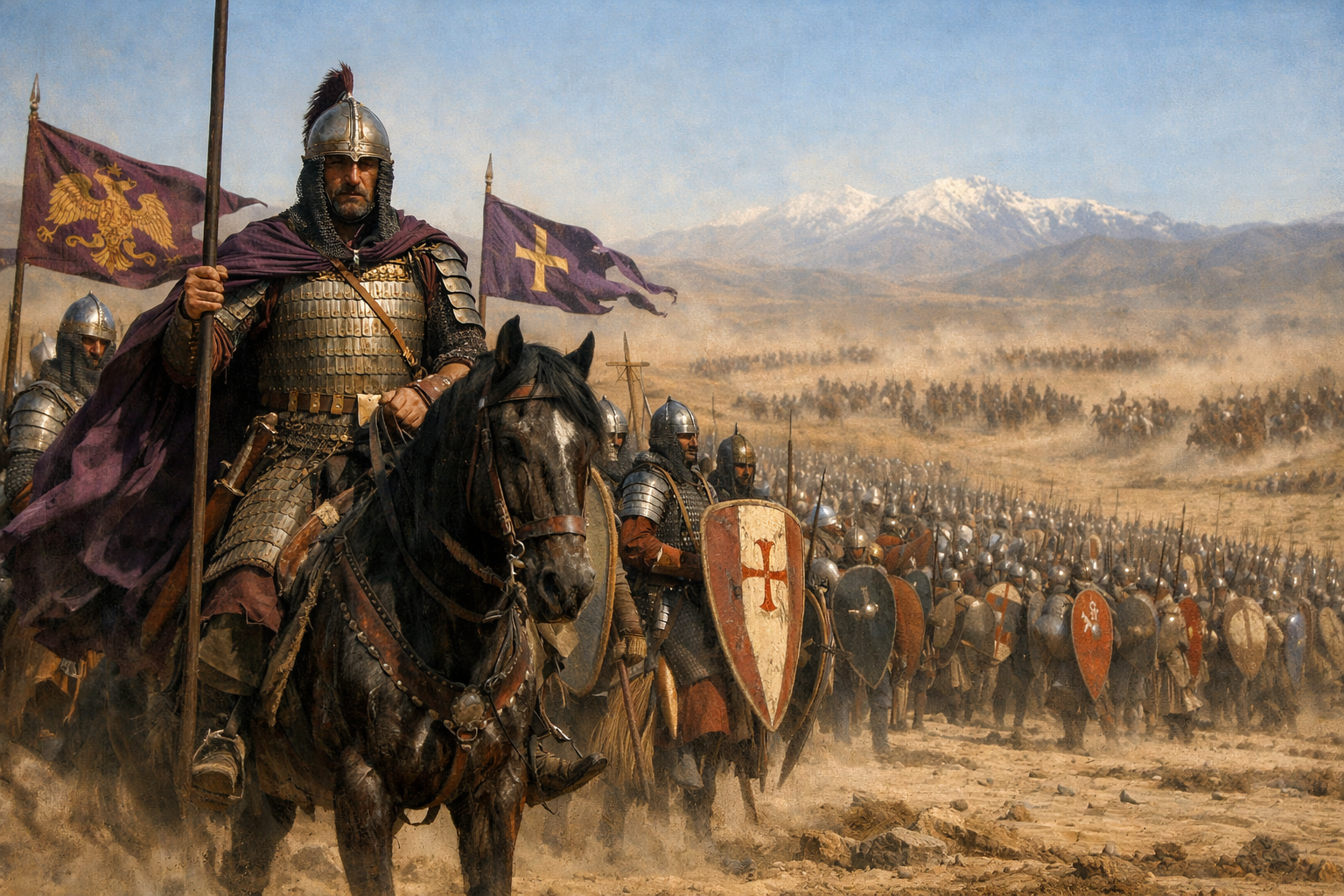
The summer sun beat down on the plains of Manzikert in eastern Anatolia. Emperor Romanos IV Diogenes sat astride his horse, sweat beading beneath his imperial armor as he surveyed the battlefield. To his left and right stretched the Byzantine army, nearly 40,000 strong, their standards catching the hot wind that swept across the dusty plateau. Facing them was the Seljuk Turkish force under Sultan Alp Arslan, smaller in number but composed of skilled horse archers who had spent years harassing the empire's eastern borders.
Romanos could feel the tension among his men. The professional soldiers of the Tagmata stood ready, their armor gleaming, while mercenary contingents of Frankish and Pecheneg troops shifted restlessly in their positions. Behind him, the purple imperial banner fluttered, the same standard that had led Roman armies to victory for centuries.
Something was wrong, though. The emperor's most trusted general, Andronikos Doukas, had positioned his reserve forces oddly far to the rear. Romanos had noticed the whispered conversations between Doukas and other nobles who opposed his reign, but surely they would not betray their emperor on the field of battle. He pushed the thought aside and focused on the Turkish lines ahead.
As the morning wore on, Seljuk horse archers began their characteristic hit-and-run attacks, sending waves of arrows into the Byzantine ranks before wheeling away. Romanos knew this dance well. It was meant to draw his forces into a rash advance, and he had fought the Turks before. But he also knew he needed a decisive victory to secure the empire's eastern frontier. As he raised his sword to signal the advance, he could not have known that this day would mark one of the most catastrophic turning points in Byzantine history.
The Battle of Manzikert occurred at a crucial moment. By 1071, the empire still appeared outwardly powerful, controlling most of Anatolia, the Balkans, and parts of Italy. Internal tensions, however, were weakening its foundations. The military aristocracy had grown increasingly powerful during the 11th century, often at odds with the civil bureaucracy in Constantinople. The death of Basil II in 1025 had ended the successful Macedonian dynasty and opened decades of political instability.
Romanos IV had come to power in 1068 through his marriage to the empress Eudokia Makrembolitissa, widow of Constantine X Doukas. From the start, he faced opposition from the powerful Doukas family, who saw him as an outsider. He recognized the growing threat posed by the Seljuk Turks all the same, as they had been gradually infiltrating the empire's eastern provinces since the 1050s.
The emperor inherited a military system in decline. The old theme system, which had provided the empire with a reliable army of farmer-soldiers, had been largely dismantled by his predecessors in favor of professional and mercenary troops. The empire's eastern defenses had been particularly neglected as previous emperors focused on threats from the Normans in Italy and the Pechenegs in the Balkans.
Romanos spent his first three years as emperor campaigning in the east, achieving some successes but no decisive victory. By 1071, he had assembled the largest Byzantine army seen in decades, aiming to push the Turks back and reassert imperial control over Armenia. The stakes were enormous. Control of Anatolia, the empire's heartland and primary source of manpower and wealth, hung in the balance.
The Battle Unfolds
The initial phases seemed to favor the Byzantines. Romanos arranged his army in the traditional formation: heavy infantry in the center, cavalry on the wings, and archers in front. The Seljuk attacks were met with disciplined resistance, and by late afternoon the emperor felt confident enough to order a general advance.
What happened next is recorded differently by Byzantine and Muslim sources, but the broad strokes are clear. As the Byzantine center advanced, the Seljuk forces began their favorite tactic, the feigned retreat. Romanos, despite his experience, took the bait and pressed forward with his best troops, opening a dangerous gap between the center and the wings of his army.
At this crucial moment, treachery struck. Andronikos Doukas, commanding the rear guard, spread word that the emperor had fallen in battle and ordered a retreat. Whether this was pre-planned betrayal or simply poor judgment remains debated by historians, but the effect was devastating. The Byzantine right wing collapsed in confusion while the left began a disorderly withdrawal.
Muslim chroniclers such as Ibn al-Athir record that the Seljuks encircled the emperor's division and cut it off from the rest of the army. The Byzantine force was overwhelmed as darkness fell, with Romanos fighting on even after his position became hopeless.
Romanos fought on with his remaining troops. As night fell, his horse was shot from under him. The emperor of the Romans was taken prisoner by Seljuk troops and brought before Sultan Alp Arslan. Contemporary accounts preserve a famous exchange between the two rulers:
"What would you do if I were brought before you as a prisoner?" Alp Arslan asked. "Perhaps I would kill you, or parade you through the streets of Constantinople," Romanos replied honestly. "My punishment is far worse," said the Sultan. "I forgive you, and set you free."
The Sultan's mercy was calculated. He knew a freed emperor would return to face civil war, while a martyred one might unite the empire. He was right. Alp Arslan treated Romanos with respect and negotiated reasonable terms for his release, yet the emperor returned to find his realm in chaos.
The Aftermath and Legacy
The immediate consequences of Manzikert were severe but not necessarily fatal. The military defeat, while serious, could have been recovered from. The Byzantine Empire had bounced back from worse disasters before. The political aftermath, though, proved catastrophic.
Upon Romanos' return, he found that Michael VII Doukas had been proclaimed emperor in his absence. Civil war erupted, ending with Romanos' defeat, blinding, and death in 1072. The treaty with the Seljuks was abandoned, and over the next decade Turkish raiders and settlers poured into an essentially defenseless Anatolia. By 1080, most of the plateau had slipped from Byzantine control, never to be fully recovered.
Manzikert's long-term impact was profound. The loss of Anatolia deprived the empire of its primary recruitment ground and breadbasket. The Byzantine Empire would continue for another 400 years, but it would never again be the dominant power it had once been. The battle also marked the beginning of Turkish rule in Anatolia, a process that led eventually to the rise of the Ottoman Empire.
What the battle demonstrated most clearly was that internal division could be more dangerous than any external enemy. The betrayal by Andronikos Doukas and the civil war that followed did more damage than the Seljuk armies ever could have managed alone.
As we move into our next episode, we'll explore how the empire attempted to recover from this devastating blow. The Komnenian dynasty, beginning with Alexios I, would restore some of Byzantium's fortune through military and administrative reforms. The loss of Anatolia, however, would continue to haunt the empire, fundamentally altering the balance of power in the medieval Mediterranean world.
Editor's Context
Read this episode through the Byzantine habit of adaptation. The empire repeatedly survived by changing its military, fiscal, religious, and diplomatic tools while insisting that it remained Roman. The date markers (000, 1071) are included because chronology is one of the easiest places for narrative history to become misleading. The episode's themes (history, empire, power) are the editorial lens for weighing cause and consequence rather than treating the story as isolated trivia.
Reviewed under the EmpiresDiary editorial workflow by Obadiah.
Drafted with AI. Accuracy review and corrections are ongoing — if you spot an error, please report it. See our workflow and editorial policy.