Manuel and the Crusaders
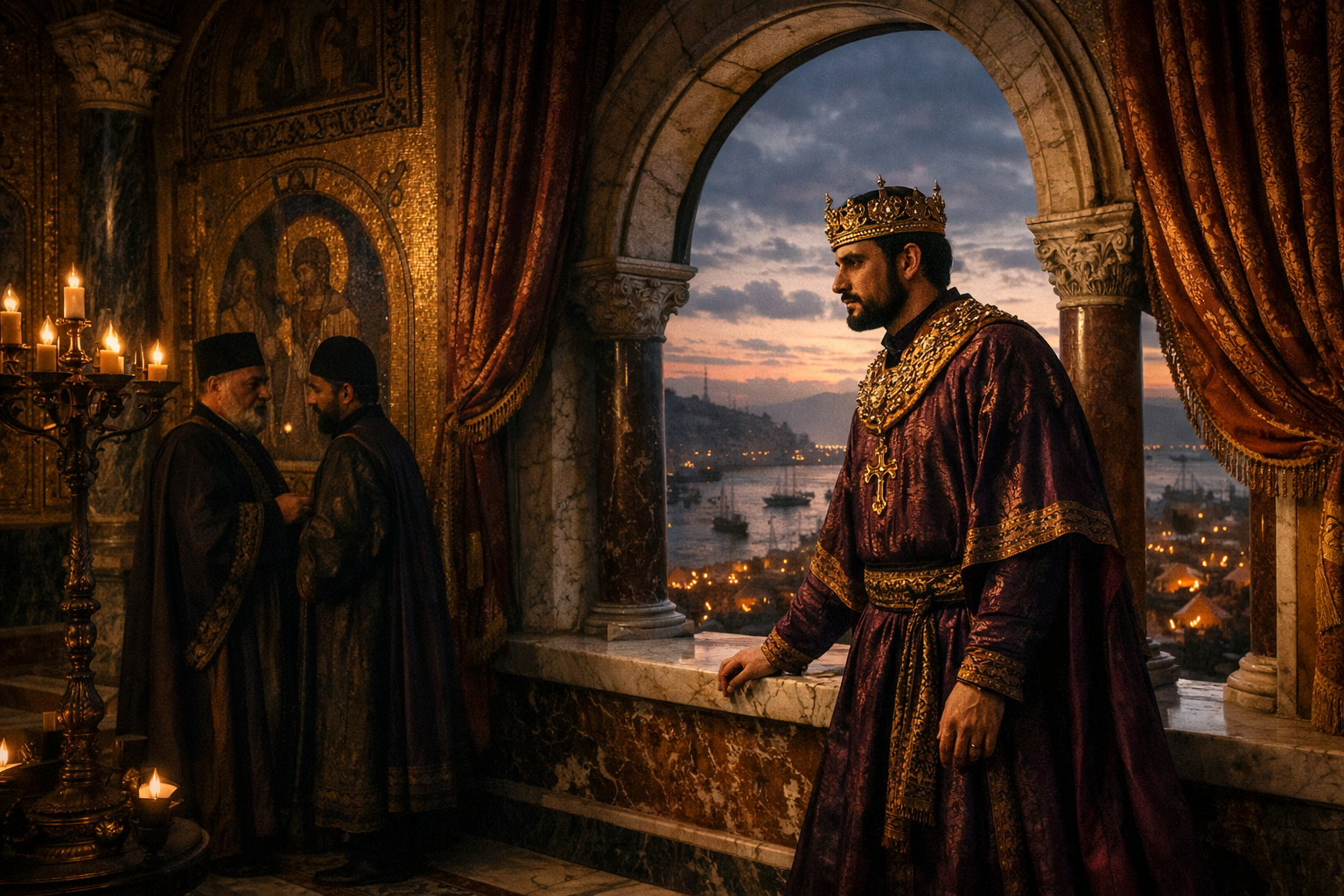
Constantinople, 1147 CE
The Great Palace of Constantinople buzzed with nervous energy as Emperor Manuel I Komnenos, twenty-eight years old, paced the marble floors of his private chambers. Through the ornate windows, he could see the massive armies of the Second Crusade approaching his capital. The German forces under Conrad III had arrived first, their campfires dotting the Asian shore of the Bosphorus. Soon the French army led by Louis VII would join them.
Manuel ran his fingers through his dark beard, a habit he'd developed since ascending to the throne four years earlier. Unlike many of his predecessors, he cut a striking martial figure: tall, athletic, and skilled in arms. But today he faced a challenge that couldn't be solved with military might alone. Two massive Western armies were at his doorstep, ostensibly allies heading to the Holy Land, but potentially threats to his empire.
His advisors were divided. Some urged him to treat these Latin Christians as enemies, remembering how the First Crusade had established independent states in formerly Byzantine territories. Others saw an opportunity to bind the West to Constantinople through diplomacy and shared purpose. As Manuel gazed at the armada of ships crossing between Europe and Asia, he knew his decisions in the coming days would shape the empire's future.
His thoughts were interrupted by the arrival of his chief diplomat, bearing news that Conrad III requested an immediate audience. Manuel straightened his purple imperial robes and touched the heavy gold cross at his neck, a reminder of both his spiritual and temporal authority. He had studied the West carefully, spoke their languages, and understood their customs. Now was the time to put that knowledge to use.
The arrival of the Second Crusade marked a crucial moment in Byzantine-Western relations. The empire had changed considerably since the First Crusade fifty years earlier. Under the Komnenos dynasty, particularly Manuel's father John II, Byzantium had regained considerable strength and territory. New challenges had emerged, though.
The Norman kingdom in southern Italy posed a constant threat of invasion. Venice had gained extensive trading privileges in Byzantine ports, undermining imperial economic control. In the east, the Turkish Seljuks remained a dangerous adversary, while the crusader states acted with growing independence from Byzantine authority.
Manuel I had inherited this tangled political landscape in 1143 at age twenty-four. Unlike his more eastward-focused father, he believed Byzantium's future lay in closer integration with the Latin West. He had already begun cultivating Western connections, marrying Conrad III's sister-in-law Bertha of Sulzbach (renamed Irene) and adopting many Western customs at his court.
The Second Crusade presented both danger and opportunity in roughly equal measure. The massive armies could become valuable allies or devastating enemies. Manuel's task was to shepherd these forces through Byzantine territory while maintaining imperial authority and advancing his broader strategic goals.
The Emperor's Strategy Unfolds
Manuel's handling of the Second Crusade showed real diplomatic sophistication. When meeting Conrad III, he emphasized their family connection and their shared Christian faith. The Byzantine emperor provided guides, supplies, and military support for the German army's crossing into Asia Minor, while carefully controlling their movements to prevent any threat to Constantinople.
Louis VII of France was a different problem. The French king was younger, more ambitious, and less willing to accept Byzantine guidance. Manuel employed impressive displays of wealth, military escorts, and careful surveillance to manage the French forces. He also put his charming wife Irene to work smoothing diplomatic relations with both contingents.
Not everything went according to plan. Despite Manuel's assistance, both crusader armies suffered devastating defeats in Asia Minor. The Germans were virtually destroyed at Dorylaeum. The French army was severely weakened before even reaching Antioch. These setbacks carried an unexpected benefit for Manuel: they demonstrated the continuing military superiority of Byzantium and its essential role in any Eastern expedition.
He moved quickly to exploit the situation. Manuel negotiated agreements with both Conrad and Louis that technically placed their remaining forces under Byzantine authority. More importantly, he began positioning himself as the natural leader of a combined Eastern and Western Christian world.
The emperor adopted Western military techniques, organized tournaments, and encouraged Latin customs at his court. He started wearing Western-style armor and even participated in jousts, shocking traditional Byzantine courtiers while impressing Western visitors. Manuel's court historian John Kinnamos praised the emperor's skill in martial exercises, describing how he outmatched celebrated Western knights, and other Byzantine writers similarly admired his prowess in these contests.
This Western-friendly policy faced serious internal opposition, though. Orthodox clergy worried about Latin influence on religious matters, and traditional aristocrats resented the influx of Western merchants and courtiers. Manuel worked to balance these concerns while pursuing his vision of a Byzantine Empire that could bridge East and West.
Consequences and Legacy
Manuel's handling of the Second Crusade set the tone for the remainder of his reign (1143-1180). His pro-Western policy produced mixed results. It helped prevent direct military confrontation with Western powers, but it also led to increased Latin economic penetration of the empire and deepening cultural tensions.
The Western strategy contributed to both the strengths and the weaknesses of late Komnenian Byzantium. It produced a more cosmopolitan empire capable of engaging effectively with Latin Christianity. It also produced one increasingly dependent on Western military and commercial cooperation. After Manuel's death, those contradictions fed the crisis that culminated in the Fourth Crusade's capture of Constantinople in 1204.
Manuel's reign represented perhaps the last serious attempt to reconcile the Byzantine and Latin Christian worlds. His sophisticated diplomacy and cultural flexibility showed how the empire could adapt to changing circumstances without abandoning its essential character. That's no small thing, given what came after.
In our next episode, we'll explore how Manuel I's ambitious foreign policy extended beyond the Second Crusade, as he sought to restore Byzantine influence in Italy and establish himself as the leader of a united Christian world. His campaigns against the Normans and negotiations with the Papacy would further test his vision of a Byzantine Empire bridging East and West.
Editor's Context
Read this episode through the Byzantine habit of adaptation. The empire repeatedly survived by changing its military, fiscal, religious, and diplomatic tools while insisting that it remained Roman. The date markers (1143, 1147 CE) are included because chronology is one of the easiest places for narrative history to become misleading. The episode's themes (history, empire, power) are the editorial lens for weighing cause and consequence rather than treating the story as isolated trivia.
Reviewed under the EmpiresDiary editorial workflow by Obadiah.
Drafted with AI. Accuracy review and corrections are ongoing — if you spot an error, please report it. See our workflow and editorial policy.