Leo III and the Image War
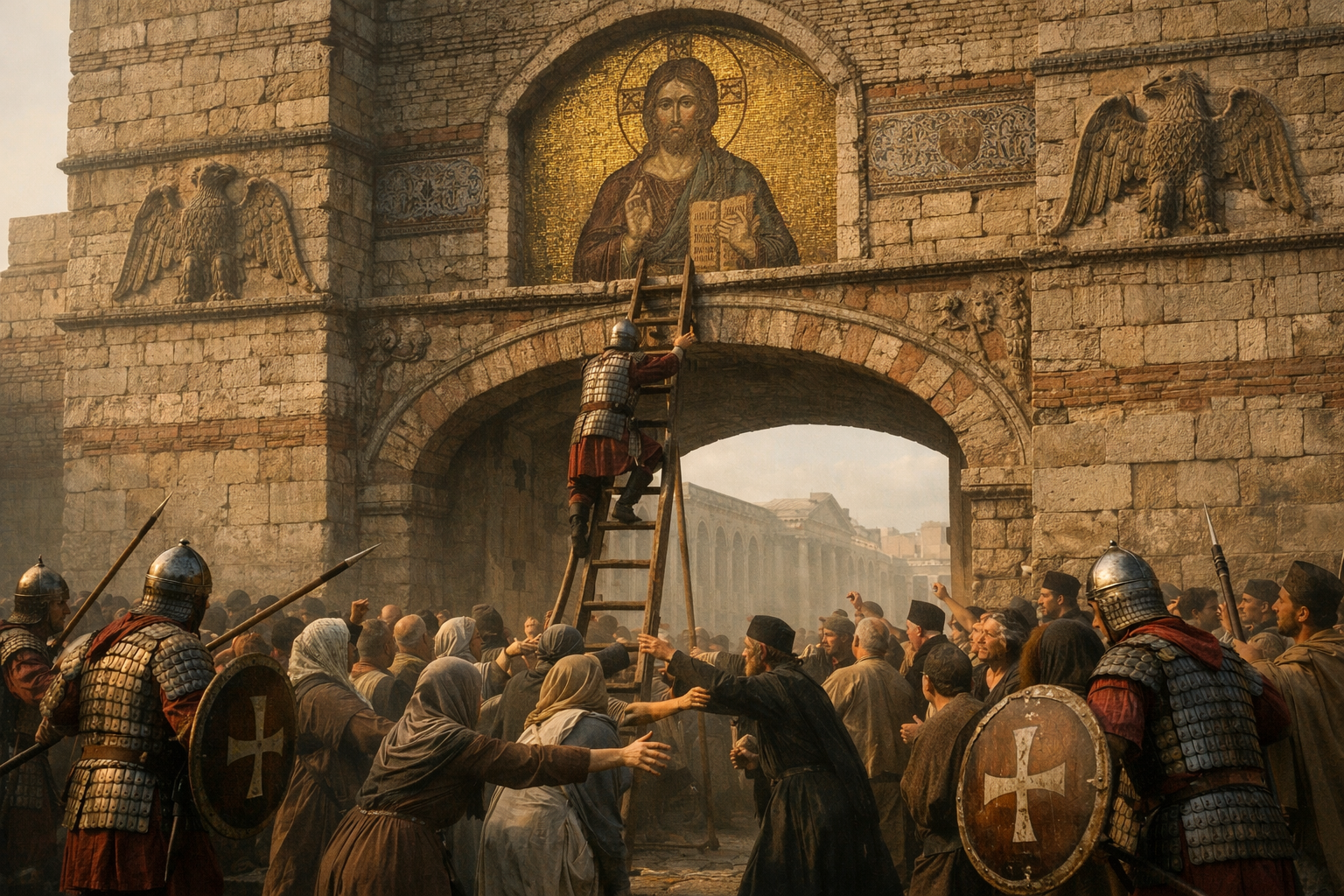
The Imperial Palace, Constantinople, 726 CE
The summer air hung heavy over Constantinople as Emperor Leo III contemplated an act that would shake the empire to its foundations. For months he had wrestled with a theological question that was becoming a matter of state security. Throughout the empire he had witnessed what he considered a disturbing trend: people prostrating themselves before icons, kissing them, burning incense before them. Some scraped off paint to mix into their drinks as medicine. To the emperor's military mind, shaped by years of fighting Muslim armies who strictly prohibited images in worship, this seemed dangerously close to idolatry. The empire had recently suffered humiliating defeats, including a devastating siege of Constantinople by the Arabs in 717-718. Could these military setbacks be divine punishment for straying from true worship?
Leo made his decision. He ordered workers to remove the iconic image of Christ that had watched over the Bronze Gate of the Great Palace for generations. It was an act that would spark more than a century of violent controversy, tear families apart, and nearly destroy the empire itself. As the workers set about their task, a crowd gathered. The angry murmurs grew louder. When soldiers moved to carry out the order, the scene turned violent. According to later tradition, a woman knocked a soldier from his ladder as he attempted to take down the image, and in the struggle that followed a soldier was killed. The Iconoclast controversy had begun.
The Rise of Icons
By the 8th century, religious icons had become deeply embedded in Byzantine spiritual and cultural life. These images, whether mosaic, painted panels, or frescoes, were seen as windows to heaven, physical points of contact between the divine and human realms. Their development had evolved gradually from Roman imperial imagery and early Christian catacomb art.
The theological justification for icons rested on the Incarnation. Since God had taken physical form in Christ, it was argued, He could be depicted in physical form. Icons of the Virgin Mary, saints, and biblical scenes filled churches and homes. They were carried in processions, used as personal protection, and viewed as miracle-working objects.
Not everyone accepted this. The Old Testament contained clear prohibitions against graven images, and some clergy worried that simple believers could not distinguish between venerating an icon and worshiping it. The rapid rise of Islam, with its strict aniconism, provided a powerful counter-model that made these anxieties harder to dismiss.
These tensions came to a head under Leo III (717-741), who faced external threats from Muslim armies alongside internal challenges to imperial authority. The emperor saw in iconoclasm (literally, "image-breaking") a way to reform religious practice and strengthen imperial control over the church at the same time.
The Great Controversy Unfolds
The conflict over icons played out across all levels of Byzantine society. In 730, Leo III officially banned religious images, ordering their destruction and replacement with crosses. The response was immediate and fierce.
Riots broke out in Constantinople when soldiers attempted to remove the famous Christ Chalke icon above the Bronze Gate. Patriarch Germanos I refused to support the imperial policy and was forced to resign. In Rome, Pope Gregory II strongly condemned iconoclasm, opening a rift between East and West that would carry lasting consequences.
The controversy intensified under Leo's son, Constantine V (741-775). A fierce iconoclast, he convened a church council in 754 that condemned icons as idolatrous. Monasteries, traditionally centers of icon production and veneration, faced particular persecution. Many monks were imprisoned, exiled, or executed.
Resistance remained strong, especially among common people and monastic communities. The empress Irene, acting as regent for her young son Constantine VI, temporarily restored icon veneration in 787 at the Second Council of Nicaea. The victory proved short-lived. A second period of iconoclasm began under Leo V in 815, reopening wounds that had barely closed.
The final triumph of the icons came in 843, when another empress-regent, Theodora, permanently restored their veneration. The event, celebrated as the "Triumph of Orthodoxy," is still commemorated annually by the Orthodox Church.
The Human Cost
The persecution of iconodules (icon-supporters) left deep scars on Byzantine society. The most famous victim was perhaps Theodore of Stoudios, whose monastery became a center of resistance. Tortured and repeatedly exiled, he nevertheless maintained a vast correspondence network that helped keep the pro-icon movement alive.
Women played a crucial role in preserving icon veneration. Many aristocratic women secretly kept icons in their homes. The empresses Irene and Theodora proved instrumental in ending both periods of iconoclasm, each stepping into the political vacuum left by iconoclast emperors and using it decisively. The period also saw new forms of religious art survive imperial persecution, including illuminated manuscripts and small portable icons that could be easily hidden.
Lasting Impact
The Iconoclast controversy had profound effects on Byzantine civilization that outlasted the conflict itself. It strengthened the theological understanding of religious images, producing sophisticated arguments about the nature of religious art that influenced both Eastern and Western Christianity. The triumph of the icons reinforced the Byzantine synthesis of classical culture with Christian spirituality.
The controversy also weakened the empire at critical moments, contributing to the loss of territories in Italy and straining relations with the papacy. Persecution pushed the monastic movement toward greater independence, while the eventual triumph of icons deepened the authority of tradition within Orthodox Christianity. These were not minor side effects. They reshaped the church's relationship with imperial power for centuries.
Our next episode explores how the restored empire under the Macedonian dynasty used this period of religious peace to launch a remarkable cultural and military renaissance. The triumph of icons marked the end of a religious dispute, but it also marked the beginning of what many consider Byzantium's golden age.
Editor's Context
Read this episode through the Byzantine habit of adaptation. The empire repeatedly survived by changing its military, fiscal, religious, and diplomatic tools while insisting that it remained Roman. The date markers (718, 741) are included because chronology is one of the easiest places for narrative history to become misleading. The episode's themes (history, empire, power) are the editorial lens for weighing cause and consequence rather than treating the story as isolated trivia.
Reviewed under the EmpiresDiary editorial workflow by Obadiah.
Drafted with AI. Accuracy review and corrections are ongoing — if you spot an error, please report it. See our workflow and editorial policy.