The Purple Prophecy
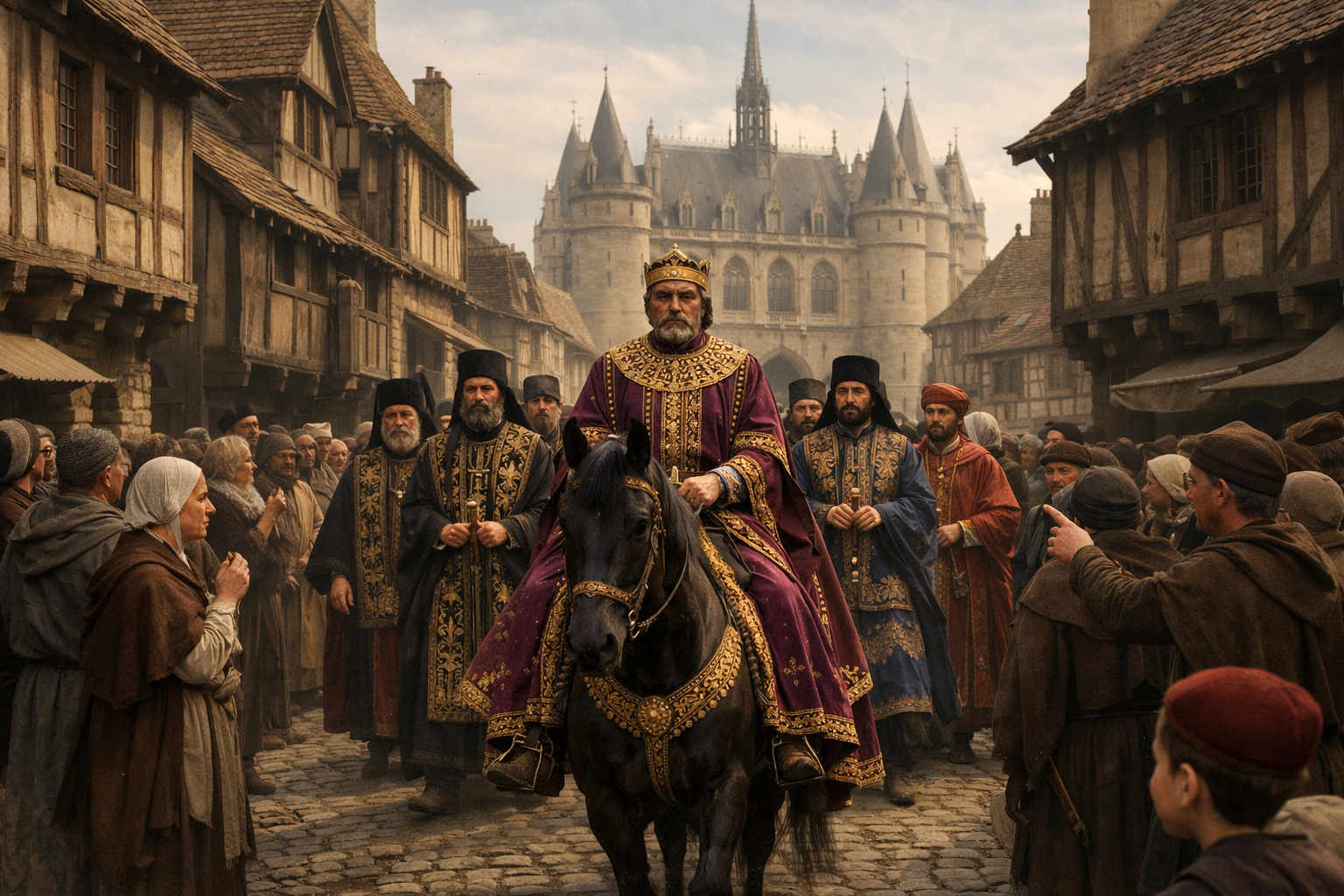
Paris, Early Summer 1400
The summer light fell across the streets of medieval Paris as a most unusual procession made its way toward the royal palace. At its center rode a figure whose very presence seemed to embody the fading glory of an ancient empire: Manuel II Palaeologus, Emperor of Byzantium. His purple robes, though travel-worn, still marked him as the heir to Roman greatness, while the golden circlet on his brow caught the pale sunlight.
The French crowds gathered to watch, many crossing themselves at the sight of this exotic Eastern ruler. Manuel's dark beard was flecked with gray, his face lined with worry, yet he maintained the dignity expected of one who ruled from Constantine's throne. Behind him rode a small retinue of Greek nobles and Orthodox priests, their elaborate ceremonial garments drawing whispers from the Parisian onlookers.
This was no mere state visit. Manuel II had done what no Byzantine emperor before him had contemplated: he had abandoned his capital of Constantinople to embark on a desperate journey through Western Europe. The reason was simple and terrifying. The Ottoman Turks under Sultan Bayezid I had nearly surrounded Constantinople, and without Western aid, the thousand-year legacy of Byzantium would surely perish.
As Manuel approached the palace where King Charles VI of France waited, his mind drifted to the city he had left behind. His nephew, the co-emperor John VII Palaiologos, remained there as regent, while Manuel had sent his wife Helena Dragas and their sons to safety in the Morea, in the Peloponnese, with his brother Theodore. The city was under virtual siege, with Ottoman forces controlling nearly all the surrounding territory. Only the massive Theodosian Walls and the command of the sea routes kept the capital from falling.
The Byzantine Empire of 1400 was a shadow of its former glory. Once stretching from Spain to the Euphrates, it now consisted of little more than Constantinople itself, a few ports along the Black Sea, and parts of the Peloponnese. The rise of the Ottoman Turks had been swift and devastating. They conquered most of Byzantine Asia Minor in the 14th century before crossing into Europe.
Sultan Bayezid I, known as "The Thunderbolt" for his lightning military campaigns, had made it his mission to finally capture Constantinople. His forces had already defeated a Western crusader army at Nicopolis in 1396, eliminating the last major attempt to push the Turks back from Europe. The Byzantine Empire's traditional strategy of playing rival powers against each other was failing, as the Ottomans had grown too powerful to contain.
Manuel II had inherited this crisis from his father, John V Palaeologus. The empire had been forced to become a tributary state to the Ottomans, paying heavy annual tributes and providing military assistance to Turkish campaigns. Even this humiliation proved insufficient. Bayezid demanded ever greater concessions and began constructing a fortress just outside Constantinople's walls.
The West, meanwhile, was divided and distracted. The Catholic Church was in the midst of the Great Schism, with rival popes in Rome and Avignon. France and England were locked in the Hundred Years' War, while the Holy Roman Empire was wracked by internal conflicts. The Italian maritime republics of Venice and Genoa, once reliable allies of Byzantium, now primarily pursued their own commercial interests.
The Western Journey
Manuel's journey began in December 1399, when he secretly boarded a Venetian ship in Constantinople. His first stop was Venice itself, where he received a magnificent welcome but little concrete support. The Venetians, while concerned about Ottoman expansion, were unwilling to risk their valuable trading privileges with the Turks.
From Venice, Manuel traveled to Milan and then made his way to Paris, arriving in early summer 1400. The French royal court was fascinated by this living link to Roman antiquity. Manuel impressed them with his learning and dignity. He was a scholar-emperor who had written theological treatises and poetry, and King Charles VI, despite suffering from bouts of mental illness, promised aid and provided Manuel with a generous pension during his stay.
In December 1400, Manuel crossed the Channel to England, where King Henry IV welcomed him at Eltham Palace for Christmas. The English monarch offered hospitality but little concrete assistance. Manuel then returned to Paris in early 1401, taking up residence at the Louvre, where he engaged with French intellectuals and introduced Greek literature and philosophy to Western scholars, helping spark early humanist interest in classical learning. His primary mission, though, securing military aid, remained unfulfilled. He remained in Paris until departing in November 1402.
Then news arrived from the East that would dramatically change the situation: Tamerlane, the Central Asian conqueror, had begun attacking Ottoman territories in Asia Minor.
The Unexpected Salvation
Just as Manuel's mission seemed to be failing, fate intervened. In July 1402, Tamerlane's forces crushed the Ottoman army at the Battle of Ankara and captured Sultan Bayezid himself. The Ottoman Empire plunged into civil war as Bayezid's sons fought for succession. The immediate threat to Constantinople had passed, though Manuel could not have known how temporary this reprieve would be.
Consequences and Legacy
Manuel II's journey failed in its immediate objective of securing large-scale Western military aid, but it left several lasting marks. His presence in Western Europe gave humanist scholars direct access to Greek learning and contributed to the early Renaissance. The contacts he established would shape Byzantine-Western relations for the empire's final fifty years.
His detailed accounts of Western Europe, preserved in letters and writings, remain valuable records of medieval European court life and diplomacy. The journey also marked a symbolic turning point. It was clear that Byzantium could no longer stand alone against the Ottoman threat.
The reprieve gained from Tamerlane's intervention allowed Constantinople to survive for another half-century, but the fundamental problems were never solved. The empire never recovered its strength, and Western aid, when it finally came in 1453, proved too little, too late.
In our next episode, we'll explore how Manuel II returned to a transformed political landscape after Bayezid's defeat. The Ottoman civil war offered new opportunities for Byzantine diplomacy, but time was running out for the empire. The question was no longer if Constantinople would fall, but when, and what legacy would survive its eventual collapse.
Editor's Context
Read this episode through the Byzantine habit of adaptation. The empire repeatedly survived by changing its military, fiscal, religious, and diplomatic tools while insisting that it remained Roman. The date markers (1399, 1401) are included because chronology is one of the easiest places for narrative history to become misleading. The episode's themes (history, empire, power) are the editorial lens for weighing cause and consequence rather than treating the story as isolated trivia.
Reviewed under the EmpiresDiary editorial workflow by Obadiah.
Drafted with AI. Accuracy review and corrections are ongoing — if you spot an error, please report it. See our workflow and editorial policy.