The Last Stand at Klis
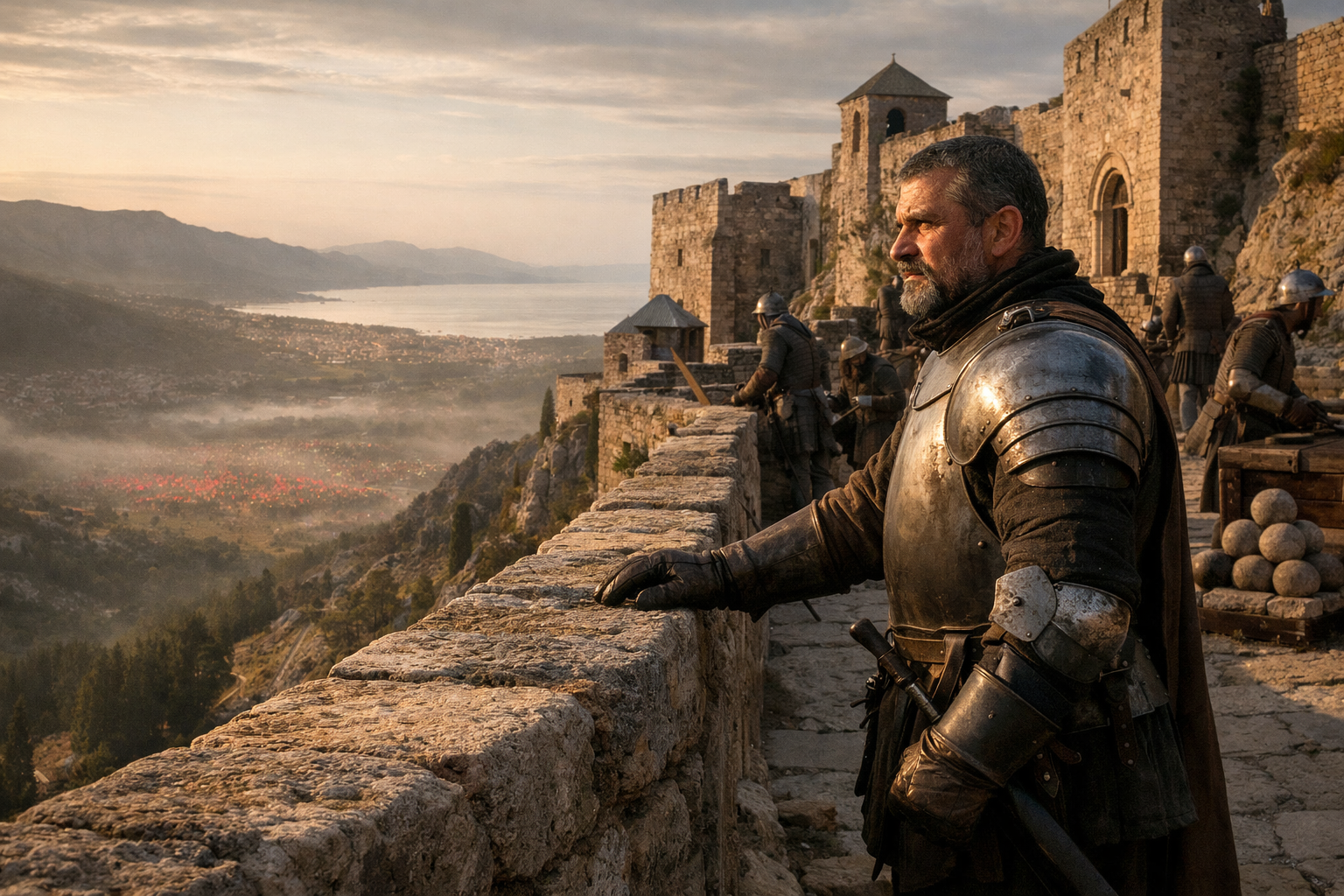
Spring 1537
The morning sun cast long shadows across the limestone cliffs of the Dinaric Alps as Captain Petar Kružić stood atop the ancient walls of Klis Fortress. Below him, the Adriatic sparkled in the distance, while the town of Split lay nestled against the coast. From this eagle's nest perched 360 meters above sea level, Kružić could see for miles in every direction, a strategic advantage that had made Klis the key to controlling Dalmatia for over a millennium.
Walking the ramparts, Kružić's weathered hand traced the rough stone walls that had withstood countless sieges since Roman times. The fortress had been his home and responsibility for over two decades, serving as the last major Christian stronghold in Dalmatia as Ottoman forces steadily expanded their grip on the Balkans. Every morning he performed this same ritual: checking the walls, reviewing the supplies, scanning the horizon for signs of Turkish movement.
But this spring morning in 1537 was different. His scouts had reported a massive Ottoman army assembling near Bosnia, led by Murat-beg Tardić, a Šibenik-born commander acting under Suleiman's orders. After years of probing attacks and failed sieges, the Ottomans were finally preparing for a decisive assault on Klis.
Inside the fortress, approximately 2,300 Croatian defenders prepared for what they knew would be the fight of their lives. The smell of bread baking in the ovens mixed with the metallic ring of weapons being sharpened. Women and children helped stockpile water and ammunition on the upper levels. In the chapel, priests offered prayers before an ancient icon of St. Vitus, the fortress's patron saint.
Kružić knew that far more than just a fortress was at stake. Klis was the last barrier preventing Ottoman expansion along the Dalmatian coast. If it fell, the entire Adriatic would be threatened, and with it Venice's maritime empire and the Christian presence in the eastern Mediterranean. As he completed his morning inspection, Kružić silently renewed the oath he had made when first appointed captain: this fortress would not fall while he drew breath.
The struggle for Klis Fortress in the 16th century represented a crucial chapter in the centuries-long Ottoman-Habsburg rivalry for control of southeastern Europe. Since the fall of Constantinople in 1453, Ottoman expansion had steadily pushed westward through the Balkans. By the 1520s, most of Bosnia, Serbia, and inland Croatia had fallen under Turkish control.
The narrow coastal strip of Dalmatia, however, remained a contested frontier zone. Venice controlled most of the major port cities, including Split, Zadar, and Dubrovnik, while the Kingdom of Croatia (in personal union with Hungary) maintained control of key inland fortresses. After the devastating Hungarian defeat at Mohács in 1526, Croatia came under Habsburg protection, making Dalmatia a three-way battleground between Ottoman, Venetian, and Habsburg interests.
Klis Fortress occupied a uniquely important position in this struggle. Built atop a nearly impregnable rocky spur, it controlled the mountain pass connecting the coastal cities with the inland regions. The fortress had ancient origins: first built by Illyrian tribes, then expanded by Romans, and further fortified by Croatian kings in the Middle Ages. By the 16th century it had evolved into a sophisticated defensive complex with multiple walls, towers, and a self-sufficient water supply.
Petar Kružić had been appointed captain of Klis in 1513 by the Croatian-Hungarian king. Known as the "Terror of the Turks," he had earned that reputation through his successful defense of the fortress against multiple Ottoman attacks throughout the 1520s and early 1530s, including several led by Gazi Husrev-beg, the governor of Bosnia, whose repeated attempts to take the fortress all ended in failure. Kružić also pioneered the use of Uskok warriors, Christian refugees from Ottoman territories who conducted guerrilla warfare against Turkish forces.
Murat-beg Tardić was the Ottoman commander chosen to succeed where earlier efforts had not. Operating under Suleiman's direct orders, he brought a disciplined force and heavy artillery to bear on the fortress in a campaign that would prove decisive. The siege of Klis would test the defenders to their absolute limit.
The Main Narrative
The Ottoman assault began in early March 1537 with a force of roughly 8,000 troops supported by heavy artillery. Murat-beg Tardić's army established positions on the surrounding heights and began bombarding the fortress walls. The defenders had anticipated this, strengthening vulnerable sections with earthworks and additional stone facing.
Inside Klis, Kružić organized the defense around three concentric rings. The outer walls were manned by experienced Uskok warriors, while Croatian regular troops held the middle defenses. The inner keep was defended by an elite guard and served as the last refuge for civilians. Food and water supplies had been carefully stockpiled, enough to last several months of siege.
The first major Ottoman assault focused on the eastern walls where artillery had opened several breaches. It began at dawn, with waves of Janissaries attempting to storm the gaps. Kružić had prepared for this by positioning his best marksmen in the towers flanking the breaches, and as the Turkish troops pressed forward they were caught in devastating crossfire. The assault was driven back with heavy Ottoman losses, but Murat-beg Tardić simply tightened the siege, cutting off all approach routes to prevent reinforcement or resupply. As weeks passed, food supplies inside Klis ran low and disease began to spread in the crowded conditions.
Kružić attempted to break the deadlock by leading a relief force to the fortress. On March 12, 1537, during a crucial assault to clear Ottoman forces from the approach road, he was surrounded and killed. His captors beheaded him and displayed his severed head on a spear to demoralize the remaining defenders. The effect was immediate and devastating. Seeing their legendary commander dead, many Croatian defenders lost heart. The German mercenaries who had accompanied the relief force retreated to their ships, leaving the fortress isolated once again.
Without Kružić's leadership and with no hope of further relief, the remaining defenders negotiated a surrender. Murat-beg Tardić, respecting their valor, allowed the garrison to evacuate with their weapons and personal belongings. On March 15, 1537, the Ottoman flag was raised over Klis Fortress for the first time.
Consequences and Lasting Impact
The fall of Klis marked a significant shift in the balance of power in Dalmatia. The Ottomans now had a commanding position overlooking Split and the central Adriatic coast, which they would hold for the next 111 years. Venice was forced to strengthen its coastal defenses and pay increased tribute to the Sublime Porte to protect its maritime trade.
The loss of Klis also carried important cultural weight. Many of the Croatian defenders, including the Uskoks, relocated to other coastal strongholds like Senj, where they continued their resistance against Ottoman expansion. Their stories became part of Croatian national mythology, particularly the heroic last stand of Petar Kružić.
The fortress itself remained a coveted prize, changing hands several times in subsequent centuries. Venice finally captured it from the Ottomans in 1648, incorporating it into their Dalmatian territories. Today, Klis Fortress is one of Croatia's most important historical monuments, a physical record of the region's long history of conflict and resistance.
In our next episode, we'll explore how the fall of Klis affected the wider struggle for control of the Adriatic. We'll see how Venice adapted to the growing Ottoman naval threat, and how the Habsburg Empire's focus shifted to securing its Hungarian territories. The stage was being set for the great naval confrontation that would culminate in the Battle of Lepanto in 1571.
Editor's Context
Read this episode through the Byzantine habit of adaptation. The empire repeatedly survived by changing its military, fiscal, religious, and diplomatic tools while insisting that it remained Roman. The date markers (360, 1537) are included because chronology is one of the easiest places for narrative history to become misleading. The episode's themes (history, empire, power) are the editorial lens for weighing cause and consequence rather than treating the story as isolated trivia.
Reviewed under the EmpiresDiary editorial workflow by Obadiah.
Drafted with AI. Accuracy review and corrections are ongoing — if you spot an error, please report it. See our workflow and editorial policy.