Born in the Purple
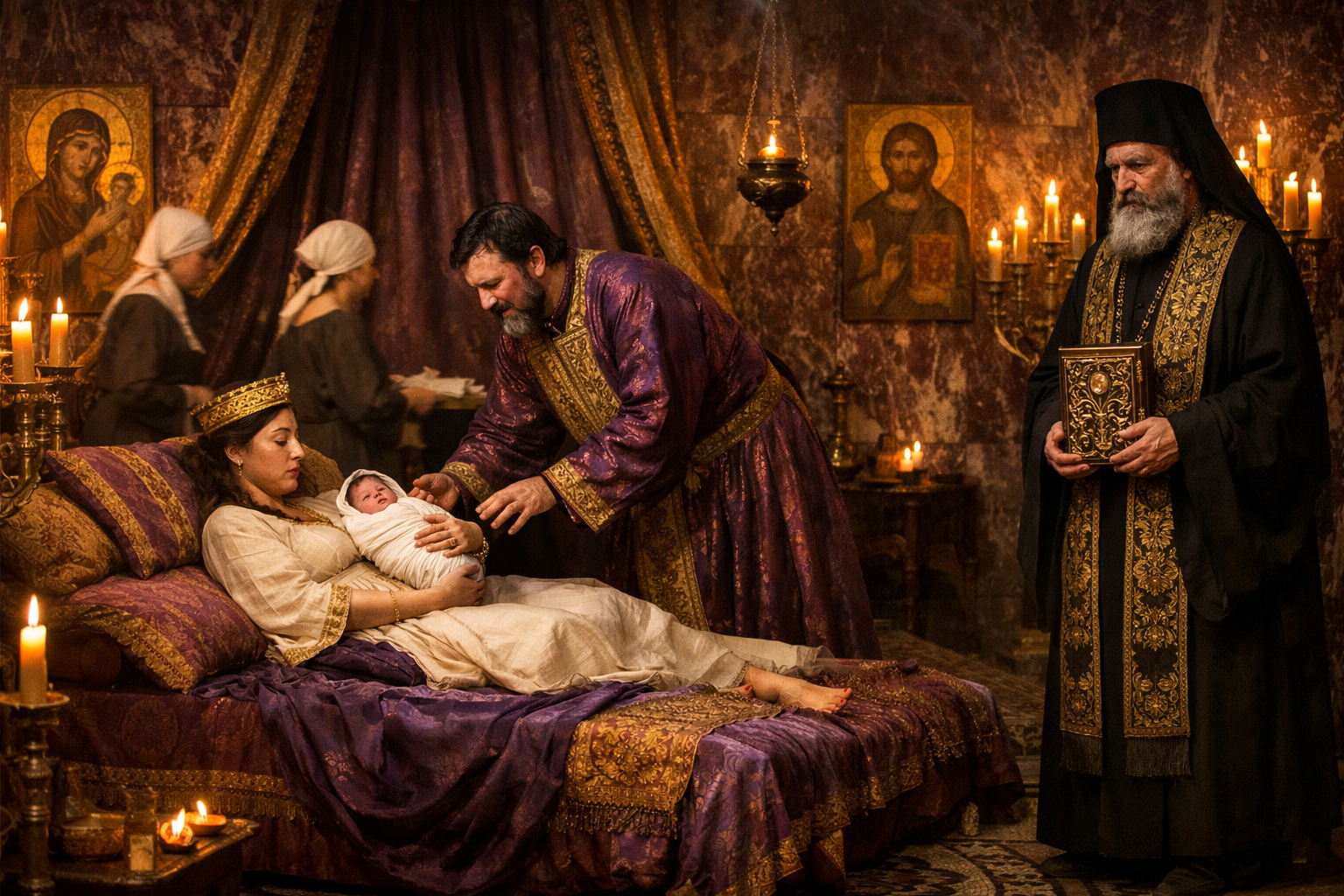
The Imperial Birthing Chamber
On a spring evening in 905 CE, the imperial birthing chamber in the Porphyra Palace glowed with the light of dozens of beeswax candles. The room's purple marble walls, which gave the palace its name, seemed to pulse with each cry of the laboring Empress Zoe Karbonopsina. Outside, Constantinople hummed with anticipation. This birth would determine the future of the Byzantine Empire.
Emperor Leo VI, nicknamed "the Wise," paced anxiously in an adjacent chamber. At thirty-nine years old, he had waited years for a male heir. Three previous marriages had produced no surviving sons, and this fourth marriage to Zoe, technically illegal under church law, was his final hope for securing the succession.
The air was thick with incense as midwives scurried about, their soft sandals whispering across the mosaic floors. Religious icons gazed down from every wall, their gold leaf catching the candlelight. The Patriarch Nicholas Mystikos stood ready to perform the baptism, though his presence was charged with tension. He had strongly opposed this fourth marriage as uncanonical.
Finally, a piercing newborn cry split the air. A healthy son had arrived, and he would be named Constantine VII. Leo rushed in to find Zoe cradling their infant. Tears streamed down the emperor's face as he gazed upon his long-awaited heir. The future of the Macedonian dynasty seemed secure at last.
But even as celebrations erupted across the capital, dark shadows loomed. Leo's health was failing. The controversial circumstances of Constantine's birth, born to a fourth wife in defiance of church law, would haunt his reign. Powerful forces were already plotting to seize control of the empire once Leo died.
The year 905 marked a crucial turning point for the Byzantine Empire. The Macedonian dynasty, founded by Basil I in 867, had brought stability and military success after centuries of religious strife and territorial losses. Under Leo VI, the empire had codified its laws, strengthened its diplomatic relations, and held firm against Bulgarian and Arab threats.
The lack of a male heir, however, had created a succession crisis. Byzantine law and tradition placed enormous importance on legitimate succession through the male line. Leo's first three marriages, to Theophano, Zoe Zaoutzaina, and Eudokia Baïana, had ended in either death or failure to produce surviving sons.
His fourth marriage to Zoe Karbonopsina violated the church's prohibition against fourth marriages, causing a major rift with the powerful Patriarch Nicholas Mystikos. This "Tetragamy Crisis" threatened to split the church and destabilize the empire at precisely the moment when unity was most needed against external threats.
The empire faced pressing challenges on multiple fronts. Symeon I of Bulgaria was expanding his territory and influence, while Arab raiders threatened the eastern provinces. The naval power of the empire was declining, and the economy strained under military expenses. Legitimate succession was crucial for maintaining political stability and military effectiveness.
The Main Narrative
The joy of Constantine's birth was followed by years of mounting uncertainty. Emperor Leo VI died on 11 May 912, leaving his adult brother Alexander as regent for the child Constantine, who was then about seven years old. Alexander, who had served as co-emperor since 879, immediately moved to delegitimize Constantine's claim, declaring him illegitimate due to the controversial fourth marriage.
The narrative unfolds through multiple perspectives.
From the view of Empress Zoe, suddenly stripped of power and forced to flee the palace with her young son, the situation was desperate. She sought protection in the Hagia Sophia, surrounded by loyal supporters who saw her as the guardian of legitimate succession.
Patriarch Nicholas Mystikos, though he had opposed the fourth marriage, found himself in a complex position. He believed the marriage had been uncanonical, yet the reality of a child heir versus the dissolute Alexander forced him to reconsider his stance.
Senior court officials, including John Eladas, a magistros and member of the regency council, worried about the empire's stability. Alexander's policies were alienating allies and encouraging enemies. Several figures began secretly corresponding with Zoe, seeing Constantine as the best hope for order.
The common people of Constantinople largely supported Constantine and Zoe. They had celebrated his birth as a gift from God and viewed Alexander's actions as threatening the divine order. Street protests erupted, with crowds chanting Constantine's name.
When Alexander died suddenly on 6 June 913, collapsing after a game of tzykanion, a power vacuum emerged. Constantine, now eight years old, was officially sole emperor, but real power was contested between three factions:
- Empress Zoe and her supporters, claiming regency rights as mother
- Patriarch Nicholas Mystikos, appointed head of a regency council
- The powerful admiral Romanos Lekapenos, who commanded the navy
The situation reached a crisis point when Symeon of Bulgaria, sensing Byzantine weakness, marched on Constantinople. Nicholas Mystikos was forced to negotiate a humiliating peace, recognizing Symeon as "Emperor of the Bulgarians."
Consequences and Impact
The events of 912-919 fundamentally altered the Byzantine Empire's trajectory. Romanos Lekapenos emerged victorious in the power struggle, forcing Zoe into a convent and arranging his daughter's marriage to Constantine VII. He ruled as senior emperor for 25 years, though he never deposed Constantine.
The Tetragamy Crisis produced a formal church ruling that fourth marriages were forbidden under any circumstances, cementing Byzantine marriage law for centuries and strengthening the church's role in imperial affairs.
Constantine VII, sidelined throughout his youth, would eventually rule in his own right and become one of Byzantium's most scholarly emperors. His writings preserved crucial information about Byzantine administration and diplomacy. The Bulgarian crisis sparked by these events led to decades of warfare, ending with Bulgaria's conquest and absorption into the empire under Basil II, Constantine's grandson.
In our next episode, we'll explore how the young Constantine VII survived his years under Romanos Lekapenos's control, preserving his claim to the throne while becoming one of history's great scholar-emperors. His passion for learning would help create the tenth-century Byzantine cultural renaissance, even as political power remained just beyond his grasp.
Editor's Context
Read this episode through the Byzantine habit of adaptation. The empire repeatedly survived by changing its military, fiscal, religious, and diplomatic tools while insisting that it remained Roman. The date markers (913, 867) are included because chronology is one of the easiest places for narrative history to become misleading. The episode's themes (history, empire, power) are the editorial lens for weighing cause and consequence rather than treating the story as isolated trivia.
Reviewed under the EmpiresDiary editorial workflow by Obadiah.
Drafted with AI. Accuracy review and corrections are ongoing — if you spot an error, please report it. See our workflow and editorial policy.