The Coinage Crisis
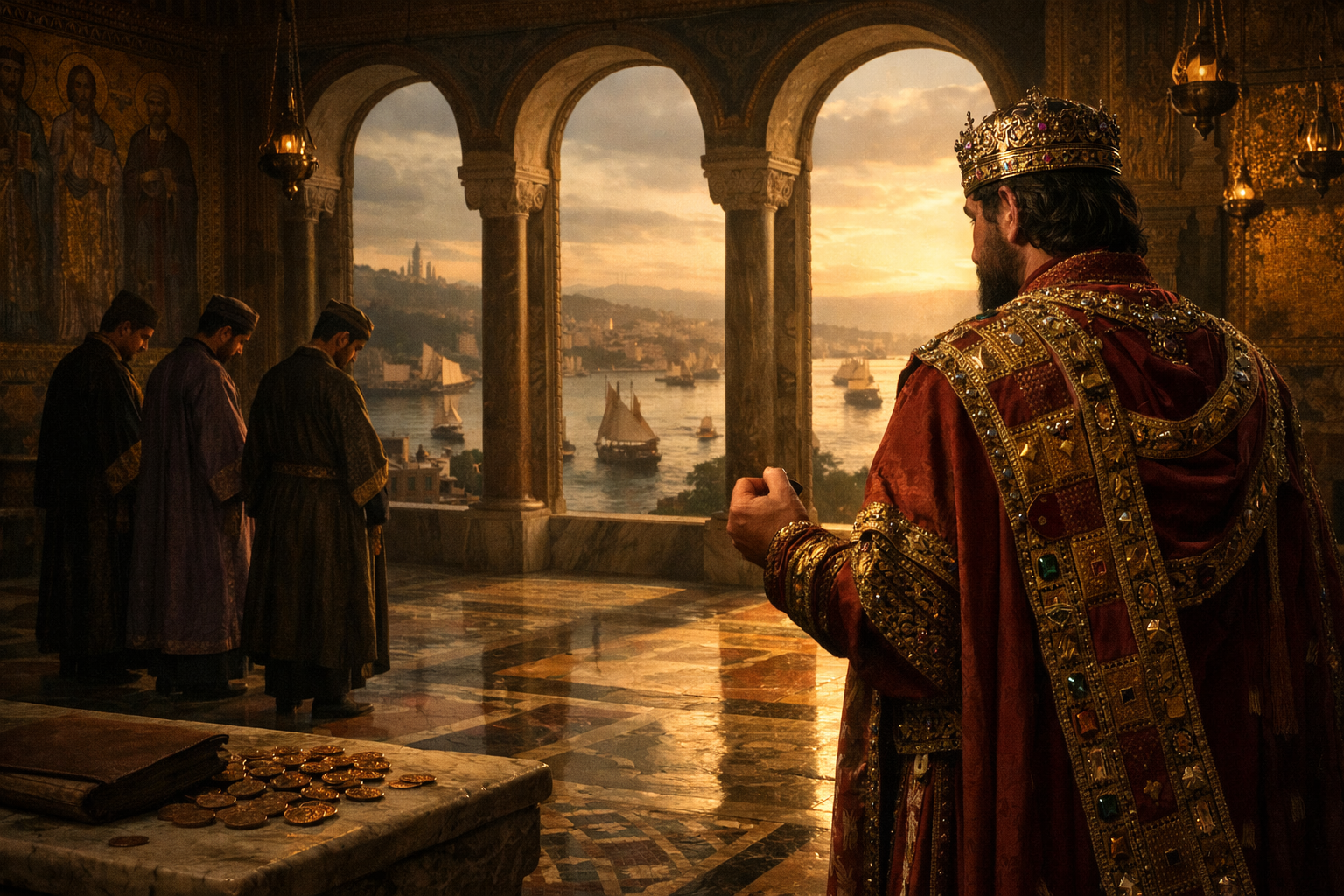
Constantinople, 1092 CE
The setting sun cast long shadows across the marble floors of the Great Palace as Emperor Alexios I Komnenos studied the gold coin in his trembling hand. What should have been pure gold was a dull, copper-colored disc that barely reflected the fading light. The nomisma, once the most trusted currency in the medieval world, had become little more than worthless metal.
Around him, his advisors shifted uncomfortably. The empire's treasury was nearly empty, and reports from across the provinces told of merchants refusing to accept Byzantine coins altogether. In the markets of Constantinople, people needed entire bags of debased nomismata to buy what a single pure gold coin had purchased just decades earlier.
The situation had become untenable. The army could not be paid, the civil service was in disarray, and foreign merchants mocked Byzantine currency in every port from Venice to Alexandria.
Alexios closed his fist around the degraded coin. The devastating loss at Manzikert to the Seljuk Turks in 1071 had started the rot, and the civil wars that followed made it worse. His predecessors had responded by debasing the coinage, mixing less and less gold with more copper until the once-stable system lay in shambles.
Looking out over the Bosphorus, where merchant ships from across the known world still crowded the harbor, Alexios knew he had to act. The empire's very survival depended on restoring faith in Byzantine money. Doing so would require one of the most ambitious financial reforms in history.
The Byzantine monetary system had been the gold standard of medieval commerce since the time of Constantine the Great. The solidus (later called the nomisma) had maintained its weight and purity for seven centuries, making it the U.S. dollar of its era, the global reserve currency that facilitated trade across three continents.
This stability began to unravel in the mid-11th century. The catastrophic defeat at Manzikert in 1071 cost the empire its wealthy Anatolian heartland. A succession of weak emperors and civil wars drained the treasury. To meet expenses, emperors from Michael VII Doukas (1071-1078) to Nikephoros III Botaneiates (1078-1081) increasingly debased the coinage, reducing its gold content from the traditional 24 carats to as low as 8 carats or less.
Inflation soared as people lost faith in Byzantine money. Foreign merchants began demanding payment in other currencies or precious materials, and the empire's sophisticated monetary economy started breaking down. Both commercial power and military capability were at risk.
When Alexios I Komnenos seized the throne in 1081, he inherited an empire in crisis. The Normans were invading from the west. The Seljuk Turks controlled most of Anatolia. Traditional sources of tax revenue had dried up while military expenses mounted, and the situation demanded radical action.
The Great Reform
Alexios's monetary reform of 1092 was unprecedented in its scope and ambition. He did not simply try to restore the old nomisma. Instead, he created an entirely new monetary system built around the hyperpyron ("super-refined") gold coin, struck at roughly 20.5 carats and intended to command immediate international confidence.
The first challenge was gathering enough gold to mint the new currency. Alexios turned to the Orthodox Church, the empire's wealthiest institution. In a controversial move, he requisitioned precious metals from church properties, promising to repay them once the economy stabilized. Though this earned him criticism from religious authorities, particularly Leo, Metropolitan of Chalcedon, who condemned the seizure as sacrilege, Alexios pressed ahead.
The reform faced immediate resistance from powerful merchants and aristocrats who had profited from the old system. Many had hoarded debased coins, hoping to pay their taxes with inferior currency. Alexios countered by establishing strict exchange rates and setting up imperial mechanisms to manage the transition. The administrative machinery he created, including the offices responsible for fiscal oversight such as the logothetes ton sekreton, worked to record transactions and enforce the new standards across the provinces.
The implementation was chaotic. Money-changers and imperial inspectors flooded the markets, checking every coin in circulation. Merchants disputed exchange rates, and tensions ran high as people reckoned with the true diminished value of their savings under the old debased system.
Alexios was relentless in enforcing the new system. He established new mints under strict imperial control and imposed harsh penalties for counterfeiting.
Foreign reactions varied. Venice, Byzantium's principal trading partner, initially resisted the new currency but eventually embraced it as the hyperpyron proved its worth. Over time, the reformed coin regained broad international trust, and merchants across the Mediterranean came to regard it as a reliable standard for trade.
Consequences and Impact
The monetary reform proved to be one of Alexios's most lasting achievements. The hyperpyron remained the standard Byzantine currency until the 13th century and helped restore the empire's economic power. That financial stability enabled Byzantium to weather the First Crusade, resist Turkish expansion, and experience a cultural renaissance under the Komnenian dynasty.
The reform also set important precedents for medieval financial management. It demonstrated that a state could successfully overhaul its currency through careful planning and strict implementation. The system of exchange rates and imperial oversight that Alexios established went on to influence monetary policies throughout medieval Europe and the Islamic world.
Perhaps most importantly, the reform showed that economic stability was crucial to imperial survival. A trusted currency allowed Byzantium to maintain its military forces, fund diplomatic initiatives, and preserve its position as a major commercial power for another century.
As Alexios's monetary reform took hold, new challenges emerged. The First Crusade would soon arrive at Constantinople's gates, bringing both opportunities and dangers. The empire would need all its restored financial strength to handle the complex politics of a changing Mediterranean world. In our next episode, we will explore how Alexios dealt with these Western warriors and their impact on Byzantine destiny.
Editor's Context
Read this episode through the Byzantine habit of adaptation. The empire repeatedly survived by changing its military, fiscal, religious, and diplomatic tools while insisting that it remained Roman. The date markers (1071, 1078) are included because chronology is one of the easiest places for narrative history to become misleading. The episode's themes (history, empire, power) are the editorial lens for weighing cause and consequence rather than treating the story as isolated trivia.
Reviewed under the EmpiresDiary editorial workflow by Obadiah.
Drafted with AI. Accuracy review and corrections are ongoing — if you spot an error, please report it. See our workflow and editorial policy.