The Restoration of the Icons
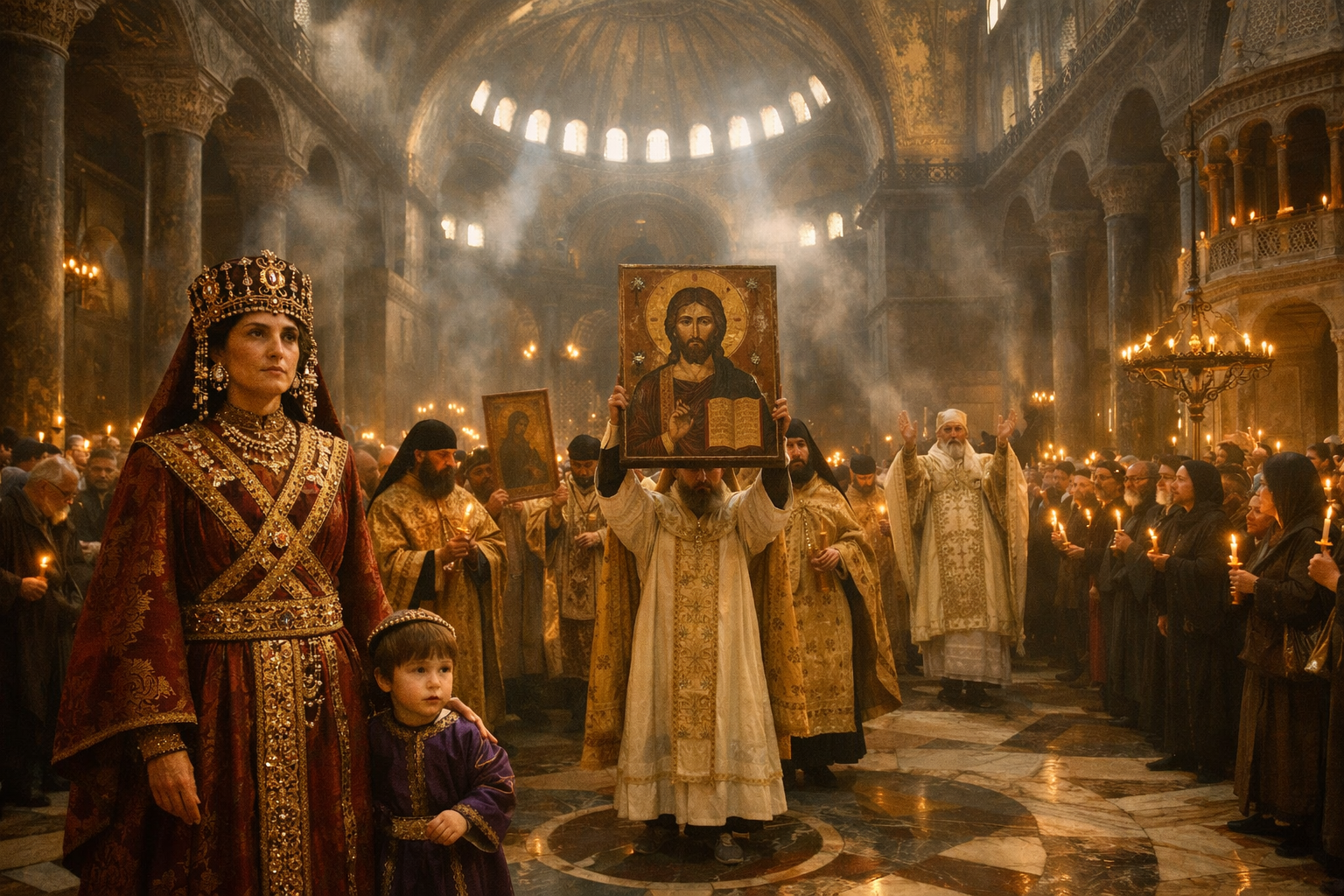
The Hagia Sophia, Constantinople, March 11, 843 CE
The great church of Hagia Sophia blazed with thousands of candles on that cold March morning. Empress Theodora stood beneath the massive dome, her young son Michael III at her side, as monks and priests carried sacred icons through the imperial doors. Incense filled the air. The congregation watched in silence. After decades of bitter conflict and persecution, the holy images were coming home.
Among the icons carried that day was the famous image of Christ Pantocrator, hidden away for safety during the years of iconoclasm. Its paint was faded and worn, but the penetrating gaze of the Savior seemed to pierce the souls of all who beheld it. Elderly members of the congregation wept openly, remembering the dark days when such images were destroyed and their defenders tortured or killed.
The Patriarch Methodius, his face bearing the scars of past persecution, raised his hands to bless the assembled faithful. His voice, strong despite his advanced years, echoed through the vast space as he proclaimed the restoration of the icons, the moment the Church would forever commemorate as the Triumph of Orthodoxy.
Michael III was only three years old. The significance of the moment would only become clear to him later. But for his mother Theodora, who had risked everything to restore the veneration of icons, this was the culmination of a struggle that had divided the empire for over a century. The restoration of the icons was a decisive moment that would shape Byzantine civilization for centuries to come.
The Origins of Iconoclasm
The controversy over religious images had begun in 726 CE, when Emperor Leo III ordered the removal of an icon of Christ from the Chalke Gate of the Great Palace. This seemingly simple act sparked a crisis that would tear the empire apart for the next 117 years.
The iconoclasts ("image-breakers") believed that the veneration of religious images constituted idolatry, forbidden by the Second Commandment. They were influenced partly by Islamic prohibitions against religious imagery and partly by a desire to reform what they saw as superstitious practices. The military successes of the Muslim armies had led some to question whether God was punishing the Byzantines for their use of icons.
The iconodules ("image-venerators") argued that icons were not objects of worship themselves but windows to the divine and physical reminders of spiritual truths. Teaching tools for the illiterate, too. They pointed to the Incarnation of Christ as theological justification: if God had taken physical form, then He could be depicted in physical form.
The dispute had political dimensions as well. The iconoclast emperors sought to assert imperial authority over the church, while the monasteries, strongholds of icon veneration, represented a powerful independent force within the empire. The controversy also strained relations with Rome and the Western Church, which strongly supported the use of religious images, complicating Byzantine diplomacy at a time when the empire could ill afford new enemies.
Main Narrative - The Final Battle Over Icons
The story reached its climax in the years leading up to 843. Emperor Theophilus, the last iconoclast ruler, had died in 842, leaving his wife Theodora as regent for their young son Michael III. Theodora was secretly an iconodule, and she faced a genuinely delicate situation. The army and clergy elevated under iconoclasm remained a potential source of resistance, and she could not afford to move carelessly.
She moved carefully but decisively. First she secured the support of influential court officials and military commanders through a combination of diplomacy and strategic appointments. Theodora's own ministers, including the powerful logothete Theoktistos and her brothers Bardas and Petronas, backed the restoration, while she reached out to the imprisoned and exiled iconodule clergy, including the future Patriarch Methodius, who had suffered terrible torture under previous regimes.
John the Grammarian, the last iconoclast patriarch, was deposed on 4 March 843 and confined to a monastery. He refused to recant. Almost nothing survives in his own words, and later accounts of him are hostile, written by authors such as John Skylitzes more than two centuries after the events.
The transition was not entirely peaceful. In several provinces, particularly in Asia Minor, iconoclast officials resisted the change. The Paulician sect, which rejected all religious images, launched a rebellion that would trouble the empire's eastern borders for years to come. Some military commanders threatened to march on Constantinople, but Theodora's preparatory work had secured enough loyal forces to prevent a civil war.
The Council of Constantinople in 843 formally restored the veneration of icons and anathematized the iconoclast position. Its proceedings reveal the careful balance struck between triumph and reconciliation. Iconoclast teachings were condemned, but most former iconoclasts were allowed to retain their positions if they recanted their views.
Consequences and Lasting Impact
The Triumph of Orthodoxy, as this restoration came to be known, had far-reaching consequences for Byzantine civilization. The victory of the iconodules produced an explosion of religious art that would define Byzantine aesthetic and spiritual expression for centuries. The distinctive style of Byzantine icons, with their gold backgrounds and formal poses, became the standard for Orthodox Christian art throughout Eastern Europe and Russia.
The triumph also strengthened the independence of the Orthodox Church, and the monasteries in particular emerged as powerful centers of cultural and spiritual life. The annual celebration of the Triumph of Orthodoxy on the first Sunday of Lent became a fundamental part of the Orthodox liturgical calendar. That observance continues to this day.
The resolution of the iconoclast controversy also contributed to the growing separation between Eastern and Western Christianity. Both churches now accepted the use of religious images, but their theological and cultural paths continued to diverge, leading eventually to the Great Schism of 1054.
As the empire emerged from the iconoclast controversy, new challenges loomed on the horizon. The rise of the Macedonian dynasty would soon usher in what many consider Byzantium's golden age. Yet the seeds of future conflicts were already being sown, as ambitious nobles began to challenge imperial authority and new enemies gathered at the empire's borders. In our next episode, we'll explore how the Macedonian emperors attempted to address these challenges and lead Byzantium to new heights of power and cultural achievement.
Editor's Context
Read this episode through the Byzantine habit of adaptation. The empire repeatedly survived by changing its military, fiscal, religious, and diplomatic tools while insisting that it remained Roman. The date markers (843, 843 CE) are included because chronology is one of the easiest places for narrative history to become misleading. The episode's themes (history, empire, power) are the editorial lens for weighing cause and consequence rather than treating the story as isolated trivia.
Reviewed under the EmpiresDiary editorial workflow by Obadiah.
Drafted with AI. Accuracy review and corrections are ongoing — if you spot an error, please report it. See our workflow and editorial policy.