The Golden Pen and the Prison Cell
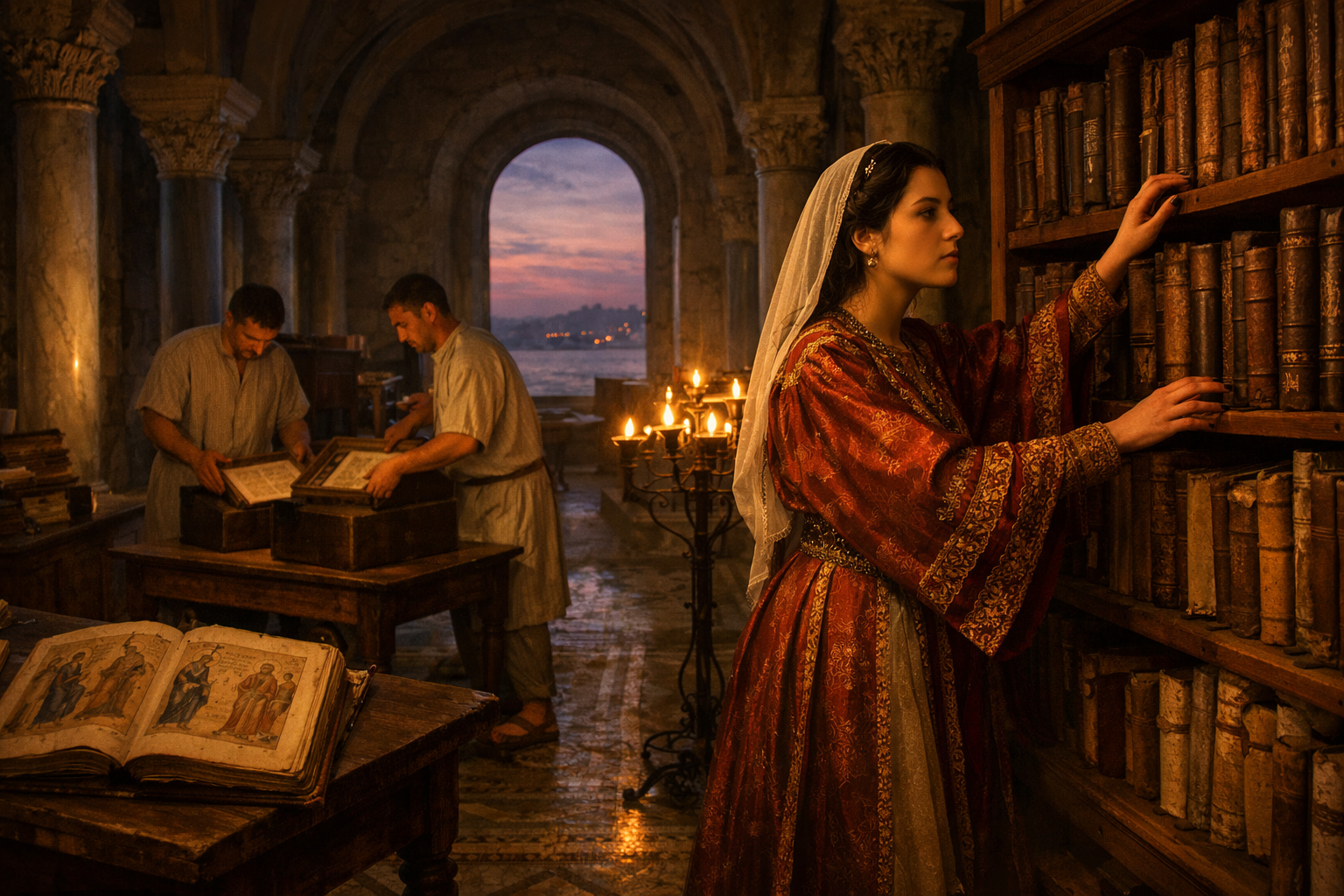
The Imperial Library, Constantinople, 780 CE
The flickering lamplight threw dancing shadows across the scrolls and codices as a young scholar hurried through the imperial library's marble corridors. She moved with purpose, silk robes rustling against the cool stone floor. Behind her, two trusted servants carried wooden boxes lined with felt, each packed with precious manuscripts.
Through the high windows, the first light of dawn was breaking over the Bosphorus. Time was short. The newly crowned Emperor Constantine VI was just nine years old, and their mother Irene served as regent. The iconoclast faction at court was growing stronger by the day, and the danger to the library's collections was plain to anyone paying attention.
Just the day before, a bonfire had burned in the Forum of Constantine, where zealous officials destroyed illuminated manuscripts they deemed "idolatrous." Ancient texts containing any images of Christ, the Virgin Mary, or the saints were being systematically condemned across the empire. Those educated in classical literature and philosophy understood the devastating loss this represented to faith and to knowledge alike.
She paused before a particular shelf, running her fingers along the spines until she found what she sought: a 4th-century illustrated copy of Virgil's Aeneid, its pages adorned with miniature paintings. Next to it sat a medical treatise by Galen, complete with anatomical drawings. Both would be condemned under the iconoclasts' strict interpretation.
She gestured to her servants, adding the volumes to their boxes. The secret chamber prepared beneath the Monastery of Saint John of Stoudios would keep these treasures safe until sanity returned to the empire.
The Second Iconoclasm
The Byzantine Empire had weathered its first iconoclastic period (726-787 CE) under emperors Leo III and Constantine V, who banned religious images as a form of idolatry. The Second Council of Nicaea in 787 briefly restored the veneration of icons, but the controversy was far from finished.
The second wave of iconoclasm (814-842 CE) proved even more destructive to Byzantine cultural heritage. Emperor Leo V the Armenian, convinced that military defeats were divine punishment for icon veneration, renewed the persecution with unprecedented vigor. Libraries were purged, monastery walls were whitewashed, and illuminated manuscripts were systematically destroyed.
The theological debate masked deeper political and social tensions. Iconoclasts, often backed by the army and the eastern provinces, saw themselves as reformers purifying the faith. Iconodules (icon-supporters), including most monastics and the educated aristocracy, viewed icons as essential tools for teaching and worship, as well as vital links to apostolic tradition.
This conflict threatened the preservation of classical knowledge, not just religious art. Many ancient texts survived only in illustrated Byzantine copies, their margins filled with explanatory images and diagrams. Mathematical treatises, medical works, and natural histories were especially vulnerable, since their scientific illustrations could be condemned alongside religious imagery.
The Hidden Library Network
Figures such as Theodore the Studite, the abbot of the Monastery of Stoudios and a leading iconodule voice, helped inspire a broader preservation effort that grew into an underground network of scholars, scribes, and monastics working to protect endangered manuscripts. Operating from hidden scriptoria in monasteries and private estates, they copied texts onto fresh parchment, sometimes deliberately omitting illustrations to avoid destruction while preserving the written content.
The network extended beyond Constantinople to distant monasteries on Mount Athos and in Cappadocia, and even reached Sicily. Trusted merchants transported manuscripts disguised as ordinary trade goods, while diplomatic pouches carried others to safety in Rome, Venice, and the Frankish kingdoms.
Not everyone involved was motivated purely by cultural preservation. Some saw political advantage in protecting these treasures, hoping to curry favor with the powerful monastic faction. Others recognized the practical value of medical and scientific works, particularly military engineers who relied on illustrated technical manuals.
Discovery carried a severe price. In 815, a group of scribes was arrested at the Monastery of Stoudios for copying prohibited texts. Their punishment, having their hands burned with hot irons, served as a warning to others. Yet the work continued in secret, often led by aristocratic women who had greater freedom of movement and faced less scrutiny than male scholars.
Theodore the Studite himself was exiled multiple times for his resistance to imperial religious policy. From confinement, he continued to correspond with supporters across the empire, coordinating resistance through letters that carefully navigated the boundaries of what authorities would tolerate.
The Tide Turns
The death of Emperor Theophilos in 842 marked a turning point. His widow, Empress Theodora, serving as regent for their young son Michael III, moved quickly to restore icon veneration. On the first Sunday of Lent in 843, now celebrated as the "Triumph of Orthodoxy," religious images were officially restored to churches.
The hidden manuscripts gradually emerged from their secret repositories. Many had survived intact. Others existed in multiple copies thanks to the tireless work of underground scribes, and some texts had been enhanced with new commentaries and annotations added during their concealment, creating hybrid works that combined classical and medieval scholarship in ways their original authors never anticipated.
Lasting Impact
The preservation network's success ensured the survival of countless classical and early Christian texts that would otherwise have been lost. When the Renaissance began in Italy centuries later, many of these works provided crucial links to ancient learning, helping spark the revival of classical studies.
The experience also established a model for cultural preservation under threat that would be repeated throughout history. The network's methods, distributing copies across multiple locations, using coded communication, and hiding valuable works within mundane collections, would inspire later efforts to protect endangered knowledge.
The crisis also forced Byzantine scholars to develop new ways of transmitting knowledge without relying on images. The result was a set of innovations in written description and technical vocabulary that enriched medieval scholarship long after the iconoclast controversy had faded from living memory.
The end of iconoclasm ushered in a new golden age of Byzantine art and learning, as we will see in the next episode. But the empire would face fresh challenges as new powers emerged in the East and West, and the preservation of knowledge would remain crucial as Byzantium transformed from a military superpower into civilization's guardian of classical heritage.
The hard-won lessons of the iconoclast period would serve the empire well in the centuries ahead, as it faced threats that tested its cultural identity as much as its political survival.
Editor's Context
Read this episode through the Byzantine habit of adaptation. The empire repeatedly survived by changing its military, fiscal, religious, and diplomatic tools while insisting that it remained Roman. The date markers (726, 814) are included because chronology is one of the easiest places for narrative history to become misleading. The episode's themes (history, empire, power) are the editorial lens for weighing cause and consequence rather than treating the story as isolated trivia.
Reviewed under the EmpiresDiary editorial workflow by Obadiah.
Drafted with AI. Accuracy review and corrections are ongoing — if you spot an error, please report it. See our workflow and editorial policy.