The Imperial Succession Crisis of 1341
Constantinople, Spring 1341
The death bells of Constantinople tolled across the city's seven hills as Emperor Andronikos III Palaeologos drew his final breaths. He was only forty-four years old, and his sudden passing threw the Byzantine Empire into chaos. In the imperial palace, two figures stood in tense silence by the deathbed: John Kantakouzenos, the Grand Domestic and the emperor's closest friend, and Anna of Savoy, the empress-regent and mother of the nine-year-old heir, John V Palaeologos.
The spring air carried the scent of orange blossoms through the open windows. Neither figure noticed. Kantakouzenos, tall and dignified in his purple-trimmed robes, had effectively run the empire alongside Andronikos for years. He had been promised the regency of young John V, but the empress's dark eyes revealed her own ambitions.
Word spread quickly through the streets. The city was already divided between the aristocracy who supported Kantakouzenos and the middle classes who backed the empress. The zealous monks, meanwhile, saw in this moment an opportunity to advance their own theological agenda. In the markets and squares, people gathered in worried clusters, knowing that imperial succession crises had torn the empire apart before.
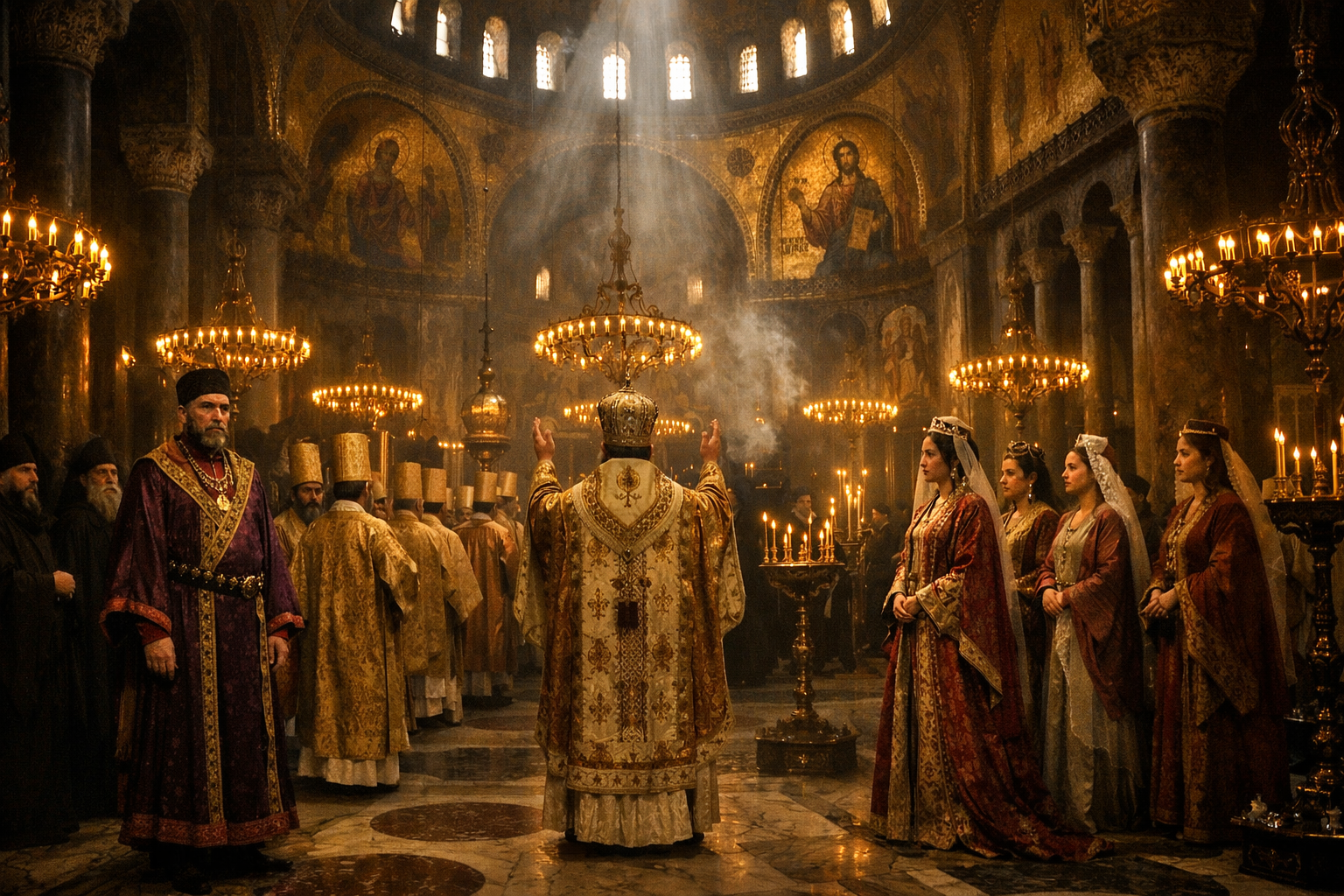
In the Hagia Sophia, Patriarch John XIV Kalekas offered prayers for the deceased emperor while calculating his own political moves. The great church's golden mosaics gleamed in the candlelight as clergy and nobles filed in to pay their respects, each wondering who would emerge victorious from the power struggle to come.
The Byzantine Empire of 1341 was a shadow of its former glory. Once stretching from Spain to Syria, it now encompassed little more than Greece, Thrace, and scattered territories in Asia Minor. The Fourth Crusade's sack of Constantinople in 1204 had dealt a devastating blow from which the empire never fully recovered. Michael VIII Palaeologos restored the capital to Byzantine hands in 1261, but the empire faced constant threats from every direction.
To the east, Turkish emirates were steadily consuming what remained of Byzantine Asia Minor. To the north, Serbia under Stefan Dusan was growing dangerously powerful. The Italian maritime republics of Venice and Genoa controlled much of the empire's commerce, and western European powers viewed Byzantium with a mixture of contempt and opportunism.
Internally, the empire was divided by political and religious controversy alike. The aristocracy had grown increasingly powerful at the expense of central authority. At the same time, a mystical religious movement known as Hesychasm was creating deep theological rifts. Led by Gregory Palamas, it taught that through meditation and prayer, monks could directly experience divine light. That controversy would become inextricably linked with the political struggle for power.
Andronikos III had maintained stability through his personal authority and his partnership with Kantakouzenos. Together they conducted military campaigns and administrative reforms that briefly reversed some of the empire's decline. His death shattered that fragile balance.
The Civil War Unfolds
The conflict erupted almost immediately. Despite his promises to the late emperor, Kantakouzenos was quickly outmaneuvered by a coalition built around the empress Anna, Patriarch John XIV, and the ambitious noble Alexios Apokaukos. In October 1341, while Kantakouzenos was away from the capital on campaign, his enemies struck. The patriarch crowned the young John V as sole emperor, and Apokaukos convinced the Constantinople mob to plunder Kantakouzenos's property.
Forced into open rebellion to protect himself, Kantakouzenos was proclaimed emperor at Didymoteicho in Thrace, claiming he would serve as guardian of John V's rights, though his formal coronation would not come until 1346. The empire split into two camps. Western territories generally supported the regency in Constantinople, while much of Thrace and Macedonia backed Kantakouzenos.
The civil war quickly took on additional dimensions. The Hesychast controversy became politicized, with Palamas supporting Kantakouzenos while his theological opponents backed the regency. Foreign powers were drawn in as well. Stefan Dusan of Serbia initially allied with Kantakouzenos but soon began conquering Byzantine territories for himself. The Ottoman Turks under Orhan I provided crucial support to Kantakouzenos, while the regency received help from Bulgaria.
Social tensions exploded during the conflict. In Thessalonica, the empire's second city, a radical movement known as the Zealots seized power in 1342. Led by common sailors and craftsmen, they established a semi-autonomous commune that persecuted aristocrats and supported the regency. Similar anti-aristocratic movements emerged in other cities.
The war devastated what remained of Byzantine strength. Armies ravaged the countryside, commerce collapsed, and foreign powers seized territory while Byzantines fought each other. Apokaukos was murdered by political prisoners in Constantinople in 1345, weakening the regency's position considerably. By 1347, Kantakouzenos entered Constantinople with Ottoman troops at his back and was accepted as senior emperor alongside John V.
Consequences and Legacy
The civil war of 1341-1347 accelerated the Byzantine Empire's decline in several crucial ways. The extensive use of Turkish mercenaries by both sides gave the Ottomans growing influence in Byzantine affairs. Within a few years Kantakouzenos granted them the fortress of Tzympe near Gallipoli (around 1352), and after a 1354 earthquake destroyed its defenses the Ottomans seized Gallipoli itself, giving them their first permanent foothold in Europe. It was a process the empire could never undo.
Serbia emerged as the dominant Balkan power, with Stefan Dusan conquering most of Macedonia, Albania, and northern Greece. The empire's economy never recovered from the devastation of the civil war. The population was further reduced by the Black Death, which struck in 1347.
The victory of Kantakouzenos also meant the triumph of Hesychasm, officially accepted by the church in 1351. While this provided some religious unity, it further alienated the empire from the West and reinforced Byzantium's isolation from Catholic Europe at precisely the moment it needed western support against the Ottoman threat.
The peace of 1347 would prove temporary. Within a decade, another civil war erupted between John V and John VI Kantakouzenos, leading to the latter's abdication and retirement to a monastery. In our next episode, we'll explore how these continued internal conflicts, combined with the rising power of the Ottoman Turks, pushed the Byzantine Empire closer to its final crisis.
Editor's Context
Read this episode through the Byzantine habit of adaptation. The empire repeatedly survived by changing its military, fiscal, religious, and diplomatic tools while insisting that it remained Roman. The date markers (1341, 1261) are included because chronology is one of the easiest places for narrative history to become misleading. The episode's themes (history, empire, power) are the editorial lens for weighing cause and consequence rather than treating the story as isolated trivia.
Reviewed under the EmpiresDiary editorial workflow by Obadiah.
Drafted with AI. Accuracy review and corrections are ongoing — if you spot an error, please report it. See our workflow and editorial policy.