The Blinding of Bulgaria
July 29, 1014 CE
The summer sun beat down on the narrow mountain pass of Kleidion in western Bulgaria. Fifteen thousand Byzantine soldiers lay dead or dying, their golden eagles and crimson banners trampled into the blood-soaked earth. Bulgarian warriors shouted in triumph from the rocky heights, where they had ambushed the imperial army with devastating effect. Samuel, Tsar of Bulgaria, allowed himself a brief smile. After decades of warfare against Byzantium, he had finally trapped their army and their emperor, Basil II.
Samuel's victory celebration proved premature. As his forces moved to encircle the remaining Byzantine troops, an unexpected horn blast echoed through the valley. From a hidden path emerged the imperial general Nikephoros Xiphias, leading a fresh force that had circled behind the Bulgarian position. Caught between two Byzantine armies, Samuel's troops broke in panic. The slaughter that followed turned the mountain stream red with Bulgarian blood.
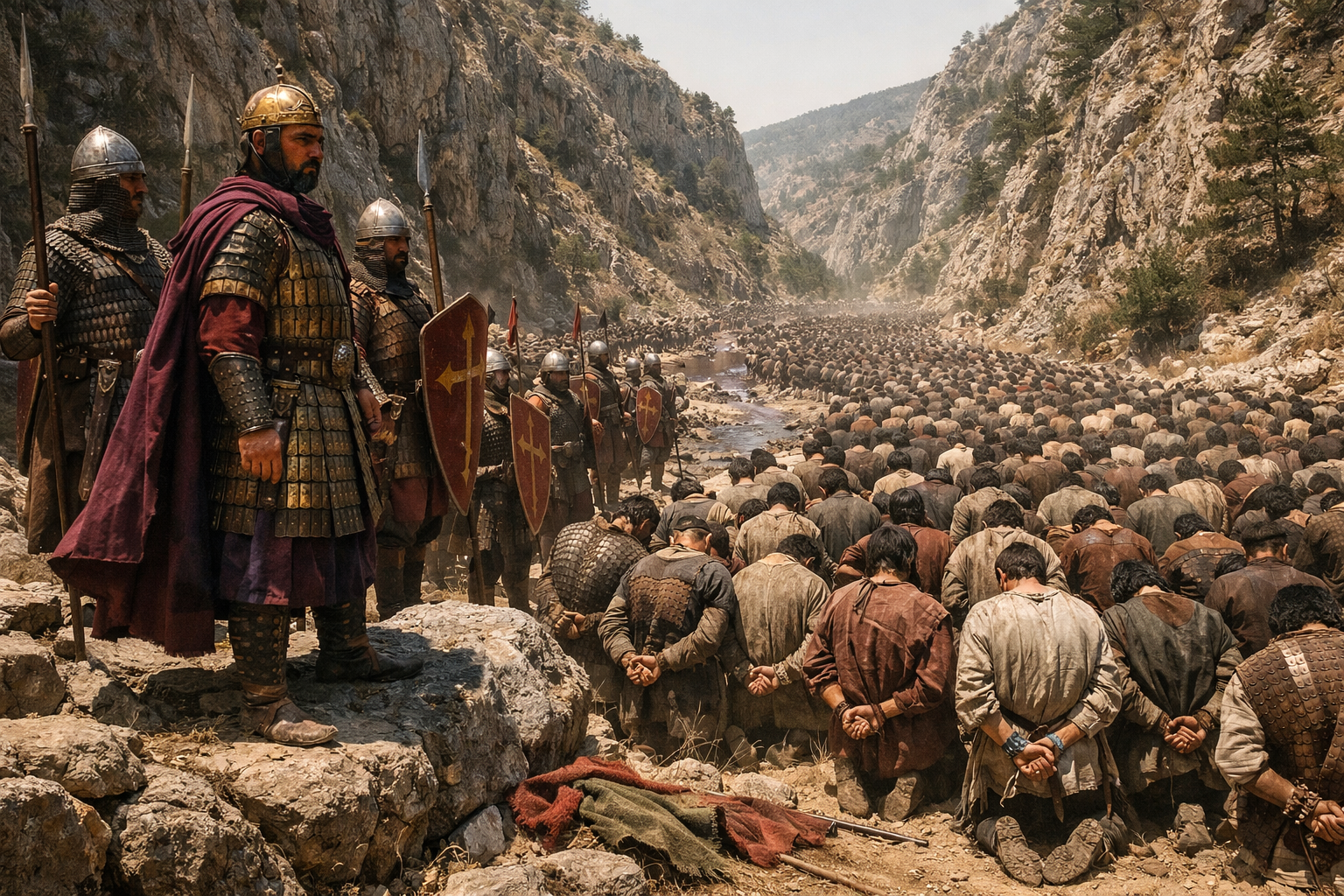
In the aftermath, Emperor Basil II surveyed the battlefield with cold satisfaction. Before him stood some 15,000 captured Bulgarian soldiers, nearly the entire army that had opposed him. After a quarter-century of bitter war against Samuel's Bulgaria, victory was finally within his grasp. But simple victory wasn't enough. Basil needed to send a message that would echo across the Balkans and through history itself. Turning to his commanders, he issued an order of unprecedented cruelty that would earn him the name "Bulgaroktonos," the Bulgar-Slayer.
The Byzantine-Bulgarian wars had raged on and off for centuries, but the conflict between Basil II and Samuel was particularly fierce. Since 976 CE, Samuel had built Bulgaria into a powerful empire stretching from the Adriatic to the Black Sea. His success threatened Byzantine dominance in the Balkans, a region crucial for both trade and military security.
Basil II had ascended to the Byzantine throne as a young child in 976, but by 1014 he had matured into a ruthless and effective military commander. Known for his austere lifestyle and strategic brilliance, Basil was determined to restore Byzantine power to its former glory. The Bulgarian threat had to be eliminated.
Samuel represented the latest in a line of Bulgarian rulers who had challenged Byzantine authority. His predecessor Boris II had been humiliated in Constantinople, forced to surrender his crown to Emperor John I Tzimiskes. Samuel had rebuilt Bulgarian power by exploiting Byzantine civil wars to expand his territory. He even claimed the title of Tsar (Caesar), directly challenging Byzantine imperial authority.
The war between Basil and Samuel dragged on for decades, with raids, sieges, and battles devastating the Balkans. Both sides employed scorched earth tactics, destroying crops and settlements. The population suffered terribly, caught between two empires locked in an existential struggle.
The Brutal Aftermath
What followed the Battle of Kleidion would shock even the hardened sensibilities of medieval warfare. Basil II ordered his soldiers to blind 99 out of every 100 captured Bulgarian soldiers. The hundredth man was left with one eye so he could lead his comrades home. The Byzantine soldiers carried out their grim work with methodical efficiency, using heated irons to destroy the eyes of 14,850 men.
The column of blinded soldiers stretched for miles as they stumbled back toward Samuel at Prespa. Some died along the way from wounds or exposure. Others were led by their one-eyed guides, forming human chains of the mutilated. The prisoners did not reach Samuel until early October 1014, more than two months after the battle. When they finally arrived, the sight broke Samuel's spirit entirely. He collapsed from shock upon seeing his ruined army and died two days later, on October 6, 1014.
Bulgarian resistance continued under Samuel's son Gabriel Radomir, but the psychological impact of the mass blinding had shattered Bulgarian morale. Gabriel was soon murdered by his cousin Ivan Vladislav, who briefly tried to rally Bulgarian forces before he too was killed in battle. By 1018, the last Bulgarian nobles surrendered to Basil II.
Contemporary accounts offer different perspectives on this act of mass mutilation. The chronicler John Skylitzes, who records the blinding and the figure of roughly 15,000 prisoners along with the detail of the one-eyed guides, presents the episode as a demonstration of imperial power. Byzantine writers more broadly tended to portray Basil as severe in war but measured in peace, a ruler who kept his harshest impulses in reserve for the battlefield. Bulgarian sources portrayed the mass blinding as an act of unconscionable brutality. The surviving Bulgarian soldiers and their families faced a harsh future. Many became beggars, dependent on monasteries and charity. Their suffering became part of Bulgarian folk memory, preserved in songs and stories that would fuel future resistance against Byzantine rule.
Long-Term Impact
Bulgaria was absorbed into the Byzantine Empire for nearly two centuries, with its lands reorganized into themes (administrative districts) under direct imperial control. The Bulgarian church lost its autocephalous status, becoming subordinate to Constantinople. Basil had achieved his military objectives. The cost, in terms of lasting hatred, was another matter.
The memory of this atrocity created a deep and durable resentment of Byzantine rule among the Bulgarians. When a new Bulgarian uprising succeeded in 1185, its leaders explicitly invoked the memory of Samuel and his blinded soldiers. The event also damaged Byzantium's reputation throughout medieval Europe, contributing to the growing East-West divide in Christianity.
Basil II's action established a troubling precedent for the treatment of defeated enemies, though few subsequent rulers went to such extremes. The episode remains one of the most notorious examples of Byzantine psychological warfare, demonstrating how a single act of calculated cruelty could shape political relationships for generations.
As Basil II returned triumphant to Constantinople, the empire reached its medieval zenith. But the very completeness of his victory would eventually prove problematic. The elimination of the Bulgarian buffer state left Byzantium exposed to new threats from the north, while the resources devoted to the Balkan campaigns had weakened defenses in the east. In our next episode, we'll explore how these strategic choices would come back to haunt the empire when a new power arose in Asia Minor: the Seljuk Turks.
Editor's Context
Read this episode through the Byzantine habit of adaptation. The empire repeatedly survived by changing its military, fiscal, religious, and diplomatic tools while insisting that it remained Roman. The date markers (976 CE, 1014 CE) are included because chronology is one of the easiest places for narrative history to become misleading. The episode's themes (history, empire, power) are the editorial lens for weighing cause and consequence rather than treating the story as isolated trivia.
Reviewed under the EmpiresDiary editorial workflow by Obadiah.
Drafted with AI. Accuracy review and corrections are ongoing — if you spot an error, please report it. See our workflow and editorial policy.