The Reign of Blood and Gold
The Bulgar Slayer's Triumph
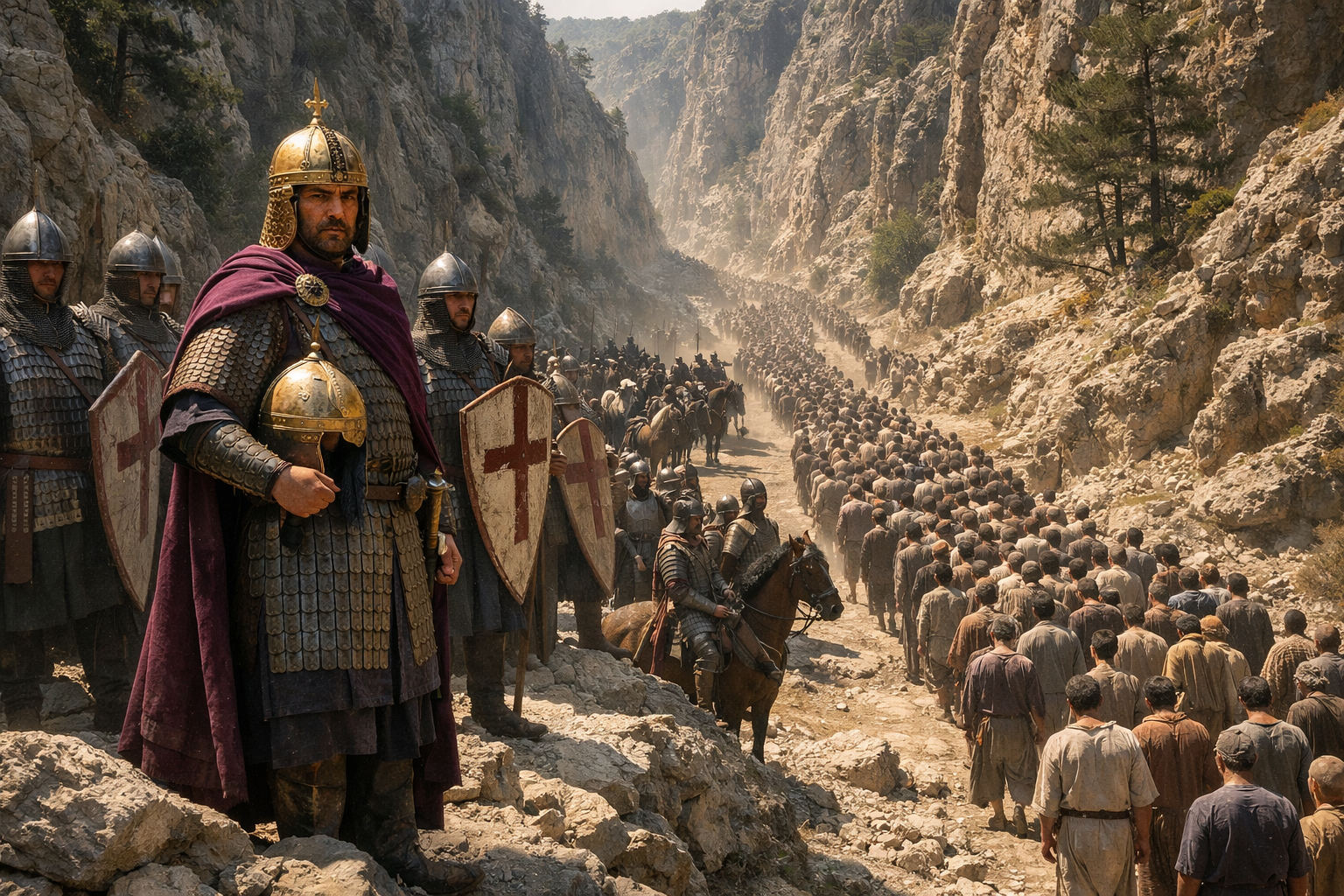
The summer sun beat down on the Kleidion Pass in 1014 CE, where 15,000 Bulgarian soldiers lay captured before the Byzantine Emperor Basil II. The narrow mountain passage in Macedonia had turned from a perfect ambush point into a death trap for Tsar Samuel's forces. As imperial guards brought group after group of prisoners forward, an order was given that would echo through history.
Basil reportedly ordered the prisoners blinded, leaving one man in every hundred with a single eye to lead the rest home. This account comes from the later chronicler John Skylitzes, who himself qualified the story with the phrase "as they say," signaling his own uncertainty about it. Byzantine soldiers carried out the blinding over several days, working with the cruel efficiency that had become their emperor's hallmark. When the mutilated army finally staggered back to their ruler in Prilep, led by their one-eyed guides, the sight proved too much for Tsar Samuel. He suffered a stroke upon seeing his once-proud warriors reduced to stumbling, sightless masses, and died two days later.
This moment marked the pinnacle of Basil II's campaign to destroy the Bulgarian Empire, earning him the fearsome epithet "Bulgaroktonos," the Bulgar-Slayer. He was far from a simple brutal tyrant, though. He was perhaps Byzantium's most effective emperor, transforming a troubled state into medieval Europe's most powerful empire through military genius and unwavering administrative discipline.
When Basil II inherited the throne in 976 at age 18, the Byzantine Empire was in crisis. His predecessors had expanded the empire's territories, but internal strife threatened to tear it apart. Two powerful noble families, the Phocas and Skleros clans, openly rebelled against imperial authority. The Bulgarian Empire under Samuel pressed from the north, while Muslim forces threatened the eastern frontiers.
The young emperor had spent his early years as a nominal ruler while court eunuchs and military aristocrats wielded real power. His co-emperor and brother, Constantine VIII, showed little interest in governance and preferred a life of luxury. Basil grew up watching how the great landholding families accumulated wealth and power at the empire's expense, weakening central authority and military effectiveness in the process.
The Byzantine army had evolved from the old Roman model into a complex system of professional troops and themed armies (regional military districts). By the late 10th century, though, the themes were increasingly controlled by powerful aristocratic families who pursued their own interests over the empire's.
Constantinople remained medieval Europe's largest and wealthiest city, and the gold solidus served as the Mediterranean's reserve currency. Byzantine silk and luxury goods were prized throughout the known world. That wealth, however, was concentrated in aristocratic hands. The imperial coffers saw less and less of it.
The Making of an Emperor
Basil's transformation from powerless figurehead to authoritarian ruler unfolded through a series of brutal civil wars. In 979, the rebel Bardas Skleros declared himself emperor and marched on Constantinople. Basil turned to his supposed protector, Bardas Phocas, to crush the rebellion. By 987, Phocas himself rebelled, forming an alliance with his former enemy Skleros to depose Basil.
The young emperor found an unlikely savior in Vladimir I of Kiev. In exchange for his sister Anna's hand in marriage and Vladimir's own conversion to Christianity, the Rus prince sent 6,000 Varangian warriors who helped Basil crush the noble rebellion. This arrangement began a long association between Byzantium and the Rus, and it marked Basil's emergence as a true autocrat.
With internal opposition crushed, Basil implemented sweeping reforms. He confiscated rebel estates, strengthened peasant land rights to weaken the nobility, and built a loyal military force answerable only to him. His famous Novel of 996 protected small landowners from aristocratic expansion, preserving the empire's tax base and its pool of military recruits.
In foreign affairs, Basil proved equally decisive. He conquered Bulgaria through annual campaigns, grinding down their resistance year by year. In the east, he expanded Byzantine territory to its greatest extent since the Arab conquests, annexing Armenia and pushing to the Euphrates River. Each victory brought new resources and secured frontiers.
The Price of Empire
Basil's achievements came at a tremendous human cost. Beyond the blinded Bulgarians, thousands died in his relentless campaigns. He never married or produced an heir, dedicating himself entirely to state affairs. Contemporary accounts describe him as austere and suspicious, wearing simple military dress over imperial purple, trusting almost no one.
His administrative reforms reshaped Byzantine society in ways that outlasted him. The civil service grew more meritocratic, with ability determining advancement over noble birth. This produced a new class of educated bureaucrats loyal to the crown. The army became more professional and ethnically diverse, incorporating Armenian, Georgian, and Scandinavian warriors alongside Greek and Anatolian troops.
Basil's greatest achievement may have been financial. When he died in 1025, the imperial treasury held a surplus of approximately 200,000 pounds of gold (around 14,400,000 nomismata). That reserve would help sustain the empire through future crises, though his successors would prove far less capable of managing it wisely.
Lasting Impact
Basil II's reign marked the absolute zenith of Byzantine power. The empire controlled territory from southern Italy to the Caucasus, and from the Danube to Syria. His administrative reforms influenced Byzantine governance for centuries, and his military successes created a legend of invincibility that long outlived him.
The very thoroughness of his victory over the aristocracy may have contributed to later decline, though. By destroying old power structures without building new ones to replace them, he left a vacuum that weaker emperors couldn't fill. Within fifty years of his death, the empire faced new threats from Norman adventurers, Turkish nomads, and Western crusaders.
Later Byzantine emperors were measured against Basil's image. His combination of military success, administrative competence, and fiscal discipline was never matched by those who followed. He remains a controversial figure: either a brutal tyrant or a necessary strongman who preserved and expanded Byzantine civilization, depending on who's doing the judging.
The death of Basil II in 1025 marked the end of an era, as the next episode will explore. His brother and successor Constantine VIII, who had spent his life in luxury while Basil governed, proved an ineffective ruler. The great empire Basil built would face new challenges, leading to the fateful Battle of Manzikert in 1071 that forever changed Byzantine fortunes in Anatolia. The age of the Bulgar-Slayer was over, but his shadow would loom large over the centuries to come.
Editor's Context
Read this episode through the Byzantine habit of adaptation. The empire repeatedly survived by changing its military, fiscal, religious, and diplomatic tools while insisting that it remained Roman. The date markers (976, 1014 CE) are included because chronology is one of the easiest places for narrative history to become misleading. The episode's themes (history, empire, power) are the editorial lens for weighing cause and consequence rather than treating the story as isolated trivia.
Reviewed under the EmpiresDiary editorial workflow by Obadiah.
Drafted with AI. Accuracy review and corrections are ongoing — if you spot an error, please report it. See our workflow and editorial policy.