The Reign of Terror: Phocas the Tyrant
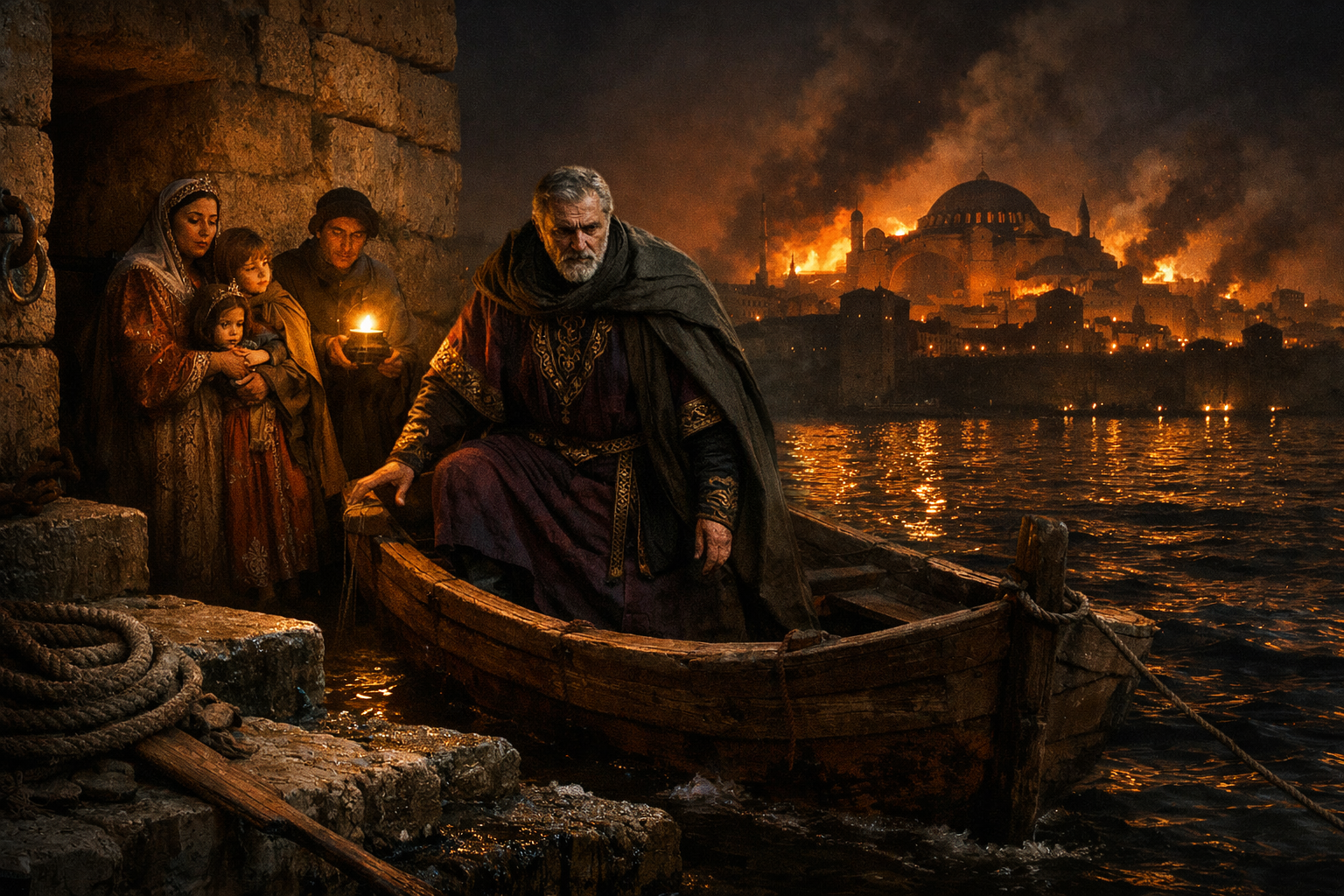
Constantinople, November 602 CE
The autumn wind whipped across the Harbor of Julian as an unusual silence fell over Constantinople. The great city's normally bustling ports stood empty, with only a few small fishing vessels bobbing in the choppy waters. Along the massive Theodosian Walls, nervous guards peered toward the western horizon, where pillars of smoke rose from burning villages. The mob was coming.
Inside the Great Palace, Emperor Maurice paced his private chambers. The 63-year-old ruler had received increasingly dire reports about a military rebellion advancing from the Danube frontier. His own troops had mutinied against his orders to winter north of the river, and now a former centurion named Phocas was leading them toward the capital.
Maurice's advisers urged him to flee. He hesitated. For twenty years he had ruled the empire with careful pragmatism, stabilizing the Persian frontier and reforming the army. Now, in the space of a few weeks, it was all unraveling. Through his window he could hear the growing roar of angry crowds gathering in the Hippodrome. The people were hungry after a harsh winter, and bread prices had soared. His popularity had collapsed.
As night fell, the chaos erupted. Mobs stormed through the streets, setting fires and looting warehouses. The city watch stood aside, unwilling to intervene. In the darkness, Maurice gathered his wife and children and slipped out through the palace's secret harbor entrance. As their small vessel pulled away from the glittering city, the emperor watched flames begin to consume the skyline he had ruled. He could not know that his desperate flight would mark the beginning of one of the darkest chapters in Byzantine history.
The year 602 CE marked a crucial turning point for the Byzantine Empire. Under Maurice's predecessor Tiberius II Constantine, and then under Maurice himself, the empire had enjoyed a period of relative stability and military success. Maurice had ended a costly war with Persia in 591 CE through a brilliant diplomatic stroke, helping the Persian Shah Khosrow II regain his throne. This created an unprecedented alliance between the two great powers.
Maurice had also reorganized the empire's military structure, creating the exarchates of Ravenna and Africa, which combined civil and military command and would prefigure later administrative developments. His careful management of resources had begun to restore the empire's finances after decades of strain.
Several factors, though, had undermined his position. A series of plague outbreaks and poor harvests created economic hardship. His attempts to reduce military spending, including cutting soldiers' pay and ordering troops to forage for supplies beyond the Danube, bred deep resentment in the army. The emperor's reputation for parsimony, though financially prudent, made him unpopular with soldiers and city dwellers alike.
The empire also faced mounting pressure from the Avars and Slavs along the Danube frontier. Maurice's insistence that the army continue campaigning through the harsh Balkan winter of 602 proved to be the final spark that ignited the revolt.
The Tyrant's Reign
Phocas entered Constantinople on November 23, 602 CE, riding a wave of popular support. He was crowned in the Church of St. John the Baptist, but his triumph was soon stained with blood. Maurice and his family had been captured near Chalcedon. In an act of calculated cruelty, Phocas ordered Maurice to watch as his five sons were executed before his eyes, from oldest to youngest, before the former emperor himself was beheaded.
The new regime wasted little time revealing its brutal nature. Phocas, a rough soldier with no experience in governance, responded to any hint of opposition with savage repression. The streets of Constantinople regularly displayed the mutilated bodies of alleged conspirators. His paranoia drove waves of denunciations and executions, targeting the senatorial aristocracy and anyone connected to Maurice's former administration.
Internationally, the consequences were catastrophic. Shah Khosrow II of Persia, who had been restored to his throne with Maurice's help, used his death as a pretext for war. Persian armies swept across the eastern provinces, capturing Syria, Palestine, and Egypt. The Avars and Slavs, no longer constrained by Maurice's defensive system, pushed deeper into the Balkans.
For ordinary people, Phocas's reign brought relentless hardship. The Persian invasion disrupted trade routes and food supplies. His attempts to maintain popularity through bread doles and circus games drained the treasury, while his paranoid purges gutted the civil administration.
Hostile later chroniclers portray a climate of fear and informers, in which open dissent became impossible and denunciation was a constant threat. Theophylact Simocatta, writing under Heraclius, was deeply hostile to Phocas and worked to rehabilitate the memory of Maurice, though his narrative ends at the very beginning of Phocas's reign and does not describe the terror that followed.
The Fall of the Tyrant
By 608 CE, opposition to Phocas had begun to coalesce around Heraclius, the powerful exarch (governor) of Africa. His son, also named Heraclius, led a fleet toward Constantinople while his cousin Nicetas advanced through Egypt. The younger Heraclius reached the capital in October 610, finding the city's population eager for deliverance from Phocas's tyranny.
The final hours were marked by desperate violence. As Heraclius's ships entered the harbor, the tyrant's few remaining supporters fought street by street until they were overwhelmed. Phocas was dragged before Heraclius on his flagship. According to the chronicler John of Antioch, Heraclius asked him, "Is this how you have governed the Empire?" Phocas replied, "Will you govern it better?" Before his execution, Phocas was subjected to various tortures and mutilations, his body eventually burned in the Forum Bovis.
Lasting Impact
The eight-year reign of Phocas marked a decisive break in Byzantine history. The relative stability of the sixth century was shattered, opening a period of crisis that would transform the empire. The Persian invasion he provoked led to a devastating twenty-six-year war that exhausted both empires, leaving them vulnerable to the rise of Islam in the 630s.
The trauma of his tyranny also left deep marks on Byzantine political culture. Future emperors were more careful to maintain the appearance of legitimacy and justice, and the church took a stronger role in checking imperial power. The period became a cautionary tale about military usurpation and unchecked rule.
Artistically, the period marked the end of the classical tradition in Byzantine art as the empire entered a more medieval phase. The Column of Phocas in the Roman Forum, ironically the last monument erected there, stands as a final echo of classical public art.
As we turn to our next episode, we will see how the young Heraclius inherited an empire in crisis. Facing Persian armies in the east and Avar hordes in the west, the new emperor had to rebuild Byzantine power almost from scratch. His remarkable journey from near-defeat to triumphant victory became one of the great epics of Byzantine history, but the empire he saved emerged fundamentally changed.
Editor's Context
Read this episode through the Byzantine habit of adaptation. The empire repeatedly survived by changing its military, fiscal, religious, and diplomatic tools while insisting that it remained Roman. The date markers (602 CE, 591 CE) are included because chronology is one of the easiest places for narrative history to become misleading. The episode's themes (history, empire, power) are the editorial lens for weighing cause and consequence rather than treating the story as isolated trivia.
Reviewed under the EmpiresDiary editorial workflow by Obadiah.
Drafted with AI. Accuracy review and corrections are ongoing — if you spot an error, please report it. See our workflow and editorial policy.