The Lost Fleet of Leo III
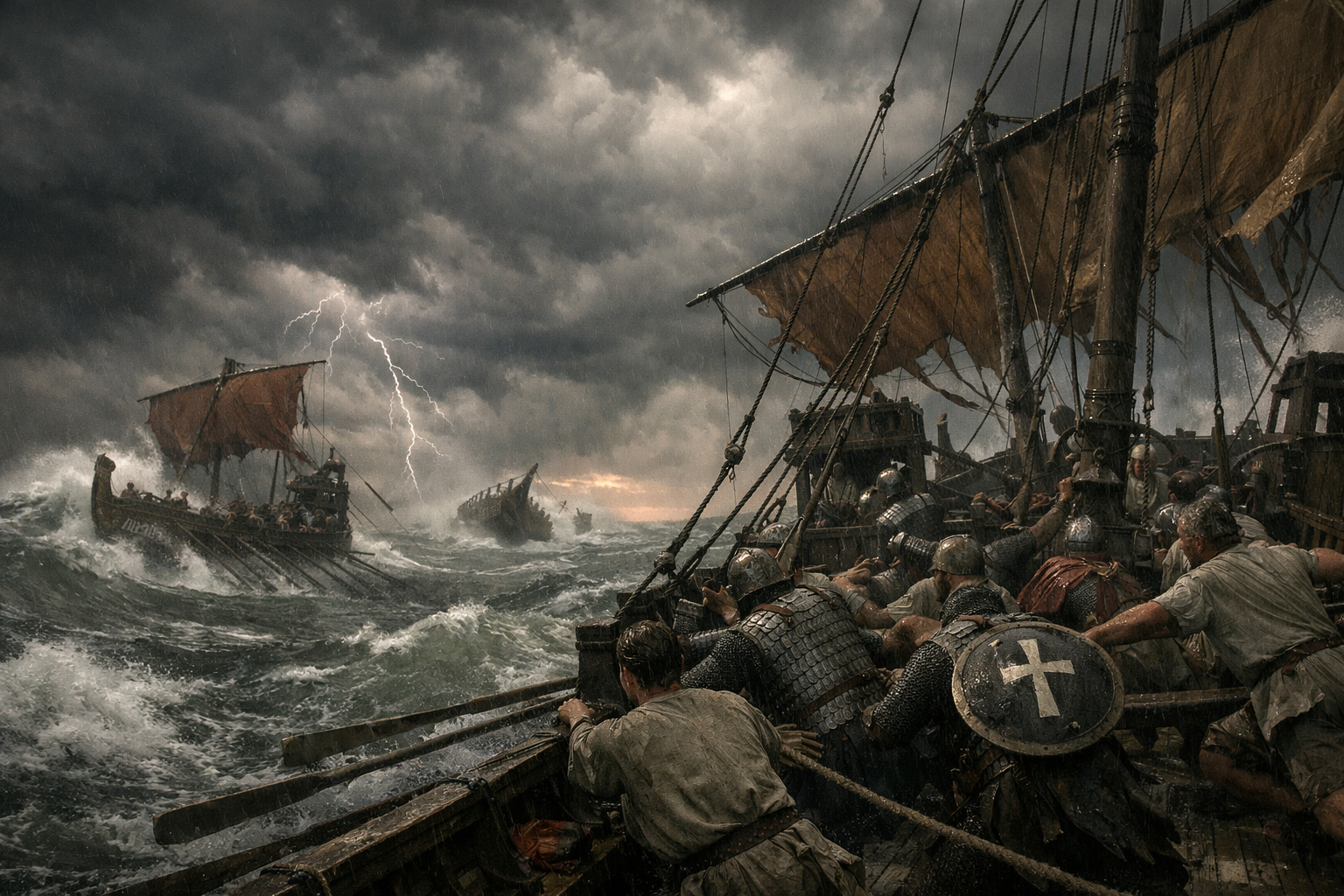
The Aegean Sea, Spring 727 CE
The turmoil of 727 CE unfolded against a backdrop of deep imperial crisis. Emperor Leo III had spared no expense assembling a fleet and dispatching it toward Italy, where the Lombard kingdom was pressing hard on Byzantine territories and the Papacy under Gregory II had begun openly defying imperial authority over the iconoclasm controversy. Leo's campaign to destroy religious images throughout the empire had pushed Rome toward open resistance, and the Italian expedition was meant to reassert control.
But the fleet never accomplished its mission. As it made its way toward Italy, a severe storm in the Adriatic wrecked much of the force. Ships were lost, trained sailors and soldiers were killed, and the survivors returned without having achieved their objective. The disaster carried far-reaching consequences for Byzantine control over Italy and for relations with the Papacy.
The storm that wrecked the fleet was a separate event from an earlier natural disturbance in the Aegean. In 726, a submarine volcanic eruption in the Thera complex (modern Santorini), dormant since its catastrophic Bronze Age eruption, produced pumice fall and alarmed populations across the region. The chronicler Theophanes records the event and notes that it intensified Leo's conviction that God was demanding religious purification. Leo interpreted the eruption as a sign supporting his iconoclast program, not as a punishment for it.
The Revolt of Agallianos
While Leo was preparing his Italian expedition, a serious challenge arose closer to home. Agallianos Kontoskeles, a tourmarches of the Theme of Hellas, led a revolt against Leo III in 726 and 727, driven by opposition to the emperor's iconoclast policies. He joined with other rebels, proclaimed a usurper named Kosmas as emperor, and sailed a rebel fleet toward Constantinople. The loyalist imperial navy met the rebel force and destroyed it using Greek fire. Agallianos drowned on 18 April 727 when he fell overboard in full armor. He was not Leo's loyal admiral but his enemy, and his end came at the hands of imperial forces, not at the hands of nature.
The Unfolding Crisis
In Constantinople, Leo III received news of the wrecked Italian expedition with shock and fury. His carefully laid plans for reasserting control over Italy lay in ruins. The loss of so many ships and trained sailors would cripple Byzantine naval power for years.
Pope Gregory II interpreted the broader situation as confirmation of his theological position. He had already been denouncing iconoclasm as heresy and asserting that the emperor had no authority to define doctrine or interfere in matters of faith. The fleet's failure did nothing to soften that stance, and Gregory continued to resist imperial religious policy from Rome.
Lombard king Liutprand saw his opportunity immediately. Without the threat of effective Byzantine intervention, he moved to seize Classis, Ravenna's seaport, along with cities of the Pentapolis and Emilia. Ravenna itself, however, remained beyond his grasp. Exarch Paul, the Byzantine governor, faced a deteriorating situation on multiple fronts. He was killed not in a Lombard assault on Ravenna but in the violent unrest that the iconoclasm controversy had stirred up in Italy, a riot driven by the same tensions that had set the entire region against imperial religious policy.
Meanwhile, in Greece and the Aegean islands, local communities were still dealing with the aftermath of the 726 eruption. Fish populations had been disrupted. Some coastal areas faced temporary difficulties. The themes of Hellas and the Aegean Islands faced economic disruption that compounded the military and political losses of the period.
The disaster also forced a rethinking of Byzantine military organization. Imperial strategists recognized that concentrating enormous fleets in single expeditions created catastrophic vulnerability. The argument for smaller, more mobile squadrons based in various coastal themes gained weight in the aftermath of these setbacks, though the shift in naval strategy developed gradually over the following decades rather than as a single reform.
Back in Constantinople, opposition to Leo's iconoclast policies grew louder. Many saw the fleet's destruction as proof that the emperor had lost divine favor. The influential monastery of Studios became a center of resistance, with its monks arguing that the disaster was punishment for the destruction of holy icons.
Long-Term Impact
The events of 726 and 727 marked a turning point. The empire's ability to project power into the western Mediterranean was permanently diminished, accelerating Byzantine withdrawal from Italy and leading to the eventual loss of Ravenna in 751. From that loss came the emergence of the independent Papal States.
Byzantine naval strategy shifted as well. Future emperors rarely risked concentrating large fleets. Smaller, more mobile squadrons based in various coastal themes became the norm. The decentralized approach proved more resilient, though it limited the empire's capacity for large-scale naval operations.
The perceived divine punishment for icon destruction became a powerful element in Orthodox Christian historical memory, cited by later writers as proof of God's protection of sacred images. The opposition to iconoclasm strengthened, though it would take another generation before imperial policy changed.
Leo III (r. 717-741) had come to power during a period of severe crisis. The empire had barely survived a massive Arab siege of Constantinople in 717-718, and Leo's military skill had been instrumental in saving the city. He reorganized the theme system, strengthened imperial administration, and introduced iconoclasm, which he believed would both purify the church and consolidate his authority. The Italian setbacks of 727 showed the limits of that program.
As we will see in our next episode, the aftermath of these events contributed to growing tensions between Constantinople and Rome. The Papacy's alliance with the Franks, which would reshape medieval Europe, was in part a consequence of Byzantium's diminished ability to protect its Italian territories. Join us as we explore how Pope Stephen II's fateful journey across the Alps in 753 changed the political landscape of Europe forever.
Editor's Context
Read this episode through the Byzantine habit of adaptation. The empire repeatedly survived by changing its military, fiscal, religious, and diplomatic tools while insisting that it remained Roman. The date markers (741, 717) are included because chronology is one of the easiest places for narrative history to become misleading. The episode's themes (history, empire, power) are the editorial lens for weighing cause and consequence rather than treating the story as isolated trivia.
Reviewed under the EmpiresDiary editorial workflow by Obadiah.
Drafted with AI. Accuracy review and corrections are ongoing — if you spot an error, please report it. See our workflow and editorial policy.