The Siege of Thessalonica, 904
Dawn of Terror
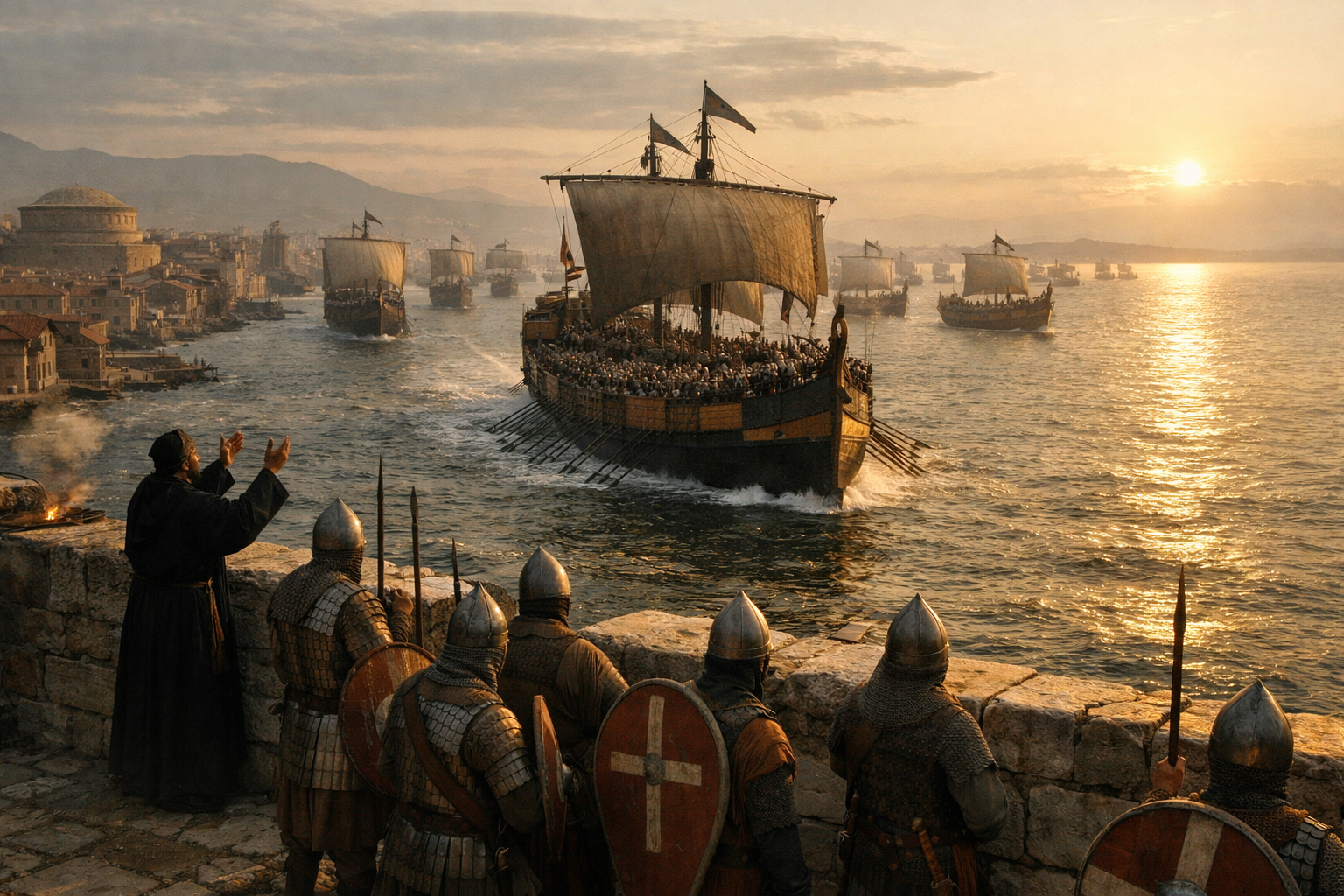
The late summer sun had barely risen over the Thermaic Gulf when lookouts on Thessalonica's sea walls spotted the first ships. By mid-morning on July 29, 904 CE, the full horror of what approached became clear: a massive Arab fleet of 54 ships carrying over 5,000 battle-hardened warriors, led by the infamous Leo of Tripoli, was bearing down on Byzantium's second-largest city.
Panic spread fast inside the great metropolis. Thessalonica's 100,000 inhabitants had grown complacent behind their mighty walls, which had repelled countless attacks over the centuries. Leo of Tripoli was no ordinary raider. He was a Greek-born renegade, captured young in an Arab raid and converted to Islam, who rose to high naval command in Abbasid service. He had chosen his moment well.
The city's defense fell to the strategoi Leo Chitzilakes and Niketas, but the garrison was badly undermanned. Priests led desperate prayers in the churches and monasteries. Out in the streets, civilians grabbed whatever weapons they could find, while wealthy merchants hurriedly buried their treasures or fled through the land gates.
As Leo's fleet drew closer, the morning sun glinted off thousands of weapons and shields. His flagship, a massive dromon with two banks of oars, led the assault force. The other ships carried siege engines and scaling ladders, leaving no doubt about their intentions. This was a full-scale assault aimed at capturing one of the empire's greatest cities.
Thessalonica had been a jewel in Byzantium's crown since its founding in 315 BCE. By the early 10th century it had grown into a prosperous metropolitan center, second only to Constantinople itself. Its location at the head of the Thermaic Gulf made it a crucial hub for trade between the Balkans and the Mediterranean. The city's wealth was legendary, its churches and monasteries housed precious relics, and its markets overflowed with goods from across the known world.
The attack came during a period of relative weakness for the Byzantine Empire. Emperor Leo VI "the Wise" (886-912) had focused more on scholarship and theological matters than military affairs, and the empire's naval power, once absolute, had declined significantly. Arab raiders, particularly from Crete and North Africa, had grown increasingly bold.
Leo of Tripoli himself embodied this shifting balance of power. Born Christian in the empire's Asian territories, he had been captured by Arab forces and converted to Islam. His rise to command within Muslim service made him a formidable enemy. Before the Thessalonica attack, he had already led successful raids against various Byzantine islands and coastal cities.
The empire's strategic attention was divided between the Bulgarians in the Balkans, the Arabs in the east, and Muslim raiders in the Mediterranean. That dispersal of forces left many cities exposed, despite their formidable defenses.
The Main Narrative
The attack unfolded in three phases, each demonstrating Leo's tactical skill and the defenders' desperate resistance.
In the first phase, Leo's ships approached the harbor in a tight crescent formation and his forces moved directly against the walls. Arab warriors deployed their siege engines while teams with scaling ladders approached at multiple points. His best archers were positioned on the upper decks of the ships, keeping the walls clear while his marines pressed the assault. John Kaminiates, a priest who survived the siege and left a detailed account in his work "On the Capture of Thessaloniki," described the attackers bringing up their equipment and pressing hard against the fortifications from the very first hours.
The second phase saw Arab warriors establish a firm foothold near the harbor. The defenders, led by the strategoi and the few military officers who remained, organized a desperate resistance. Women and children joined in, throwing stones and pouring boiling oil on the attackers. But Leo launched simultaneous assaults on multiple sections of the wall, forcing the defenders to spread themselves thin. Clergy led prayers and rallied the population's spirits, but the military situation grew increasingly desperate.
The decisive moment came on the third day. A section of wall near the harbor, weakened by repeated battering ram attacks, finally gave way. Arab warriors poured through the breach while others used the confusion to scale the walls elsewhere. Street fighting was fierce but brief. The defenders were overwhelmed by professional soldiers.
Many of the city's inhabitants fled to churches and religious houses hoping for sanctuary. The raiders showed little mercy. According to Kaminiates' account, one of the most horrifying scenes unfolded in a nunnery, where Leo of Tripoli himself sat upon the altar while those who had taken refuge there were slaughtered around him.
Consequences and Impact
The sack of Thessalonica sent shockwaves through the Byzantine Empire. Thousands of citizens were killed, with contemporary sources suggesting a figure near 5,000, and 22,000 were taken captive to be sold in the slave markets of Crete and Syria. Among the notable events of the sack, Leo also freed some 4,000 Muslim prisoners who had been held in the city. The city's vast wealth, accumulated over centuries, was loaded onto Leo's ships. Precious religious artifacts, including sacred relics, were lost forever.
The disaster forced Emperor Leo VI to address the empire's naval weaknesses at last. He ordered the strengthening of coastal defenses and the construction of new warships. The event also prompted improved intelligence gathering about naval threats and better coordination between military commands.
Recovery took decades. The population was severely reduced, and many of the city's grandest buildings lay in ruins. The empire's investment in rebuilding Thessalonica's defenses was substantial, and the new fortifications were stronger than anything that had stood before.
As Thessalonica slowly rebuilt, new threats were already taking shape. The Bulgarian Empire under Simeon I was growing more powerful, and his armies would soon threaten not just Thessalonica but Constantinople itself. In our next episode, we'll look at how the Byzantines faced this challenge from the north, and how diplomatic intrigue proved as important as military force in holding the empire's territories together.
Editor's Context
Read this episode through the Byzantine habit of adaptation. The empire repeatedly survived by changing its military, fiscal, religious, and diplomatic tools while insisting that it remained Roman. The date markers (000, 904 CE) are included because chronology is one of the easiest places for narrative history to become misleading. The episode's themes (history, empire, power) are the editorial lens for weighing cause and consequence rather than treating the story as isolated trivia.
Reviewed under the EmpiresDiary editorial workflow by Obadiah.
Drafted with AI. Accuracy review and corrections are ongoing — if you spot an error, please report it. See our workflow and editorial policy.