The Purple Chamber: Power Behind the Throne
542 CE
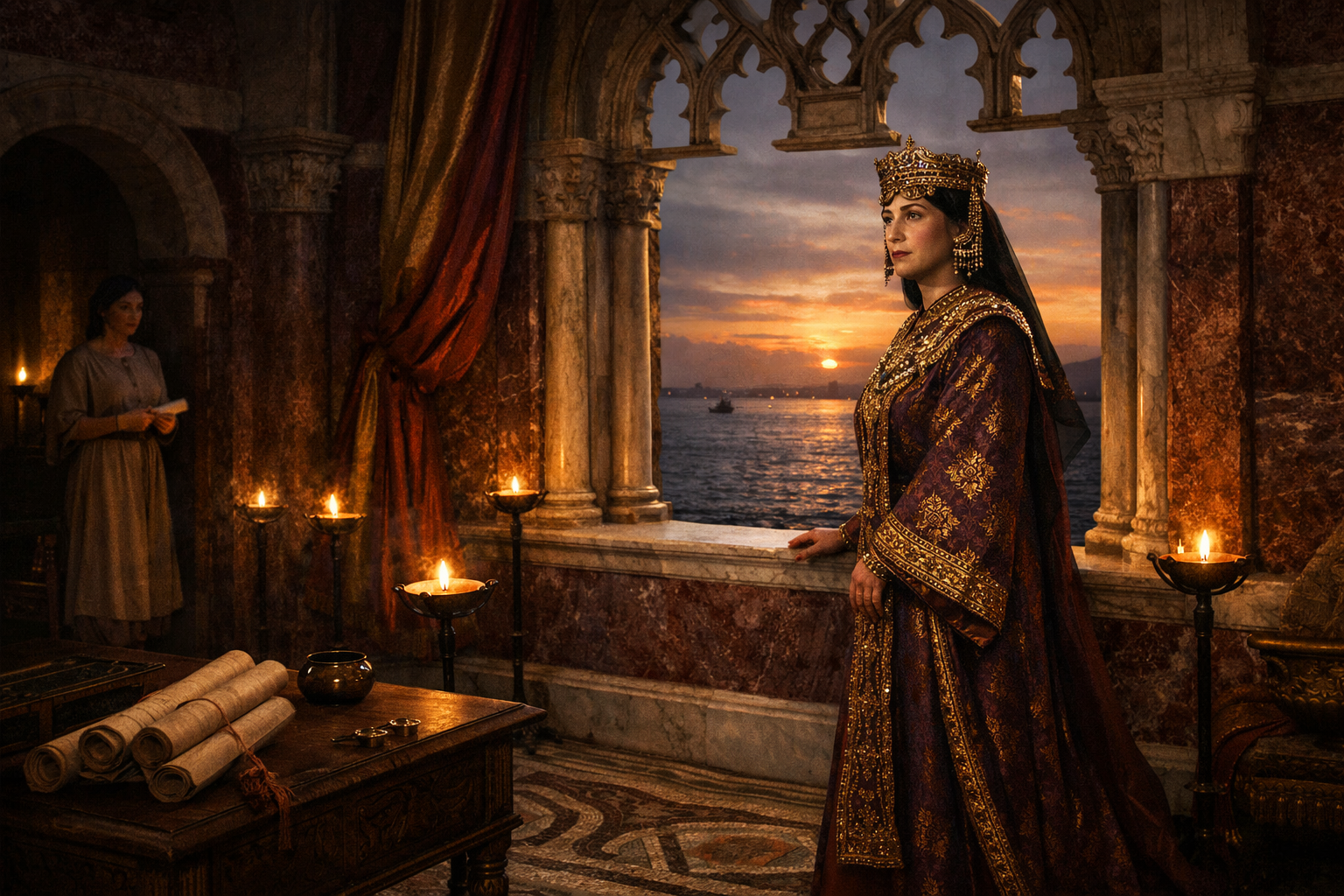
The heavy silk curtains rustled in the evening breeze as Empress Theodora gazed out from her private chambers in the Boukoleon Palace. Below her window, the waters of the Marmara Sea lapped against the imperial harbor's stone walls. Behind her, dozens of oil lamps cast dancing shadows across the walls of the gynaikonitis, the women's quarters where Byzantine empresses had wielded their influence for generations. Nearby, the Porphyra, the imperial birthing chamber lined with porphyry stone veneer, gave its name to the honored title "porphyrogenitus," meaning born in the purple, reserved for children born to a reigning emperor.
A servant entered quietly, bearing news that Emperor Justinian had fallen gravely ill with plague fever. Theodora's face remained impassive, though her mind raced. She had risen from humble origins to become the most powerful woman in the empire, and now her husband's illness threatened everything. The women's quarters had seen such moments before. It was here that empresses had shaped policy, arranged marriages, and sometimes seized power outright.
The room itself seemed to hold the whispered secrets of centuries: the plots of Pulcheria who had ruled as regent for her young brother Theodosius II, the schemes of Verina who had crowned her lover as emperor, the prayers of Ariadne who had chosen her own successor to the throne.
Theodora moved to her writing desk, where correspondence from across the empire awaited her attention. The flickering lamplight caught the gleam of her imperial seal ring, the symbol of her official authority. Her true power, though, lay in the networks she had built, the loyalty she commanded, and her mastery of the palace's intricate political machinery. From the gynaikonitis, she would ensure the empire's stability, with or without Justinian's direct rule.
The role of Byzantine empresses evolved significantly from the empire's founding in the 4th century. While Roman emperors' wives had held largely ceremonial positions, the Byzantine court developed elaborate protocols and offices that gave empresses real administrative and political power. They received their own coronation ceremony, minted coins bearing their image, and held the title "Augusta," equal in many ways to the emperor's "Augustus."
The gynaikonitis served as both living quarters and unofficial seat of power. Located in the sprawling Great Palace complex, it connected to both the ceremonial spaces where the empress received petitioners and the private imperial chapel. This arrangement allowed empresses to move between public and private spheres, conducting business through formal and informal channels alike.
By the 6th century, when Theodora rose to power, there was ample precedent for influential empresses. Pulcheria (399-453) had effectively ruled the Eastern Empire during her brother's minority and helped arrange the marriage that brought Marcian to the throne. Verina (d. 484) had been instrumental in several succession disputes after her husband Leo I's death. Ariadne (c. 450-515) had chosen both her husbands as emperors, ensuring stable transitions of power.
Byzantine succession was never strictly hereditary, which is what made this system necessary in the first place. An emperor could be chosen from any background, provided he had sufficient support from the army, senate, and people. That reality made marriage alliances and empress-led factions crucial to holding power across generations.
Main Narrative
When Theodora managed affairs during Justinian's plague illness in 542, the stakes were enormous, not just for her personally, but for the empire's ambitious program of reconquest and legal reform that she and Justinian had championed together. Procopius records that eastern-frontier generals, hearing reports that the emperor had died, began discussing potential successors, and that Theodora moved decisively to manage the crisis.
Through her trusted eunuch spies, she learned that some military commanders were already discussing potential successors. She sent messages to key allies in the senate, reminding them of past favors and promises. Within the palace itself, she ensured that access to the ailing emperor was strictly controlled, with only physicians and servants she personally trusted allowed near him.
From the women's quarters, Theodora orchestrated a careful display of continuity and strength. She continued to hold court, hearing petitions and issuing orders in Justinian's name. When the patriarch of Constantinople requested an audience to discuss the succession, she received him in full imperial regalia, making it clear that no such discussions were necessary.
Procopius, whose accounts of Theodora range from admiring to hostile depending on the work, nonetheless conveys throughout his writings the degree to which she exercised genuine authority alongside Justinian, managing factions and directing affairs with a political skill that contemporaries found remarkable. Rumors circulated in the city that the emperor was already dead and that the empress was concealing it, yet the machinery of government continued to function under her direction.
Justinian eventually recovered. The crisis had revealed, though, how effectively the machinery of imperial power could function under an empress's direction. Theodora had demonstrated that the women's quarters of the palace were a vital center of government.
Consequences and Impact
The precedent set by Theodora and other powerful empresses fundamentally shaped Byzantine political culture. Future emperors recognized that a capable empress was a co-ruler whose support could mean the difference between success and failure.
This system produced several notable advantages. It provided stability during transitions of power, as empresses often outlived their husbands and could ensure smooth successions. It gave the empire additional diplomatic flexibility, since empresses maintained their own networks of foreign contacts and could negotiate independently. Perhaps most importantly, it meant the empire benefited from the talents of exceptional women who might otherwise have been excluded from power entirely.
The gynaikonitis remained a crucial political space for centuries after Theodora. Empresses like Irene of Athens, Theodora (wife of Theophilos), and Zoe Porphyrogenita all used it as their base for exercising power, whether as regents, co-rulers, or sole monarchs.
In our next episode, we'll explore how these traditions of female power intersected with religious authority during the Iconoclast controversy. We'll see how empresses like Irene and Theodora became champions of icon veneration, leading the empire through one of its most turbulent theological disputes. The women's quarters of the palace would once again prove crucial as competing visions of orthodoxy clashed in the sacred palace.
Editor's Context
Read this episode through the Byzantine habit of adaptation. The empire repeatedly survived by changing its military, fiscal, religious, and diplomatic tools while insisting that it remained Roman. The date markers (527 CE, 399) are included because chronology is one of the easiest places for narrative history to become misleading. The episode's themes (history, empire, power) are the editorial lens for weighing cause and consequence rather than treating the story as isolated trivia.
Reviewed under the EmpiresDiary editorial workflow by Obadiah.
Drafted with AI. Accuracy review and corrections are ongoing — if you spot an error, please report it. See our workflow and editorial policy.