The Last Crusader Emperor
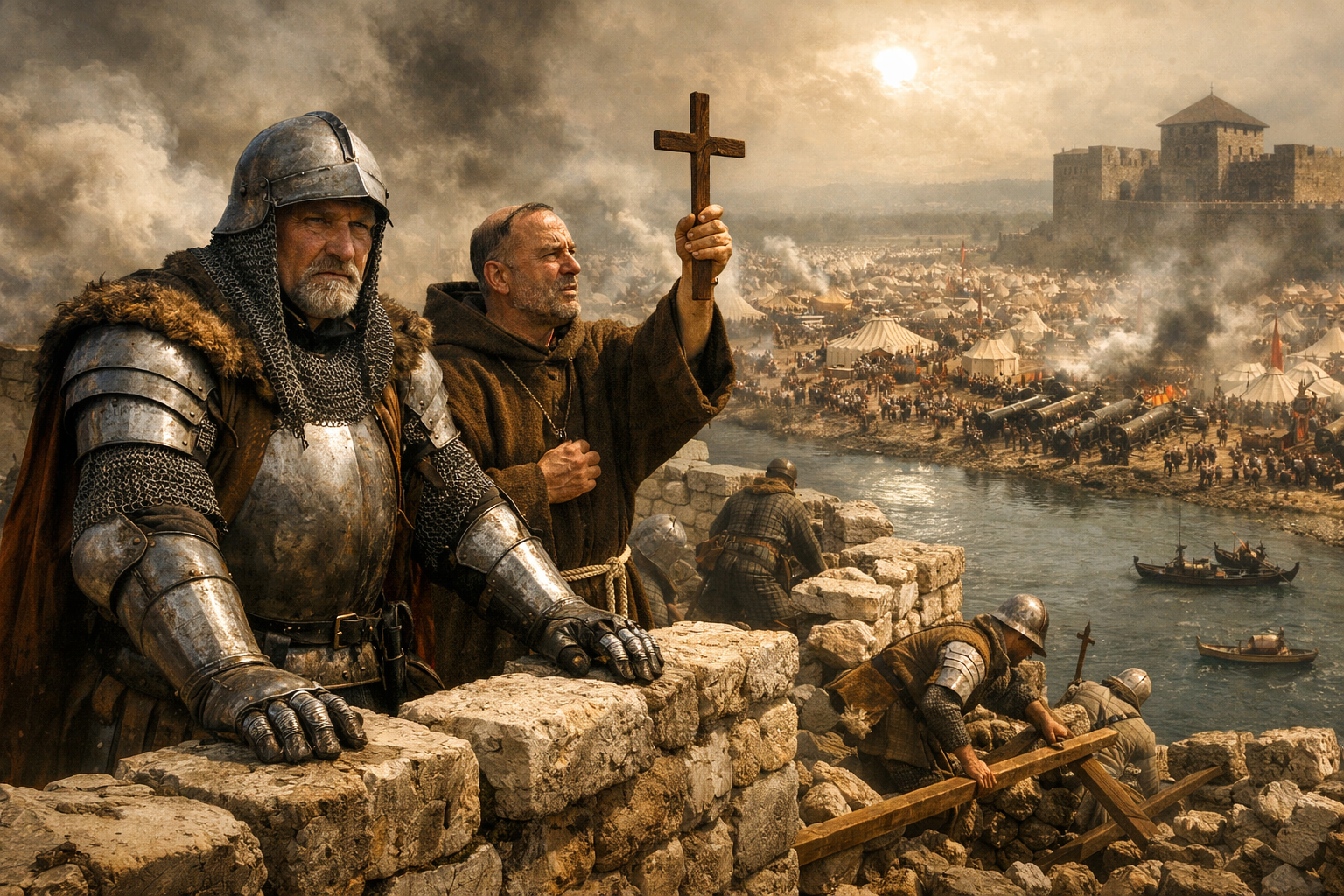
Belgrade, July 21, 1456
The summer sun beat mercilessly on the walls of Belgrade as Ottoman cannons shook the air. From the fortress battlements, John Hunyadi, the veteran commander of Hungarian forces, watched vast columns of Turkish troops stretching to the horizon. Sultan Mehmed II, fresh from his conquest of Constantinople just three years prior, had brought nearly 70,000 men and over 300 cannons to claim this vital stronghold on the Danube.
Hunyadi's weathered face betrayed no fear. He knew the gravity of the situation well enough. Belgrade was the key to Hungary, and Hungary was the gateway to Central Europe. If the fortress fell, there would be little to stop the Ottoman advance into the heart of Christendom. Around him, Serbian and Hungarian defenders worked feverishly to repair damaged walls while Franciscan friars led by John of Capistrano moved among the troops, offering prayers and encouragement.
The great Turkish bombards had been pounding the walls for weeks, their massive stone projectiles reducing sections to rubble. But Hunyadi had prepared well, strengthening the fortifications and assembling a flotilla of small riverboats on the Danube. As he watched the Ottoman guns firing in the distance, he knew the decisive moment was close.
Through years of fighting the Turks, Hunyadi had learned their tactics. He could see Sultan Mehmed's strategy unfolding: the systematic bombardment would continue until enough breaches were created for the Janissaries, the elite Ottoman infantry, to storm through. Hunyadi had a counter-plan, one that would require perfect timing and desperate courage.
The siege of Belgrade in 1456 came at a crucial moment in European history. The fall of Constantinople in 1453 had sent shockwaves through Christendom, marking the final end of the Byzantine Empire after 1,123 years. Sultan Mehmed II, now styled "The Conqueror," was determined to push his advantage and expand Ottoman power into Central Europe.
Hungary had emerged as the primary bulwark against that expansion. Since the late fourteenth century, the kingdom had developed a sophisticated system of frontier fortresses along its southern border, with Belgrade (called Nandorfehervár by the Hungarians) as its lynchpin. Hunyadi had risen from minor nobility to become Hungary's leading military commander and regent, spending decades fighting the Turks and understanding the existential threat they posed.
Pope Callixtus III had proclaimed a crusade in response to the Ottoman advance, but most European powers were too absorbed in their own conflicts to send significant aid. The burden of defense fell on Hungary, supported by Serbian troops who had fled their homeland after it fell to the Turks, along with a motley collection of crusaders inspired by the preaching of John of Capistrano. It was a thin coalition for such a large task.
The siege would prove to be a pivotal test of whether European Christianity could halt the seemingly unstoppable Ottoman advance that had already swallowed the Byzantine Empire whole.
The Battle Unfolds
The first phase of Hunyadi's counterattack began on July 14th, when his flotilla of small boats challenged the Ottoman naval blockade on the Danube. In a fierce river battle, the Christian ships, though outnumbered, broke through the Turkish lines. This victory allowed Hunyadi to reinforce the garrison and bring in much-needed supplies.
Mehmed II responded by ordering an intensification of the bombardment, focusing on the fortress's northern walls. By July 21st, several breaches had been created. The Sultan launched a major assault, and thousands of Janissaries surged forward as night fell, fighting their way into the outer fortifications.
The battle reached its crescendo in the early hours of July 22nd. Ottoman forces had penetrated the city's outer defenses and were fighting street by street toward the inner castle. It was at this moment that Hunyadi unveiled the masterstroke of his defense. While the Turks were occupied in street fighting, he gathered his heavy cavalry and veteran infantry for a desperate sortie from the fortress gates.
On a hillside overlooking the Ottoman positions, John of Capistrano had rallied thousands of common crusaders. As Hunyadi's professional soldiers struck outward, Capistrano's crusaders charged down the hill and caught the Turkish forces in a devastating pincer movement. The Ottoman troops, exhausted from hours of fighting and surprised by the counterattack's ferocity, began to waver.
Then came the turning point. Some of the crusaders managed to capture several Ottoman cannon and turn them against their former owners. Sultan Mehmed II himself was wounded in the chaos and briefly lost consciousness. As night turned to dawn, the Ottoman army fell into disarray and retreated, abandoning their siege equipment on the field.
Consequences and Impact
The successful defense of Belgrade had far-reaching consequences. The Ottoman advance into Central Europe was halted for seventy years, giving Hungary and other Christian powers crucial time to prepare their defenses. The victory was celebrated throughout Europe. Pope Callixtus III ordered church bells to be rung at noon in commemoration, a tradition that continues in some places to this day.
The triumph came at a great cost, though. Hunyadi died of plague weeks after the siege, in August 1456, and Capistrano succumbed to the same disease that October. Their deaths marked the end of an era in Hungarian history and the crusading movement's last great success.
Belgrade's defense preserved more than just Hungary. It helped protect the Byzantine legacy that had fled westward after Constantinople's fall. Scholars, artists, and religious figures who had escaped the Ottoman advance found refuge in Hungarian territories, contributing to the Renaissance that was beginning to flower in Central Europe. The ideas they carried with them didn't vanish when the empire did.
In the next episode, we'll explore how the Byzantine inheritance continued to shape European civilization after the empire's fall. We'll follow Greek scholars who found new homes in Italy and Hungary, bringing with them precious manuscripts and knowledge that helped fuel the Renaissance. The empire had fallen, but its spirit lived on in unexpected ways and places.
Editor's Context
Read this episode through the Byzantine habit of adaptation. The empire repeatedly survived by changing its military, fiscal, religious, and diplomatic tools while insisting that it remained Roman. The date markers (300, 1456) are included because chronology is one of the easiest places for narrative history to become misleading. The episode's themes (history, empire, power) are the editorial lens for weighing cause and consequence rather than treating the story as isolated trivia.
Reviewed under the EmpiresDiary editorial workflow by Obadiah.
Drafted with AI. Accuracy review and corrections are ongoing — if you spot an error, please report it. See our workflow and editorial policy.