The Purple Queen's Revenge
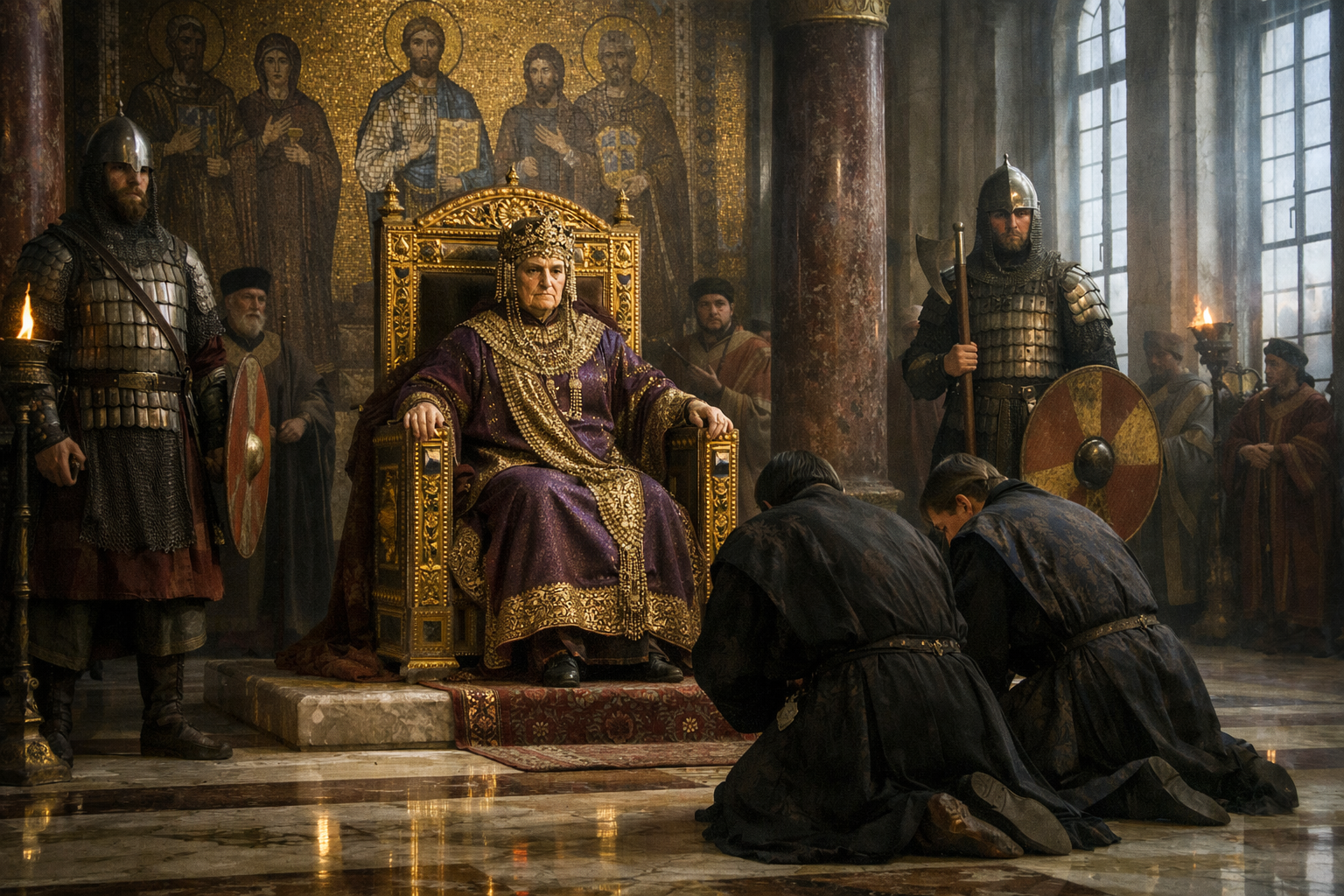
The Imperial Palace, Constantinople, Winter 1055
The marble halls of the Great Palace echoed with urgent footsteps as messengers rushed through its gilded corridors. Empress Theodora, last of the great Macedonian dynasty, sat rigid upon the throne she had only recently claimed as sole ruler. At roughly seventy-five years old, her face bore the stern determination that had kept her alive through decades of palace intrigues. Now, on this winter morning, she listened as her most trusted advisors delivered the news she had been expecting.
Word had reached the palace that certain noble families were quietly maneuvering to place a rival candidate, Nikephoros Proteuon, on the throne. The great aristocratic clans had grown increasingly powerful and restless, and they viewed the aging, unmarried Theodora as a temporary obstacle rather than a legitimate ruler.
Through the tall windows, the sounds of the city drifted across the palace grounds. Constantinople, so often the birthplace of riots and rebellions, was tense but outwardly calm. Theodora rose, her purple silk robes rustling. She had spent decades watching her sister Zoe's husbands rule and ruin the empire. Now, as the last legitimate heir of the Macedonian line, she would not allow a collection of ambitious aristocrats to steal her birthright. She spoke with quiet authority: "Summon the Varangian Guard. And send word to the themes closest to the city. I want loyal troops ready."
The Byzantine Empire of 1055 stood at a crucial turning point. The Macedonian dynasty, which had ruled since 867 CE, was approaching its end. The once-powerful empire still controlled vast territories, but cracks were showing. In the east, Turkish raiders pressed against the frontiers. In Italy, Norman adventurers were carving out territories. Most dangerously, the great noble families had grown increasingly powerful and restless.
The preceding decades had seen a parade of emperors rise and fall through marriage to the Macedonian princesses Zoe and Theodora. Zoe's three husbands, Romanos III, Michael IV, and Constantine IX, had each proven inadequate to the task of ruling. Theodora had served as co-empress alongside Zoe from 1042 until Zoe's death in 1050, and had then continued under Constantine IX until his death in January 1055, when she finally became sole empress regnant. With no direct male heir remaining, she was the empire's last hope for stable rule from within the dynasty.
The noble families saw their opportunity. The Doukas and Komnenos clans had built their power through military commands and vast estates in Anatolia. They viewed the aging, unmarried Theodora as their chance to finally place one of their own in the imperial seat. But they had underestimated the woman they dismissed as a mere placeholder.
The Main Narrative
As the weeks passed, the conspiracy around Nikephoros Proteuon failed to gain the momentum its backers had hoped for. Theodora moved with quiet efficiency rather than open confrontation. Her agents spread gold and promises among the guild leaders and neighborhood strongmen who truly controlled Constantinople's streets. The common people had no particular desire to see the last Macedonian empress displaced by an ambitious noble.
The Varangian Guard took up positions around the palace complex. These elite warriors were fanatically loyal to the imperial throne, not to any noble faction, and their presence made clear that any move against Theodora would carry a steep price.
The conspirators found their position weakening without a single battle being fought. Word spread that imperial forces remained firmly under palace control. The theme of Optimatoi, from just across the Bosphorus, stood ready. The plot to elevate Nikephoros Proteuon was forestalled bloodlessly, and the challenge to Theodora's authority dissolved before it could become an open crisis.
The noble leaders who had backed the scheme found themselves outmaneuvered. Theodora had no need for dramatic confrontations. She had simply made clear, through the steady application of imperial authority, that the throne was not available.
Consequences and Impact
Theodora's firm handling of the succession threat transformed Byzantine politics, at least for a time. The leading noble families saw their immediate ambitions checked. Some, like the Doukas clan, would eventually recover their influence. Others found their position diminished.
She also established new precedents for imperial authority. A professional bureaucracy took shape, one more dependent on imperial favor than on noble birth. She strengthened the theme system to reduce the power of great landowners. And she demonstrated, plainly, that a woman could rule in her own right rather than as a conduit for male power.
Her sole reign was notably vigorous. Contemporary observers remarked on her direct involvement in administration, her willingness to hear petitions personally, and her refusal to delegate core decisions to powerful ministers who might overshadow her. She governed as an active empress, not a figurehead.
When Theodora died in 1056, she left a stronger imperial system, though the empire would soon face new challenges. The noble families would eventually return to prominence. But never again would they show such open contempt for imperial authority during her lifetime.
In our next episode, we will examine how the end of the Macedonian dynasty led to new turmoil, as the empire searched for stability under the Komnenian emperors. The rise of the Seljuk Turks would present an existential threat, forcing Byzantium to reinvent itself once again. Join us as we explore how an empire adapted to survive in an increasingly hostile world.
Editor's Context
Read this episode through the Byzantine habit of adaptation. The empire repeatedly survived by changing its military, fiscal, religious, and diplomatic tools while insisting that it remained Roman. The date markers (1042, 1056) are included because chronology is one of the easiest places for narrative history to become misleading. The episode's themes (history, empire, power) are the editorial lens for weighing cause and consequence rather than treating the story as isolated trivia.
Reviewed under the EmpiresDiary editorial workflow by Obadiah.
Drafted with AI. Accuracy review and corrections are ongoing — if you spot an error, please report it. See our workflow and editorial policy.