The Iconoclast Emperor
Constantinople, 726 CE
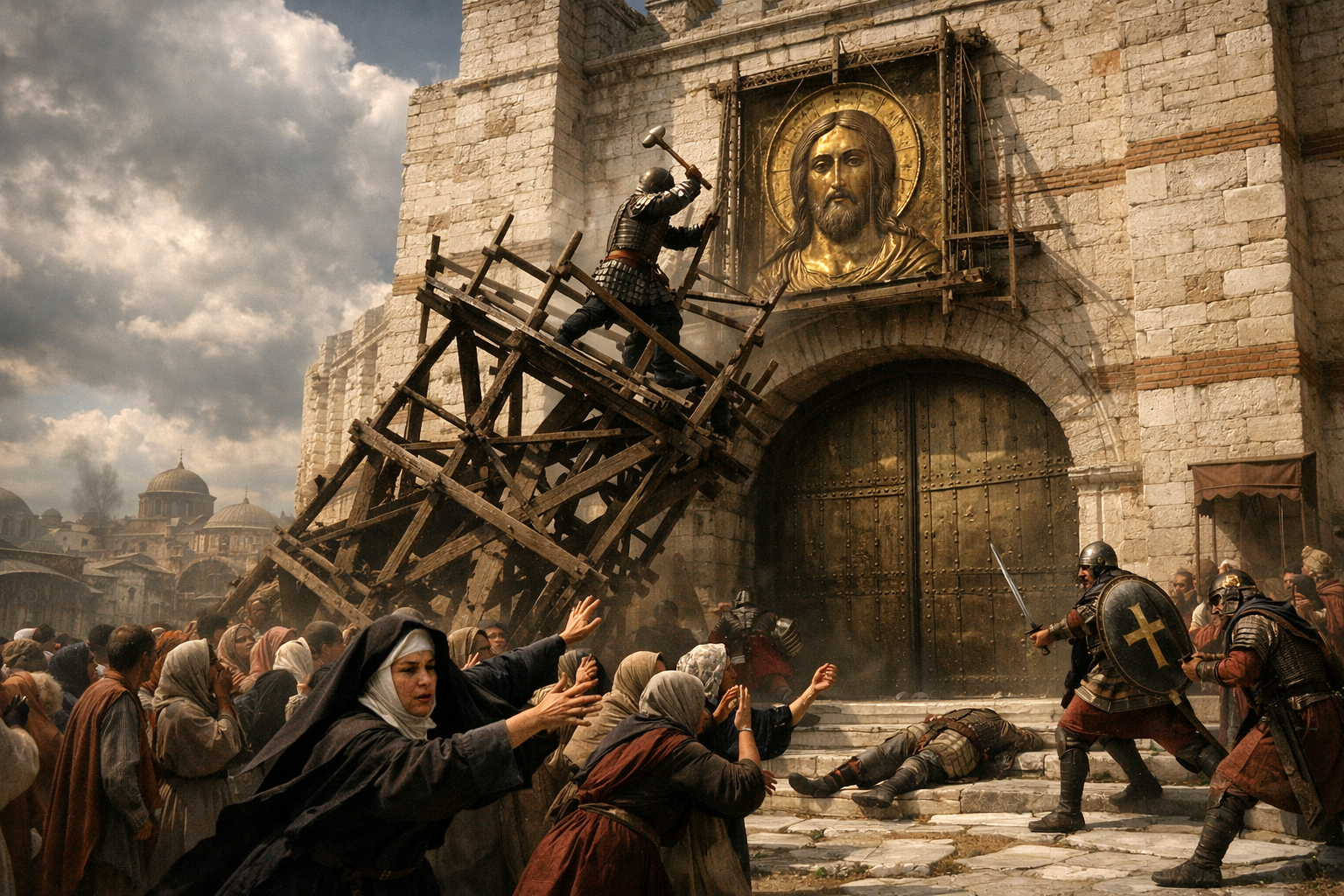
The summer air hung heavy over Constantinople as crowds gathered in the capital's main square, eyes fixed on the bronze figure of Christ that had stood above the Chalke Gate of the Great Palace for generations. Imperial scaffolding now surrounded the sacred image, and atop it stood a soldier carrying orders from Emperor Leo III himself.
The crowd watched in horror as the soldier raised his hammer. The first strike against the bronze face of Christ rang across the square like thunder. A collective gasp went up. An elderly woman fell to her knees, wailing prayers. Then came another blow, and another.
Suddenly a group of women surged forward from the crowd. Led by a determined nun, they rushed the scaffolding and toppled it with surprising force. The soldier tumbled down, his hammer clattering on the stones. As imperial guards moved in, the nun seized the fallen hammer and hurled it at the officer in charge, striking him dead.
The square erupted. Guards drew swords while citizens pelted them with stones and debris. Blood stained the white marble steps as riots spread through the streets. This was no mere protest. It was the beginning of a religious and political crisis that would tear the Byzantine Empire apart for over a century.
Within hours, word of the riot reached Emperor Leo III in his palace chambers. The former soldier who had clawed his way from humble origins to the imperial throne now faced a devastating choice: back down from his campaign against religious images, or risk civil war. As he gazed out over the smoke rising from his capital, Leo made his decision. The icons would have to go, no matter the cost.
The controversy over religious images had been simmering for decades before it finally exploded in 726 CE. The Byzantine Empire, heir to Roman power in the East, had built a deep tradition of religious art. Icons depicting Christ, Mary, and the saints had become central to public worship and private devotion alike, adorning church walls, homes, and public spaces throughout the empire.
A growing movement, though, questioned these practices. Critics pointed to the Biblical commandment against graven images and worried that icon veneration had crossed into idolatry. The debate gained political urgency as the empire faced existential threats: Muslim armies had conquered much of Byzantium's territory in the 7th century, and some wondered whether God was punishing them for straying from true worship.
Leo III, who ruled from 717 to 741, came to believe that icons were indeed a form of idolatry. Having successfully defended Constantinople from an Arab siege in 718, he saw himself as divinely appointed to purify the Christian faith. His military background made him comfortable with using force to achieve that goal.
The empire Leo inherited was already fractured, divided between the Greek-speaking East and the Latin West, between monks and secular clergy, between urban and rural populations. The icon controversy deepened every one of those fractures, producing a century of intermittent civil conflict known as the Iconoclast Period (726-843 CE).
The Great Debate Unfolds
The iconoclast ("icon-breaking") movement gathered momentum under Leo III and his son Constantine V (741-775). Imperial edicts ordered the destruction of religious images across the empire. Monks and nuns, the strongest defenders of icons, faced persecution. Many were imprisoned, exiled, or executed.
The conflict played out on several levels at once:
Theological Arguments:
- Iconoclasts argued that any depiction of Christ was either inadequate, since it could only show his human nature, or heretical, if it claimed to capture his divine nature.
- Icon defenders, led by John of Damascus, countered that since God became visible in Christ's incarnation, he could legitimately be depicted in art. They drew a firm line between the veneration of icons and the worship of God alone.
Political Dimensions:
- Emperors saw iconoclasm as a tool for asserting control over the wealthy monasteries and tightening imperial authority.
- The papacy in Rome strongly opposed iconoclasm, widening the already serious rift between East and West.
- Arab Muslims and Jewish communities within the empire generally supported iconoclasm, a position that aligned with their own religious traditions.
Social Impact:
- Families were torn apart as members chose opposing sides.
- Artists and craftsmen lost their livelihoods when religious art was banned.
- A vast amount of cultural heritage was destroyed, including mosaics, frescoes, and manuscripts.
The tide began to turn in 780 when Constantine VI became emperor under the regency of his mother, Irene. A committed supporter of icons, Irene convened the Second Council of Nicaea in 787, which condemned iconoclasm and restored the veneration of images. The controversy, however, was far from finished.
Consequences and Legacy
The impact of the iconoclast controversy reached well beyond its immediate religious dimensions:
-
Political: The conflict weakened imperial authority and accelerated the empire's rupture with Rome, contributing to the eventual Great Schism between Eastern and Western Christianity.
-
Cultural: When icon veneration was restored in 843 under Empress Theodora, in the event the Church calls the "Triumph of Orthodoxy," Byzantine art entered a new golden age. Countless masterpieces from the pre-iconoclast period were gone forever, though.
-
Religious: The Orthodox Church emerged with a more clearly defined theology of images that continues to shape Eastern Christianity today. The annual celebration of the Triumph of Orthodoxy remains an important feast day.
-
Social: The controversy demonstrated the power of popular resistance to imperial authority and exposed the influential role of women in Byzantine society, from the riot-leading nun in 726 to the empresses who restored icon veneration a century later.
As the 9th century progressed, the Byzantine Empire entered a period of renewed strength and cultural flowering known as the Macedonian Renaissance. The scars of the iconoclast controversy didn't vanish, though, and new challenges were already forming. A resurgent Bulgaria pressed from the north, and internal political intrigues threatened the empire's hard-won stability.
In our next episode, we'll explore how the Macedonian dynasty restored Byzantium's fortunes and pushed its influence deep into the Slavic world, even as relations with the Latin West continued to deteriorate.
Editor's Context
Read this episode through the Byzantine habit of adaptation. The empire repeatedly survived by changing its military, fiscal, religious, and diplomatic tools while insisting that it remained Roman. The date markers (718, 741) are included because chronology is one of the easiest places for narrative history to become misleading. The episode's themes (history, empire, power) are the editorial lens for weighing cause and consequence rather than treating the story as isolated trivia.
Reviewed under the EmpiresDiary editorial workflow by Obadiah.
Drafted with AI. Accuracy review and corrections are ongoing — if you spot an error, please report it. See our workflow and editorial policy.