The Purple Queen's Gambit
A Mother's Calculated Move
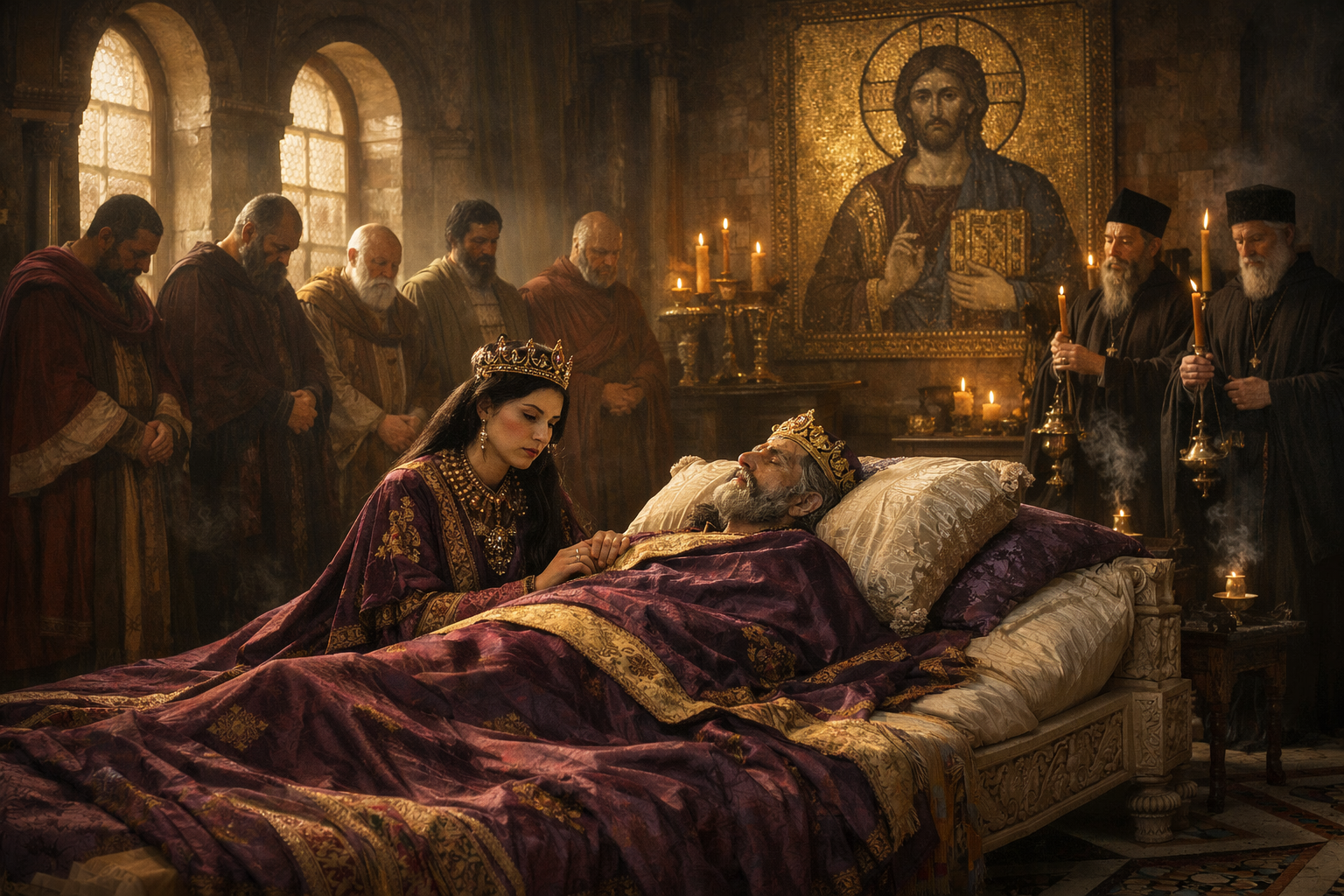
The imperial palace in Constantinople hummed with tension on a crisp autumn morning in 780 CE. Empress Irene knelt beside the deathbed of her husband, Emperor Leo IV, her face a carefully composed mask of grief. At just 28 years old, she was about to become the most powerful woman in the Byzantine Empire, but only as regent for her nine-year-old son, Constantine VI. As court officials filed in to witness Leo's final moments, Irene's mind was already racing with plans that would reshape the empire.
The Athenian-born empress had always been different from her predecessors. Blessed with extraordinary beauty and an even sharper intellect, she had spent years threading through the treacherous currents of Byzantine court politics since arriving as a teenage bride. Now, watching her husband draw his last breath, she knew the real challenge was about to begin. The empire's powerful iconoclast faction, those who opposed the veneration of religious images, had dominated policy for decades. They would expect her to maintain their stance as regent.
She had other ideas. As the palace erupted into formal mourning rituals, she retreated to her chambers with her most trusted advisors. The empire was about to experience a dramatic transformation, one that would pit mother against son and shake the foundations of Byzantine society. What no one yet realized was that this widow in purple silk had no intention of serving as a temporary regent and then stepping aside.
An Empire Divided
By 780 CE, the Byzantine Empire had been torn apart for over half a century by the iconoclastic controversy. Emperor Leo III had banned religious images in 730 CE, believing they promoted idolatry. This policy, continued by his son Constantine V and grandson Leo IV, had created deep divisions in Byzantine society. The iconoclasts controlled the army and much of the aristocracy, while monasteries and many common people clung to their beloved icons.
External threats pressed in from every direction. The powerful Abbasid Caliphate pushed against the eastern frontiers, while Bulgars raided from the north. The loss of Italy to the Lombards and the rise of Charlemagne's Frankish kingdom in the West had severely reduced Byzantine influence in Europe, and the economy was strained by constant warfare and internal strife.
Into this volatile situation stepped Irene, an outsider from Athens chosen as Leo IV's bride for her beauty and intelligence. Though raised in a family that secretly venerated icons, she had carefully concealed her true religious sympathies throughout her husband's reign. Now, as regent for young Constantine VI, she saw an opportunity to reverse decades of iconoclast policy. Doing so would require every ounce of her political skill, and a fair measure of ruthlessness.
The Power Play Unfolds
Irene's first moves were subtle but decisive. She began appointing icon-supporters (iconodules) to key positions while gradually sidelining iconoclast officials. Her most crucial ally was Tarasius, whom she appointed as Patriarch of Constantinople in 784 CE. Together, they planned a church council to restore icon veneration.
The army posed the greatest threat. In 786 CE, her first attempt to convene a council in Constantinople collapsed when iconoclast soldiers disrupted the proceedings. Undeterred, she devised a clever solution: announcing a campaign against the Arabs, she moved the iconoclast troops out of the capital, then quickly disbanded them and formed new units loyal to her.
The Second Council of Nicaea in 787 CE marked Irene's greatest triumph. With papal legates present, the council reversed the iconoclast policies and restored the veneration of images. But this victory came at a price. Tension with her son Constantine VI, now a teenager eager to rule in his own right, was growing fast.
The relationship between mother and son deteriorated rapidly. In 790 CE, Constantine attempted to seize power with the support of some military units. Irene suppressed the revolt but was briefly forced to step aside. By 792 CE she had regained her position as co-ruler, yet the power struggle ground on. In 797 CE she made her most shocking move, ordering her own son's blinding. It was a traditional Byzantine method of disqualifying someone from the throne, and the deed was carried out in the very chamber where Constantine had been born. He died shortly afterward.
A Woman in a Man's World
Irene now ruled alone, the first woman to do so in Byzantine history. She styled herself "Basileus" (Emperor) rather than "Basilissa" (Empress), appearing on coins in male regalia. Her reign brought significant changes: peace with the Abbasids and reduced taxation, along with generous patronage of monasteries and churches. She even explored a potential marriage alliance with Charlemagne that might have reunited the Roman Empire.
Her position remained precarious, though. The blinding of her son had shocked many, and her policies had created powerful enemies. In 802 CE, a conspiracy of officials and nobles deposed her, installing the finance minister Nikephoros as emperor. Irene was exiled to Lesbos, where she died the following year.
Lasting Impact
Irene's reign left an indelible mark on Byzantine history. Her restoration of icon veneration ended the first phase of iconoclasm and shaped Byzantine art and spirituality for centuries to come. The schism she helped heal between Constantinople and Rome would hold for nearly three centuries before new conflicts tore it open again.
Her rule also set important precedents for women in power, though it would be centuries before another woman ruled Byzantium in her own right. The violent end of Constantine VI marked the close of the Isaurian dynasty and demonstrated the brutal supremacy of imperial power over family ties.
As Nikephoros I took the throne in 802 CE, he inherited an empire transformed by Irene's policies. The next episode will explore how he and his successors dealt with new challenges: mounting pressure from the Bulgars, the rise of Charlemagne's empire in the West, and the continuing struggle to maintain Byzantine power in an increasingly hostile world.
Editor's Context
Read this episode through the Byzantine habit of adaptation. The empire repeatedly survived by changing its military, fiscal, religious, and diplomatic tools while insisting that it remained Roman. The date markers (784 CE, 730 CE) are included because chronology is one of the easiest places for narrative history to become misleading. The episode's themes (history, empire, power) are the editorial lens for weighing cause and consequence rather than treating the story as isolated trivia.
Reviewed under the EmpiresDiary editorial workflow by Obadiah.
Drafted with AI. Accuracy review and corrections are ongoing — if you spot an error, please report it. See our workflow and editorial policy.