From Shepherd to Sultan: The Rise of Osman
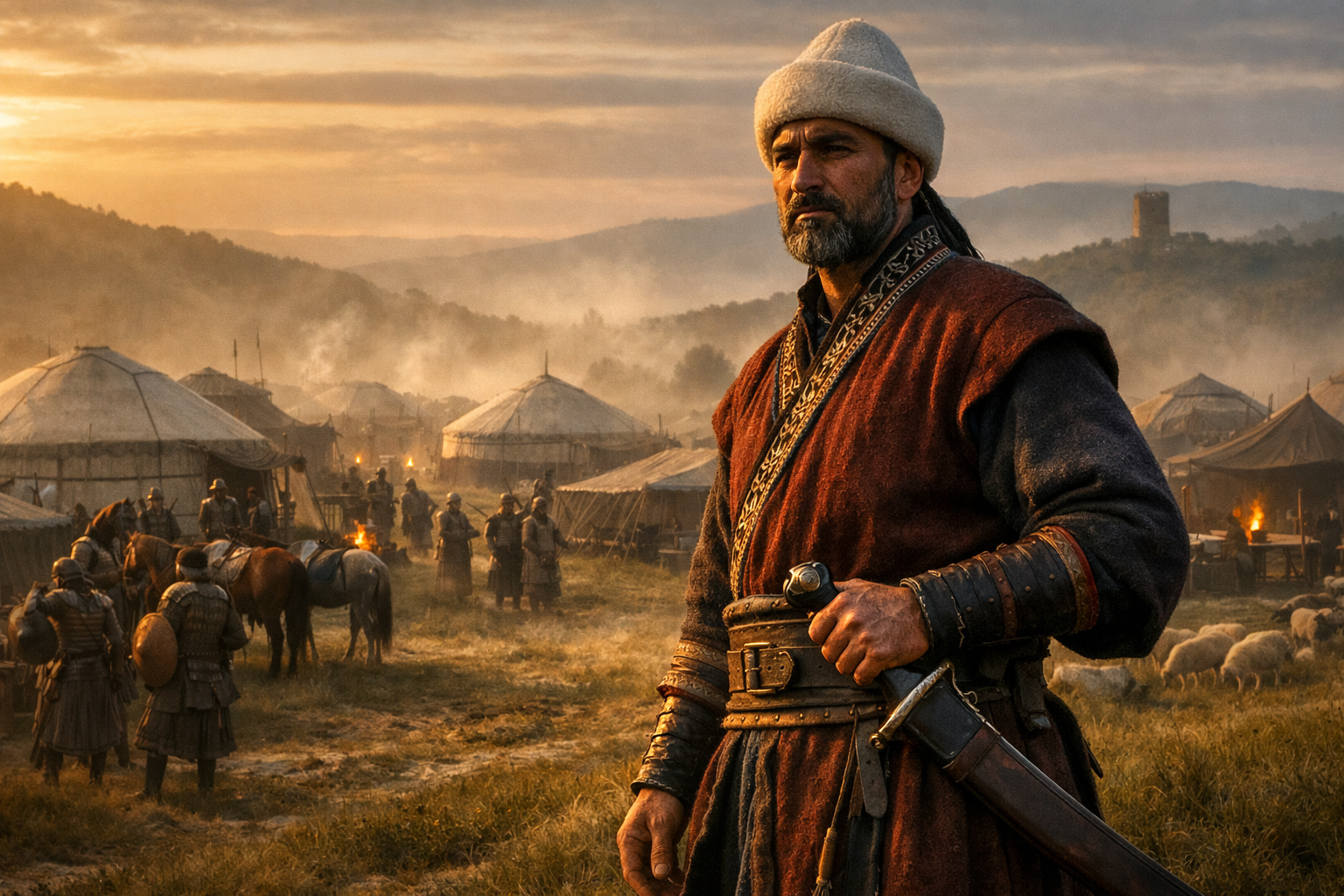
The Söğüt Plains, 1299 CE
The morning mist clung to the rolling hills of western Anatolia as Osman Bey stood at the edge of his camp, one weathered hand resting on the pommel of his curved sword. Before him stretched the fertile plains of Söğüt, where his people's sheep grazed alongside their horses. Behind him the camp was waking up: hammers rang on anvils, livestock bleated, and the calls to morning prayer carried across the settlement.
At forty-one, Osman's face bore the marks of a lifetime in the saddle. Sun-darkened skin, keen eyes that never stopped moving across the horizon. His people, the Kayı tribe, were frontier warriors operating in the dangerous borderlands between the declining Byzantine Empire and the various Turkish beyliks (principalities) that had emerged from the collapse of the Seljuk Sultanate.
This morning was different. Word had arrived that Byzantine forces were gathering near the fortress of Bilecik, preparing to challenge his authority in the region. For years Osman had been expanding his control through raids, alliances, and careful diplomacy. Some local Christians had accepted his protection, appreciating his tolerance and fair governance. Others, particularly the Byzantine authorities, saw him as a dangerous upstart who needed to be crushed.
As his warriors assembled, a mix of Turkish ghazis (religious warriors), local allies, and Christian converts, Osman recalled the dream that had set him on this path. Years earlier he had seen a vision of a great tree growing from his body, its branches spreading across three continents. A crescent moon had risen from his chest and expanded until it covered the world. The local holy man, Sheikh Edebali, had interpreted this as a divine sign that Osman's descendants would rule a great empire.
Now, standing on the edge of his first major confrontation with Byzantine power, Osman offered a silent prayer. He couldn't have known how completely that dream would come true.
Anatolia in Transition
The late thirteenth century was a time of profound change in Anatolia. The Byzantine Empire, which had ruled these lands for nearly a millennium, was in serious decline. The Fourth Crusade's sack of Constantinople in 1204 had delivered a blow from which Byzantium never fully recovered, and the Mongol invasion of the 1240s had shattered the Seljuk Sultanate of Rum, opening a power vacuum across central and western Anatolia.
Into that fractured landscape stepped numerous Turkish beyliks, each carving out territory along the Byzantine frontier. The Kayı tribe, led by Osman's father Ertuğrul, had received land grants from the Seljuk Sultan in exchange for service as frontier warriors. These tribes brought with them a dynamic military tradition built on horsemanship, archery, and raid-based warfare known as "gaza."
The political situation defied easy categories. Byzantine control had contracted to fortified cities and towns, while the countryside was a patchwork of competing authorities. Local Greek Christians, Armenian communities, and Turkish Muslims lived side by side, sometimes in conflict, sometimes in cooperation. Fluid loyalties and practical arrangements mattered far more than rigid religious or ethnic lines.
Osman built his rise on exactly that fluidity. He understood the importance of incorporating local populations rather than simply raiding them. He offered protection to Christian villages that accepted his authority, appointed local Christians to administrative positions, and formed marriage alliances with Byzantine nobles. This pragmatic approach would become a defining feature of Ottoman governance for generations.
The Making of a Dynasty
Osman's transformation from tribal leader to empire-founder unfolded through calculated moves and decisive battles. When he declared independence from the declining Seljuk Sultanate in 1299, his territory was modest, centered on Söğüt and a handful of surrounding settlements. His timing, though, was sharp, and his strategy sharper.
His first major victory came at Bilecik that same year. Byzantine forces had gathered there to check his growing power. He didn't meet them in open battle. Instead, he sent word that he was holding a wedding celebration and invited the Byzantine garrison commander. When the Byzantine leaders arrived at the supposed festivities, Osman's warriors ambushed and captured them, taking the fortress with minimal bloodshed.
Bilecik opened the door. Local Turkish warriors, seeing his success, began rallying to his banner. Byzantine defectors, impressed by his leadership and his tolerance, brought valuable knowledge of fortress warfare and administration. His forces grew from a few hundred mounted warriors to thousands of trained soldiers.
The Byzantine historian George Pachymeres recorded that Osman was seen as particularly dangerous because he combined military skill with political acumen. Other Turkish raiders plundered and moved on. Osman established permanent control over conquered territories and built a functioning state structure behind him.
Local Christian communities showed a divided reaction. Some, exhausted by Byzantine taxation and ineffective protection, accepted his authority without much resistance. Others, especially the wealthy urban elite, fought back hard. The general picture that emerges from the period is one of a population caught between two worlds, uncertain whether Osman represented a new order worth accepting or a threat to be resisted.
By 1302, Osman had achieved another crucial victory at Bapheus, defeating a Byzantine army sent by Emperor Andronikos II and commanded in the field by George Mouzalon. It was the first time his forces had beaten a major Byzantine field army in the open. After that, no one could dismiss him.
The Impact: Foundations of an Empire
The principles Osman established during his reign shaped Ottoman governance for centuries. Religious tolerance, pragmatic incorporation of local elites, and a careful balance between Islamic tradition and local custom became cornerstones of imperial administration. His successors inherited not just territory but a method.
That method drove a relentless westward pressure on Byzantine power, one that wouldn't stop until the final conquest of Constantinople in 1453. His descendants would rule one of the world's most powerful empires for over 600 years, holding territories across three continents. The ghazi warriors he had relied on so effectively evolved into the famous Ottoman military system. His habit of appointing capable people regardless of their origin laid the groundwork for the Ottoman meritocratic tradition, which later drew strength from converted Christians through the devşirme system.
Osman died in 1323/24 and passed leadership to his son Orhan, who continued and expanded his father's work. The next chapter follows Orhan's transformation of his father's frontier principality into a more sophisticated state, setting the stage for the Ottoman push into the Balkans. The dream of a world-spanning empire was beginning to take shape, but the greatest challenges and triumphs still lay ahead.
Editor's Context
Read this episode as a study in imperial administration as much as conquest. Ottoman power depended on frontier politics, fiscal systems, elite bargains, and the ability to absorb local complexity. The date markers (1299, 1204) are included because chronology is one of the easiest places for narrative history to become misleading. The episode's themes (history, empire, power) are the editorial lens for weighing cause and consequence rather than treating the story as isolated trivia.
Reviewed under the EmpiresDiary editorial workflow by Obadiah.
Drafted with AI. Accuracy review and corrections are ongoing — if you spot an error, please report it. See our workflow and editorial policy.