The Dance of Diplomacy and War: The Treaty of Karlowitz, 1699
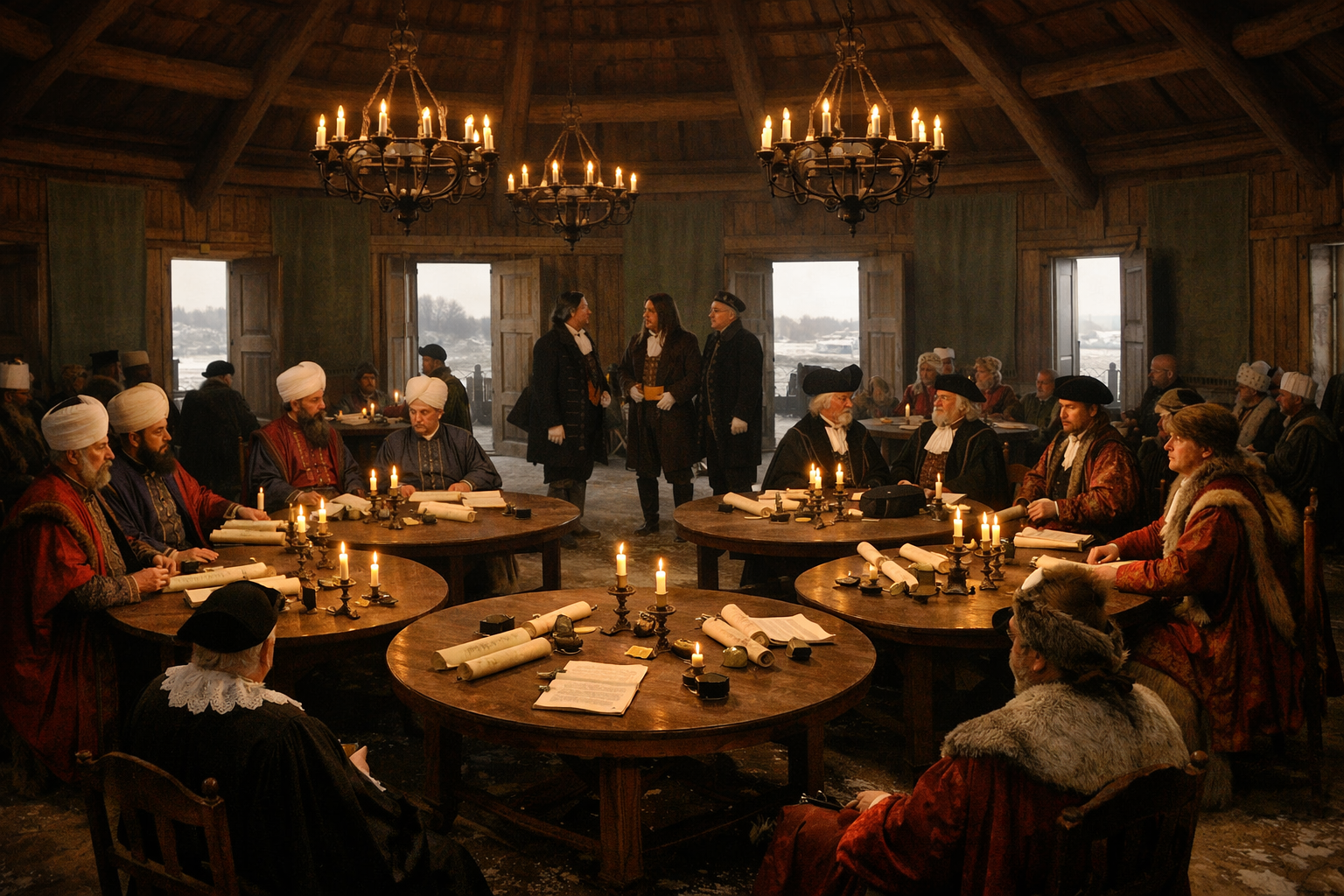
January 26, 1699, Karlowitz (Modern-day Sremski Karlovci, Serbia)
The winter wind howled across the snow-covered plains of Syrmia as the Ottoman delegation approached the wooden pavilion specially constructed for the peace negotiations. The circular building had multiple entrances arranged like points on a compass, each door positioned so that representatives of the various powers could enter simultaneously. No nation would suffer the indignity of entering behind another. The Ottoman Empire, Habsburg Austria, Venice, Poland-Lithuania, and Russia would all cross the threshold at once.
Inside, five identical tables formed a perfect circle, with identical chairs and writing implements at each station. The walls were hung with neutral tapestries, carefully chosen to avoid any religious or political symbolism that might offend the assembled dignitaries.
The Ottoman delegation was led on the ground by Reisülküttab Rami Mehmed Efendi and the Phanariot dragoman Alexander Mavrocordato. Grand Vizier Amcazade Hüseyin Pasha remained at Belgrade with the remnants of the army, in case negotiations broke down, directing the delegation from a distance. For the first time in its history, the Ottoman Empire was entering peace negotiations not as the dominant power dictating terms, but as a defeated party forced to make concessions.
The British and Dutch mediators took their positions in the center of the room as the delegates settled in. The scene was unprecedented. The mighty Ottoman Empire, which had once threatened the gates of Vienna itself, was now participating in a European-style peace congress, accepting principles of international diplomacy that had previously been foreign to Ottoman statecraft.
The loss at the Second Battle of Mohacs in 1687, the fall of Belgrade in 1688, and the crushing defeat at Zenta in 1697 had shattered Ottoman military supremacy in southeastern Europe.
The Treaty of Karlowitz marked a pivotal turning point in Ottoman history, representing the first major territorial losses for an empire that had been expanding for nearly four centuries. The road to this moment had begun with the failed Siege of Vienna in 1683, when Grand Vizier Kara Mustafa Pasha's armies were routed by a coalition of European forces led by Polish King John III Sobieski.
That defeat triggered the formation of the Holy League, a rare alliance between the Habsburg Empire, Poland-Lithuania, Venice, and Russia (initially joined as the Tsardom of Muscovy), blessed by Pope Innocent XI. The League launched a sustained campaign against Ottoman territories in Europe, known as the Great Turkish War (1683-1699).
The Ottoman military machine, once the most feared in Europe, had shown its vulnerabilities. The empire's traditional structure, built on the Janissary corps and the timar system, had failed to keep pace with European military innovations. While European armies had embraced new technologies and tactics during the Military Revolution of the 17th century, the Ottomans had changed little since their golden age under Suleiman the Magnificent. The gap had become impossible to ignore.
The empire's economic foundation was also under severe strain. The influx of American silver into European markets had caused inflation throughout Ottoman territories, and the discovery of new trade routes had cut into the empire's control over traditional east-west commerce. These pressures limited the Ottomans' ability to maintain their military edge and defend their vast holdings.
Sultan Mustafa II had personally led Ottoman forces in several campaigns and had been forced to acknowledge that the empire could no longer match its European rivals in the field. The defeat at Zenta in 1697, where the Sultan himself had barely escaped capture, made a negotiated peace the only viable path forward.
The Great Negotiation
The negotiations at Karlowitz represented a dramatic shift in Ottoman diplomatic practice. Traditionally, the empire had dealt with European powers through unilateral declarations, maintaining the fiction of Ottoman superiority. Now they were engaged in complex multilateral talks on an equal footing with their Christian adversaries.
The British and Dutch mediators, William Paget and Jakob Colyer, played crucial roles in bridging the cultural and diplomatic gaps between the parties. They had to work through not only the territorial demands of each power but also intricate questions of protocol and precedence that could easily derail the proceedings.
The Ottoman delegation was led by Rami Mehmed Efendi, working alongside Alexander Mavrocordato, under the direction of Hüseyin Pasha at Belgrade. The Habsburg Empire, represented by Count Wolfgang von Ottingen, demanded the return of Hungary and Transylvania. The Venetians, through their envoy Carlo Ruzzini, sought to secure their conquests in Dalmatia and the Morea (Peloponnese). Polish diplomat Stanislaw Malachowski pressed for the return of Podolia and parts of Ukraine.
Russia's position complicated things further. Tsar Peter I's representative, Prokopy Voznitsin, maintained a harder line than the other Christian powers, reflecting Russia's emerging ambitions as a major European force. His demands centered on the fortress of Azov and access to the Black Sea.
Over two months of intense discussion, the Ottoman delegates employed tactical delays and attempted to play their opponents against each other. Their position was fundamentally weak, though, and they could not prevent the loss of significant territories.
The final agreement, signed on January 26, 1699, resulted in the Ottoman Empire ceding:
- All of Hungary (except for the Banat of Temesvar) and Transylvania to the Habsburgs
- Podolia and Right-bank Ukraine to Poland-Lithuania
- The Morea and most of Dalmatia to Venice
- Azov to Russia (in a separate treaty signed in 1700)
Consequences and Impact
The Treaty of Karlowitz marked the beginning of the Ottoman Empire's long decline as a European power, setting precedents that would shape Ottoman relations with Europe for the next two centuries.
First, it established that the Ottomans could no longer dictate terms to European powers and would have to engage in modern diplomatic practices. The empire would increasingly find itself drawn into the European state system, participating in conferences and accepting the principle of diplomatic reciprocity.
Second, the territorial losses produced a psychological shift within Ottoman society and administration. The myth of Ottoman invincibility was shattered, prompting the first serious attempts at military and administrative reform, known as the "Tulip Period" reforms under Ahmed III.
The treaty also established a pattern of territorial loss that would continue until the empire's final dissolution in the 20th century. The Ottoman Empire would increasingly be known as the "sick man of Europe," struggling to hold its remaining territories against external pressures and internal nationalist movements alike.
As the delegates departed from Karlowitz, they left behind more than a peace treaty. They had witnessed the opening of a new era in Ottoman history. The next episode will explore how the empire attempted to adapt to its diminished status through the reforms of the Tulip Period, as Ottoman elites sought to understand and selectively adopt European innovations while maintaining their Islamic and Turkish identity. The stage was set for a century of transformation and challenge.
Editor's Context
Read this episode as a study in imperial administration as much as conquest. Ottoman power depended on frontier politics, fiscal systems, elite bargains, and the ability to absorb local complexity. The date markers (1697, 1699) are included because chronology is one of the easiest places for narrative history to become misleading. The episode's themes (history, empire, power) are the editorial lens for weighing cause and consequence rather than treating the story as isolated trivia.
Reviewed under the EmpiresDiary editorial workflow by Obadiah.
Drafted with AI. Accuracy review and corrections are ongoing — if you spot an error, please report it. See our workflow and editorial policy.