The Battle of Lepanto, 1571
Dawn Over the Gulf of Patras
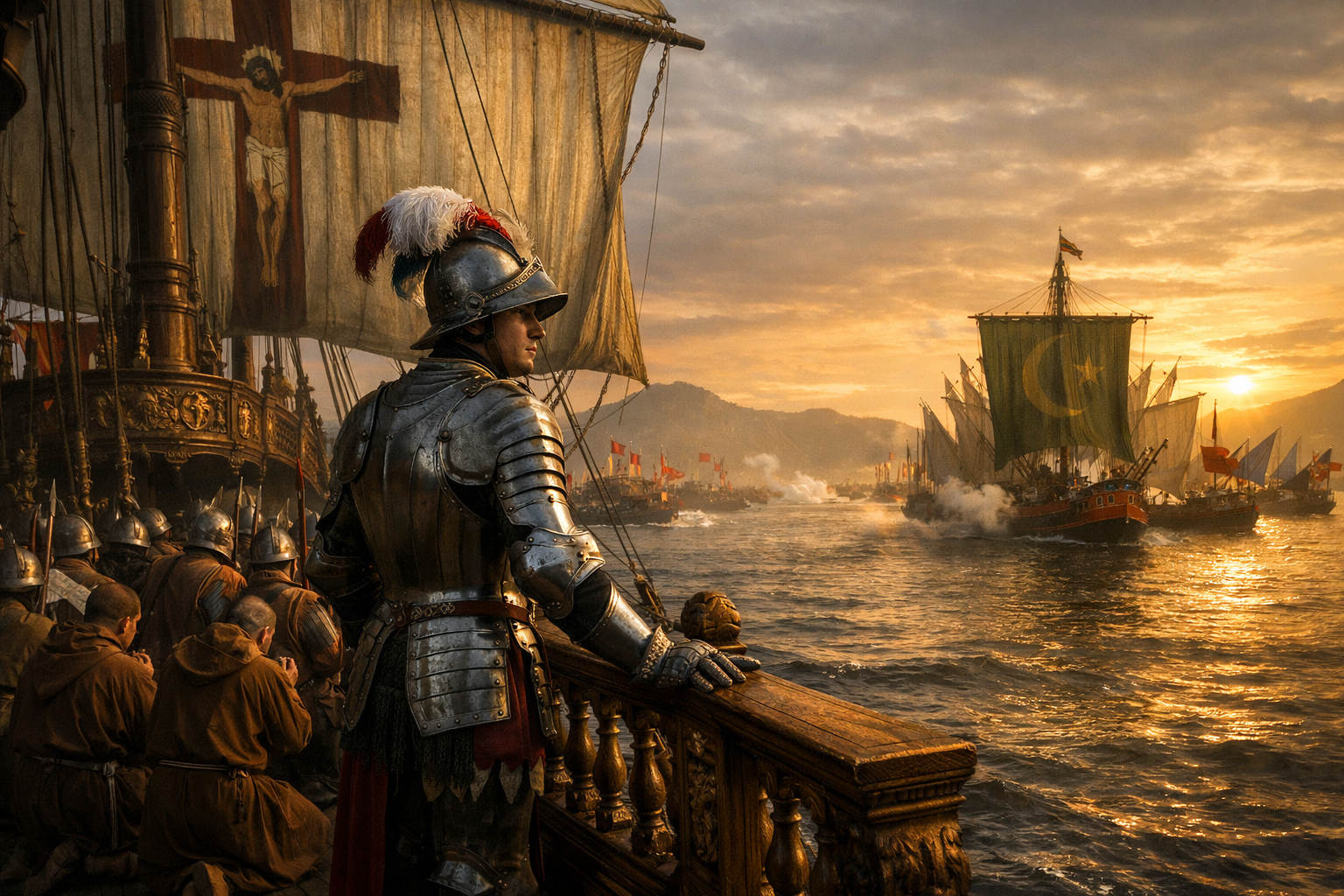
The morning of October 7, 1571, broke with an eerie calm over the Gulf of Patras. As the sun rose over the Greek coastline, two massive fleets emerged from the mist: nearly 500 ships carrying over 150,000 men, the largest naval engagement Europe had seen in centuries. The Ottoman fleet under Ali Pasha advanced under crescent banners. Opposite them, the Holy League's ships under Don John of Austria bore the cross of Christianity.
Aboard his flagship, the Real, Don John stood at the helm, his armor catching the morning light. At just 24 years old, the illegitimate son of Emperor Charles V carried the hopes of Christian Europe on his shoulders. Across the water, the Ottoman galleys were already moving into their characteristic crescent formation, a tactic that had delivered victory after victory across the Mediterranean.
Ali Pasha watched from his massive flagship, the Sultana, with something close to confidence. The Ottomans had ruled these waters for decades, their corsairs striking fear into coastal communities from Spain to Venice. From his mainmast flew the great green Banner of the Caliphs, embroidered in gold with the name of Allah some 28,900 times. As the fleets closed to within a few miles of each other, cannon fire broke the morning silence.
Thousands of oars churned the water as the galleys surged forward. Christian soldiers knelt for blessings from Capuchin friars while Ottoman warriors called out to Allah. The sun caught the glint of arquebuses, pikes, and scimitars. The greatest naval battle of the century had begun.
Mediterranean Power Struggle
The Battle of Lepanto grew out of decades of mounting tension between the Ottoman Empire and the Christian powers of Europe. By 1571, Ottoman naval strength had reached its peak under Sultan Selim II. Their fleets dominated the eastern Mediterranean, raiding Christian territories and squeezing Venice's maritime empire. The fall of Cyprus to Ottoman forces in 1570 finally pushed Pope Pius V to act, and he forged the Holy League: an alliance of the Papal States, Spain, Venice, Genoa, and several smaller Christian powers.
Ottoman expansion westward had been grinding on for over a century. They had taken Rhodes in 1522 and laid siege to Malta in 1565. Their naval strategy rested on highly mobile galleys, experienced crews, and the Janissary corps serving as marine infantry. Galley warfare was something they had refined to a high art, using superior numbers and coordinated attacks to overwhelm opponents.
The Christian powers, though frequently divided by political rivalry, had been developing new naval technologies. Spanish and Venetian shipwrights built larger galleys with higher sides and better gun platforms. The six Venetian galleasses that would prove decisive at Lepanto were the cutting edge of naval architecture: floating fortresses packed with heavy cannon.
The stakes were plain. An Ottoman victory would leave the central Mediterranean undefended. A Christian triumph might finally arrest Turkish expansion. The battle would also test two distinct military traditions: Ottoman reliance on skilled archers and boarding actions against the Christian preference for heavy artillery and arquebusiers.
The Battle Unfolds: A Clash of Titans
The two fleets closed to combat range around noon. The Christian fleet was arranged in four divisions: the left wing under Agostino Barbarigo, the center under Don John, the right wing under Giovanni Andrea Doria, and a reserve under Alvaro de Bazan. The Ottomans mirrored this arrangement with their own left, center, and right divisions.
The Christian galleasses struck first. Positioned ahead of the main fleet, they poured devastating broadsides into the advancing Ottoman lines. Turkish galleys, unaccustomed to facing artillery of that weight, took serious losses before they even reached the main Christian formation. Ali Pasha pressed the attack anyway, and the battle broke apart into dozens of fierce ship-to-ship engagements.
At the center, Don John's Real and Ali Pasha's Sultana collided with a thunderous crash and locked together. What followed was hours of brutal close-quarters fighting. Janissaries and Spanish infantry traded arquebus fire and sword strokes across the joined decks. The water around the locked ships ran dark with blood.
On the Christian left, Barbarigo faced a serious crisis when Turkish galleys threatened to outflank his division against the coastline. He raised his visor to survey the situation and was struck in the eye by an Ottoman arrow, a wound that would kill him. His men held the line regardless, and the Ottoman flanking move failed.
The turning point came when Spanish marines finally overwhelmed the Sultana's defenders. Ali Pasha fell in the fighting, and the Ottoman banner came down. The death of their commander and the loss of the standard sent panic through the Turkish center. De Bazan's reserve, moving to reinforce wherever the Christian line bent, showed how much tactical flexibility mattered in a battle of this scale.
Consequences: A New Mediterranean Order
The defeat was catastrophic for the Ottomans. They lost over 200 ships and approximately 30,000 men. Christian casualties came to around 7,500. It was the first major Ottoman naval defeat in decades, and it shattered the aura of invincibility their fleet had carried for a generation.
The Ottomans rebuilt their navy quickly, but Lepanto had changed something harder to replace than ships. It proved that Turkish forces could be beaten, and that Christian powers were capable of sustained cooperation against them. The battle also made clear that naval artillery and ship design had become the decisive factors in Mediterranean warfare.
Across Christian Europe, the victory was celebrated with artwork, poetry, and public festivities. Miguel de Cervantes, who fought at Lepanto and was wounded there, later described it as the greatest occasion that past centuries had seen. The battle's influence on naval thinking lasted for generations, as galley warfare slowly gave way to the age of sail.
As news of the victory spread, the Ottoman Empire faced a genuine moment of reckoning. The fleet would be rebuilt within months, but the myth of Ottoman invincibility was gone. The next episode will examine how the empire responded to this setback, and how the balance of power across the Mediterranean continued to shift in the decades that followed.
Editor's Context
Read this episode as a study in imperial administration as much as conquest. Ottoman power depended on frontier politics, fiscal systems, elite bargains, and the ability to absorb local complexity. The date markers (150, 1571) are included because chronology is one of the easiest places for narrative history to become misleading. The episode's themes (history, empire, power) are the editorial lens for weighing cause and consequence rather than treating the story as isolated trivia.
Reviewed under the EmpiresDiary editorial workflow by Obadiah.
Drafted with AI. Accuracy review and corrections are ongoing — if you spot an error, please report it. See our workflow and editorial policy.