The Battle of Chaldiran: East Meets West
August 23, 1514
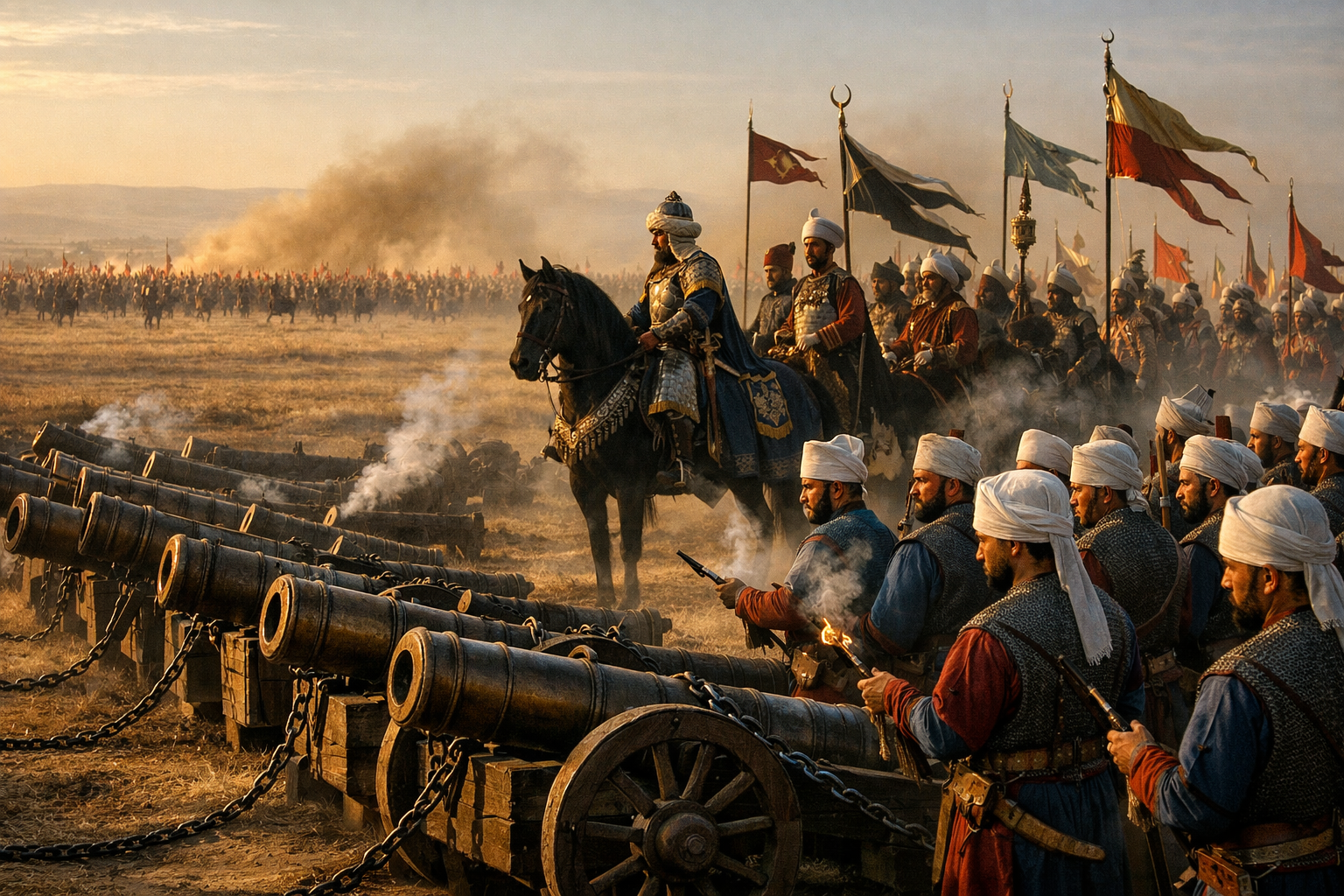
The morning sun cast long shadows across the plain of Chaldiran in northwestern Persia. Sultan Selim I, known as "Selim the Grim," sat astride his war horse, surveying the Ottoman battle lines. Before him, hundreds of bronze cannons gleamed in the early light, their barrels aimed toward the distant horizon where dust clouds marked the approach of the Safavid army.
Behind the artillery stood ranks of Janissary musketeers, matchlock firearms at the ready. These professional infantry formed the backbone of Ottoman military power, a stark contrast to the cavalry-centered force approaching from the east. The sultan's hands tightened on his reins. This wasn't just another battle. It was a clash of military traditions and competing visions for the future of Islam.
Selim watched the magnificent army of Shah Ismail I draw closer, the dust rising in great columns as the Safavid host advanced across the plain. The Safavid ruler's Qizilbash cavalry, wearing their distinctive red headgear, were renowned throughout Asia. These tribal warriors had never known defeat, and their leader was viewed by his followers as nearly divine. The Persian army's elaborate bronze armor and curved shamshirs (swords) caught the morning light, evidence of a military tradition stretching back centuries.
Facing each other across the plain, the two armies embodied opposite philosophies of war. The Ottomans had embraced the gunpowder revolution, fielding a force that combined traditional Islamic cavalry with artillery and infantry modeled on European innovations. The Safavids still relied on mounted warfare, the same tactical inheritance that had served Persian armies since the days of Cyrus the Great.
Chaldiran was the culmination of decades of mounting tension between the Ottoman Empire and the rising Safavid state. Since the late fifteenth century, the Safavids had been consolidating power in Persia, promoting Twelver Shi'ism as the state religion. That posed both a political and a religious threat to the Sunni Ottoman Empire.
Shah Ismail had been steadily expanding his influence, particularly among the Turkmen tribes of eastern Anatolia who were nominally under Ottoman control. His charismatic leadership and claims of divine guidance had won him a devoted following, threatening Ottoman authority in their eastern provinces. These Turkmen supporters, the Qizilbash ("Red Heads"), formed the core of his fighting force.
Sultan Selim I came to power in 1512 after deposing his father Bayezid II, and he was determined to eliminate the Safavid threat. Unlike his more cautious predecessor, Selim earned his nickname through a ruthless approach to governance. He had already ordered the massacre of thousands of Shi'ite supporters within Ottoman territories, treating them as potential agents of the Safavid cause.
By 1514, the Ottoman Empire stood at a pivotal moment in its military development. It had been incorporating gunpowder weapons since the siege of Constantinople in 1453, and by the early sixteenth century it possessed one of the most modern armies in the world. The Janissaries and the artillery corps weren't decorative additions to the old order. They had become its center of gravity.
The Battle Unfolds
As the morning progressed, Shah Ismail launched his attack. The Qizilbash cavalry charged forward in their traditional fashion, expecting to shatter the Ottoman lines through momentum and sheer skill at arms. What followed would reshape warfare across the Middle East.
Sultan Selim ordered his artillery to open fire. Hundreds of cannons roared, sending iron balls tearing through the charging Persian ranks. The Safavid cavalry, unaccustomed to facing that kind of firepower, struggled to hold formation as horses and riders fell in clusters across the plain.
Despite the punishment, the Qizilbash managed to reach the Ottoman lines at several points. There they ran into the disciplined Janissary musketeers, who delivered coordinated volleys into the Persian cavalry. The pairing of artillery and musket fire proved more than the Safavid force could absorb.
Shah Ismail himself led a desperate charge against the Ottoman center. Several of his most elite warriors broke through and engaged the Janissaries in close combat, and the shah's personal courage that day was beyond question. But the weight of Ottoman firepower couldn't be overcome by valor alone.
Grand Vizier Hersekzade Ahmed Pasha coordinated the Ottoman defensive effort, keeping artillery and musket fire concentrated on the most dangerous Safavid thrusts. The Ottoman cavalry, held in reserve throughout the morning, was deployed selectively to seal any breakthroughs and guard the army's flanks.
By midday it was over. The Safavid army, for all its renowned cavalry and the personal bravery of its shah, could not punch through a line anchored by cannons and firearms. Shah Ismail retreated, leaving thousands of his best warriors dead on the field. He had survived. His aura of invincibility had not.
Consequences and Impact
Chaldiran marked a turning point in Middle Eastern military history. It demonstrated, with brutal clarity, the advantage of gunpowder weapons over traditional cavalry tactics, and it forced the Safavid Empire to begin rethinking its entire approach to warfare. The battle also confirmed the Ottoman Empire as the dominant power in the region for generations.
For the Safavids, the psychological damage ran deep. Shah Ismail had never lost a battle before Chaldiran. Afterward, he fell into a prolonged depression and largely withdrew from military campaigns for the rest of his reign. The myth of his divine invincibility was broken, and with it went a significant part of the religious authority on which Safavid rule rested.
The Ottomans secured their eastern frontier and took control of eastern Anatolia and northern Iraq. With that threat contained, Sultan Selim turned his attention southward toward the Mamluk Empire in Egypt, which he conquered in 1517. That victory made the Ottomans the predominant Islamic power in the world.
In our next episode, we'll follow Sultan Selim I as he capitalized on Chaldiran to launch his campaign against the Mamluks, leading to the Ottoman conquest of Egypt and the acquisition of the title of Caliph. That expansion set the stage for the golden age of the Ottoman Empire under his son, Suleiman the Magnificent.
Editor's Context
Read this episode as a study in imperial administration as much as conquest. Ottoman power depended on frontier politics, fiscal systems, elite bargains, and the ability to absorb local complexity. The date markers (1514, 1453) are included because chronology is one of the easiest places for narrative history to become misleading. The episode's themes (history, empire, power) are the editorial lens for weighing cause and consequence rather than treating the story as isolated trivia.
Reviewed under the EmpiresDiary editorial workflow by Obadiah.
Drafted with AI. Accuracy review and corrections are ongoing — if you spot an error, please report it. See our workflow and editorial policy.