The Last Caliph's Flight
March 3, 1924
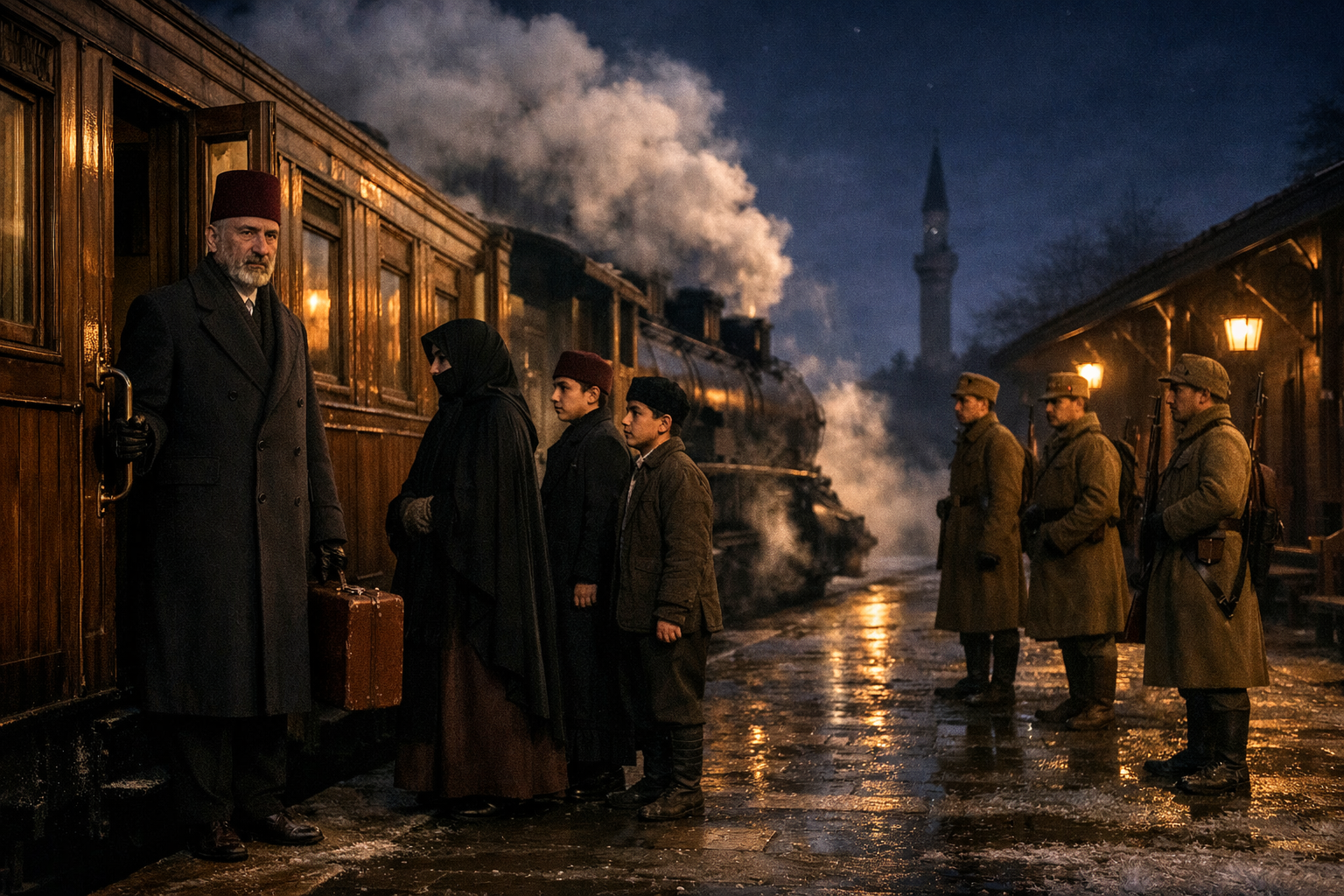
The bitter winter wind cut through the narrow streets of Constantinople as a small convoy of automobiles moved through the darkened city in the early hours of the morning. Inside the lead vehicle, a distinguished man with a neatly trimmed beard gazed at the passing shadows of minarets and domes that had defined his ancestors' skyline for centuries. Abdul Mecid II, the last Caliph of Islam and heir to the Ottoman dynasty, clutched a small leather case containing his most precious possessions: family photographs, personal papers, and a handful of jewelry salvaged from the once-vast imperial treasury.
The convoy moved out of the city toward Catalca Station, deliberately routed away from Constantinople's center to avoid any demonstrations. Turkish Republican guards, posted by Mustafa Kemal's new government, watched without expression as the former Caliph and his immediate family waited through the day at the station before boarding the Simplon-Orient Express toward midnight. No fanfare marked the departure. No crowds gathered to bid farewell to the man who, until just hours before, had been the spiritual leader of millions of Muslims worldwide.
As the train lurched forward, Abdul Mecid stood at the window of his private compartment and watched the lights recede into the dark. The city his ancestor Mehmed II had conquered in 1453, transforming a declining Byzantine outpost into the capital of a world empire, was slipping away for good. The journey ahead would carry him through the Balkans to Switzerland and into permanent exile.
In his pocket was a letter from the Grand National Assembly of Turkey, delivered just days earlier, declaring the abolition of the Caliphate. Six hundred and twenty-three years of Ottoman rule had ended, not with the clash of armies or the fall of great walls, but with a legislative act and a midnight train.
The abolition of the Caliphate in 1924 was the culmination of events set in motion by the Ottoman Empire's defeat in World War I. The 1918 Armistice of Mudros left the once-mighty empire occupied by Allied forces and facing dismemberment under the Treaty of Sevres in 1920.
Sultan Mehmed VI, the last Ottoman ruler, had fled aboard a British warship in 1922 when Mustafa Kemal's nationalist forces seized Constantinople. The Grand National Assembly in Ankara then separated the Caliphate from the Sultanate, abolished the latter, and appointed Abdul Mecid II as Caliph, though stripped of all temporal power.
The position itself had been held by Ottoman sultans since 1517 and carried enormous symbolic weight as the spiritual leadership of the Muslim world. For Mustafa Kemal and his Republican allies, however, the Caliphate represented precisely what they were trying to dismantle: religious authority entangled in governance, continuity with the old Ottoman order, and a barrier to building a secular modern state.
The preceding months had brought mounting tension between the Republican government and supporters of the Caliphate both inside Turkey and abroad. Muslim leaders from India to Egypt called for preserving the institution as a unifying force for the Islamic world. Kemal was unmoved. He saw the Caliphate as incompatible with his vision of a modern Turkish republic and was determined to sever every link with the Ottoman past.
Main Narrative
Even Kemal's staunchest supporters did not take the decision lightly. The debate in the Grand National Assembly on March 1-2, 1924, exposed real divisions over the wisdom of such a drastic move.
Rauf Orbay, a hero of the Turkish War of Independence and former prime minister, argued passionately for keeping the Caliphate as a purely spiritual office, warning that abolishing it risked alienating Muslim communities worldwide who had supported Turkey's struggle for independence.
Kemal's influential ally Ismet Inonu, by contrast, supported abolition as a necessary step in building a modern republic, pushing back against those who wished to preserve any institutional link with the Ottoman past.
The human drama extended well beyond the assembly chambers. At Dolmabahce Palace, Abdul Mecid II had continued receiving delegations from Muslim communities around the world, maintaining a composed and dignified presence even as his position grew more precarious by the week. By most accounts he received the news of the assembly's final vote with remarkable composure and, in the hours before departure, expressed concern above all for his library and art collection, hoping they might be preserved for the nation.
Out in the streets of Constantinople, the mood was fractured. Some citizens gathered in silent protest outside mosques. Others celebrated what they saw as the final step in Turkey's transformation into a modern state. Police reports from the period noted pro-Caliphate demonstrations in conservative neighborhoods alongside spontaneous republican celebrations elsewhere. The city held both reactions at once, sometimes on the same block.
The international response came quickly. In India, Muslim leaders declared a day of mourning, with Khilafat Movement figures including the Ali brothers reacting with deep dismay at the loss of the institution. From Cairo, King Fuad I began quietly exploring whether he might assume the Caliphate himself. British diplomatic cables expressed concern about unrest in their Muslim colonies, while French authorities in North Africa tightened surveillance of religious gatherings.
Consequences and Lasting Impact
The abolition severed Turkey's official ties with its Ottoman past almost completely, accelerating Kemal's modernization programs. The removal of religious authority from governance became the cornerstone of Turkish secularism, and that principle has shaped the country's politics ever since.
The absence of a universally recognized Caliph created a vacuum in Islamic leadership that various movements rushed to fill. The rise of pan-Islamic politics, the founding of the Muslim Brotherhood in 1928, and later claims to religious authority by state and non-state actors alike all connect back to this moment. The vacancy was never cleanly resolved.
For the Ottoman dynasty, exile meant dispersal across Europe and the Middle East. The family was barred from returning to Turkey until 1974, when the law was partially repealed. Abdul Mecid II spent his remaining years in Paris, working as a painter and calligrapher until his death in 1944. He never recovered his former position, but by most accounts he never lost his composure either.
As Abdul Mecid's train crossed into Europe, Kemal was already pushing the next phases of his revolutionary program. In our next episode, we will look at the sweeping reforms that reshaped Turkey through the 1920s and 1930s, from the adoption of the Latin alphabet to the emancipation of women, as the young republic worked to build a new identity from the ruins of empire.
Editor's Context
Read this episode as a study in imperial administration as much as conquest. Ottoman power depended on frontier politics, fiscal systems, elite bargains, and the ability to absorb local complexity. The date markers (1918, 1924) are included because chronology is one of the easiest places for narrative history to become misleading. The episode's themes (history, empire, power) are the editorial lens for weighing cause and consequence rather than treating the story as isolated trivia.
Reviewed under the EmpiresDiary editorial workflow by Obadiah.
Drafted with AI. Accuracy review and corrections are ongoing — if you spot an error, please report it. See our workflow and editorial policy.