The Last Dance of the Janissaries
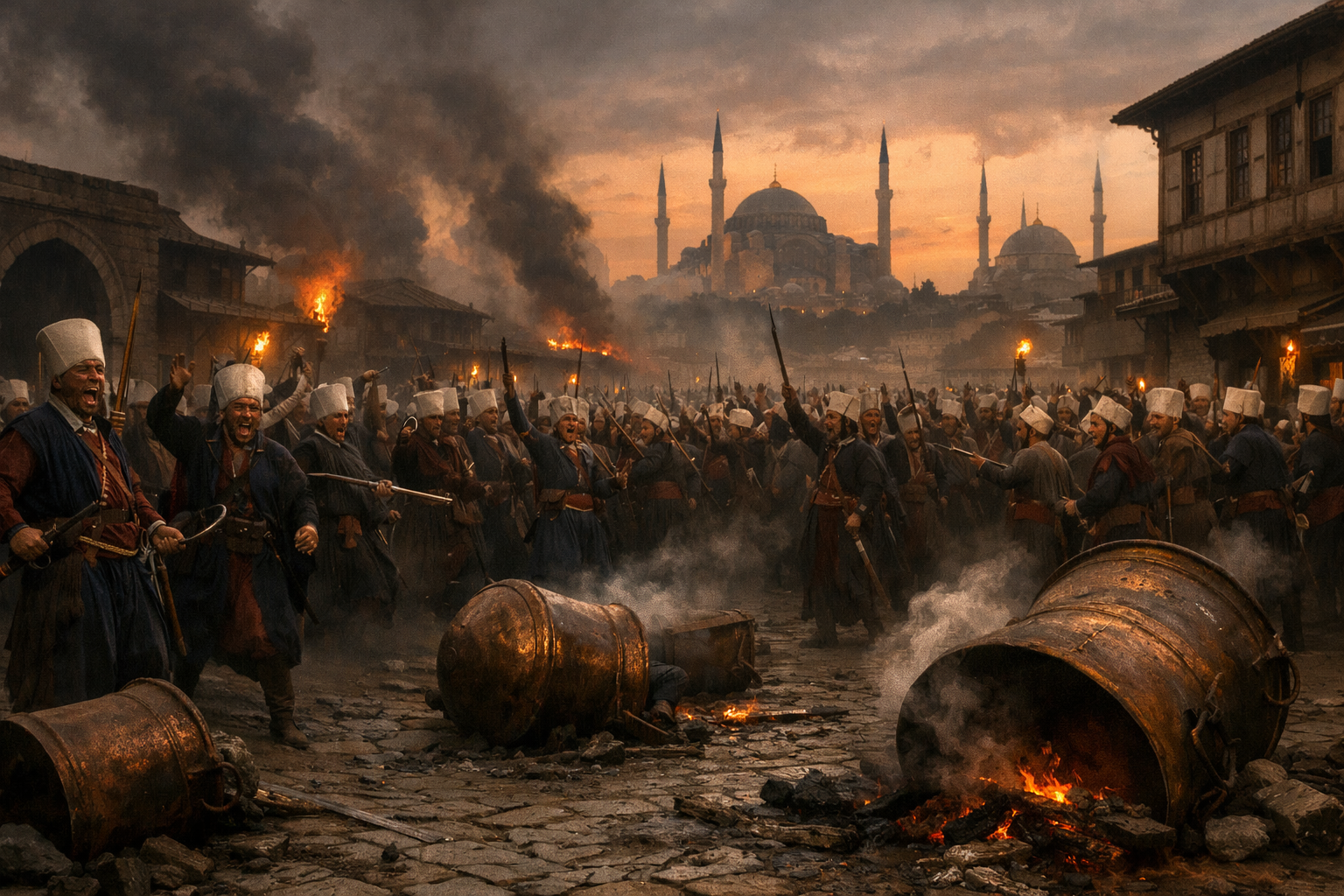
June 15, 1826
The summer air hung heavy over Istanbul as dawn crept across the Bosphorus. In the ancient quarters of the city, an ominous silence broke apart under the rhythmic beating of drums. The Janissaries, once the elite infantry of the Ottoman Empire, were summoning their members to revolt. Their distinctive copper kettles, traditionally used for serving food, were now turned upside down in the time-honored signal of rebellion.
Outside the Et Meydani (Meat Square), their traditional gathering place, thousands of Janissaries assembled with fury on their faces. They had just learned of Sultan Mahmud II's decree establishing a new military corps trained in modern European tactics, the Eskinci Ocagi, a name drawn from older Ottoman campaign-soldier terminology to soften Janissary opposition, which they saw as a direct threat to their privileged position. The sound of those overturned kettles echoed through the narrow streets of Istanbul like a death knell.
In his chambers at Topkapi Palace, Sultan Mahmud II received the news with grim determination. He had spent years preparing for this moment, knowing that any attempt to modernize the Ottoman military would draw fierce resistance from the Janissaries. Now, gazing out over the city, he could see columns of smoke rising from buildings set ablaze by the rebellious troops.
His most trusted advisor, Husrev Pasha, entered the chamber with urgent news of the Janissaries' march. Mahmud II's response was resolute: he ordered the Sacred Banner of the Prophet to be unfurled, calling the faithful to rally behind their Sultan. Within hours, the green silk standard of Prophet Muhammad was raised in front of the Sultan Ahmed Mosque, a powerful symbol calling all faithful Muslims to defend their faith and their Sultan. The streets of Istanbul were about to become the stage for one of the most dramatic transformations in Ottoman history, an event that would become known as the Auspicious Incident (Vaka-i Hayriye).
The Janissary Corps, established in the 14th century by Sultan Murad I, had once been the most formidable military force in the Islamic world. Originally composed of Christian boys taken from conquered territories through the devsirme system, these slave-soldiers were converted to Islam and trained to serve as the Sultan's elite infantry and personal guard.
For centuries they stood at the forefront of Ottoman military success, playing crucial roles in the conquest of Constantinople in 1453 and the expansion of the empire to its greatest extent under Suleiman the Magnificent. By the 18th century, though, they had become a privileged class more interested in protecting their economic position than in maintaining military excellence.
The Janissaries had gained the right to marry, own businesses, and pass their positions to their sons, effectively becoming a hereditary military caste. They blocked every attempt at modernization, particularly the adoption of European military techniques and technologies. That conservative stance contributed to a string of Ottoman military defeats, including devastating losses to Russia and Austria.
Sultan Selim III's earlier attempt to create a new military corps in 1807 had ended in disaster. The Janissaries deposed him and eventually had him killed. His successor, Mahmud II, spent years carefully preparing for a confrontation he knew was coming. He built support among the ulema (religious scholars), positioned loyal troops throughout the city, and waited.
The immediate catalyst for the 1826 crisis was Mahmud II's creation of the Eskinci Ocagi, which would train with European instructors and use modern weapons and tactics. It was a direct challenge to the Janissaries' monopoly on military power within the empire, and they knew it.
The Main Narrative
As the Sacred Banner of the Prophet flew over the Sultan Ahmed Mosque, Istanbul's population began to choose sides. The ulema, led by the Seyhulislam, issued a fatwa supporting the Sultan's reforms and condemning the Janissaries' rebellion. Common citizens, long resentful of Janissary bullying and corruption, armed themselves with whatever weapons they could find.
The Janissary corps numbered around 135,000 across the empire, yet in Istanbul the Janissaries found themselves increasingly isolated. Their traditional allies among the religious conservatives and craft guilds hesitated, sensing that this time was different.
The Sultan's loyal forces, including the newly trained artillery units and the topçus (bombardiers), surrounded the Et Meydani where the main body of Janissaries had gathered. Mahmud II sent one final offer of amnesty to those who would surrender and join the new army. Some accepted. The hardcore veterans refused.
What followed was terrible. The Sultan's artillery opened fire on the Janissary barracks while loyal troops and armed civilians attacked from all sides. The narrow streets around Et Meydani became killing grounds as the Janissaries fought back with desperate ferocity. Cannon fire mixed with the crash of falling buildings, and smoke filled the air as the fighting raged through the day and into the night.
By dawn of June 16, the main Janissary barracks were in flames and thousands lay dead. Those who survived were arrested, and in the weeks that followed, Janissary units throughout the empire were systematically disbanded or destroyed.
Consequences and Lasting Impact
The destruction of the Janissary Corps, the Auspicious Incident, marked a turning point in Ottoman history. Mahmud II immediately established a new, modern army called the Asakir-i Mansure-i Muhammediye (Victorious Soldiers of Muhammad), trained along European lines and equipped with the latest weapons.
Removing the Janissaries cleared a major obstacle to modernization. Mahmud II moved quickly to implement wide-ranging reforms of his own, covering military organization, administration, dress, and central government. These changes laid the groundwork for the Tanzimat era, which was formally launched in 1839 by his son and successor Abdulmecid I through the Edict of Gulhane. The reforms reshaped the empire from the inside out.
The loss carried costs, too. The Janissaries had embodied a distinctive Ottoman military tradition that helped build one of the world's great empires, and that tradition vanished with them. The new army, while more technically proficient, never earned the fearsome reputation of its predecessors.
Culturally, the damage was real. The Janissaries had been patrons of arts, particularly music and literature. Their destruction brought on the decline of certain Ottoman musical traditions and the cultural practices tied to the corps.
In our next episode, we'll explore how Sultan Mahmud II used his victory over the Janissaries to push through sweeping reforms that set the stage for the Tanzimat period. Those changes would attempt to modernize the Ottoman Empire, but they also created new tensions between traditionalists and reformers, tensions that would keep shaping Ottoman society until the empire's final days.
Editor's Context
Read this episode as a study in imperial administration as much as conquest. Ottoman power depended on frontier politics, fiscal systems, elite bargains, and the ability to absorb local complexity. The date markers (1807, 1453) are included because chronology is one of the easiest places for narrative history to become misleading. The episode's themes (history, empire, power) are the editorial lens for weighing cause and consequence rather than treating the story as isolated trivia.
Reviewed under the EmpiresDiary editorial workflow by Obadiah.
Drafted with AI. Accuracy review and corrections are ongoing — if you spot an error, please report it. See our workflow and editorial policy.