The Slave Who Would Be Sultan
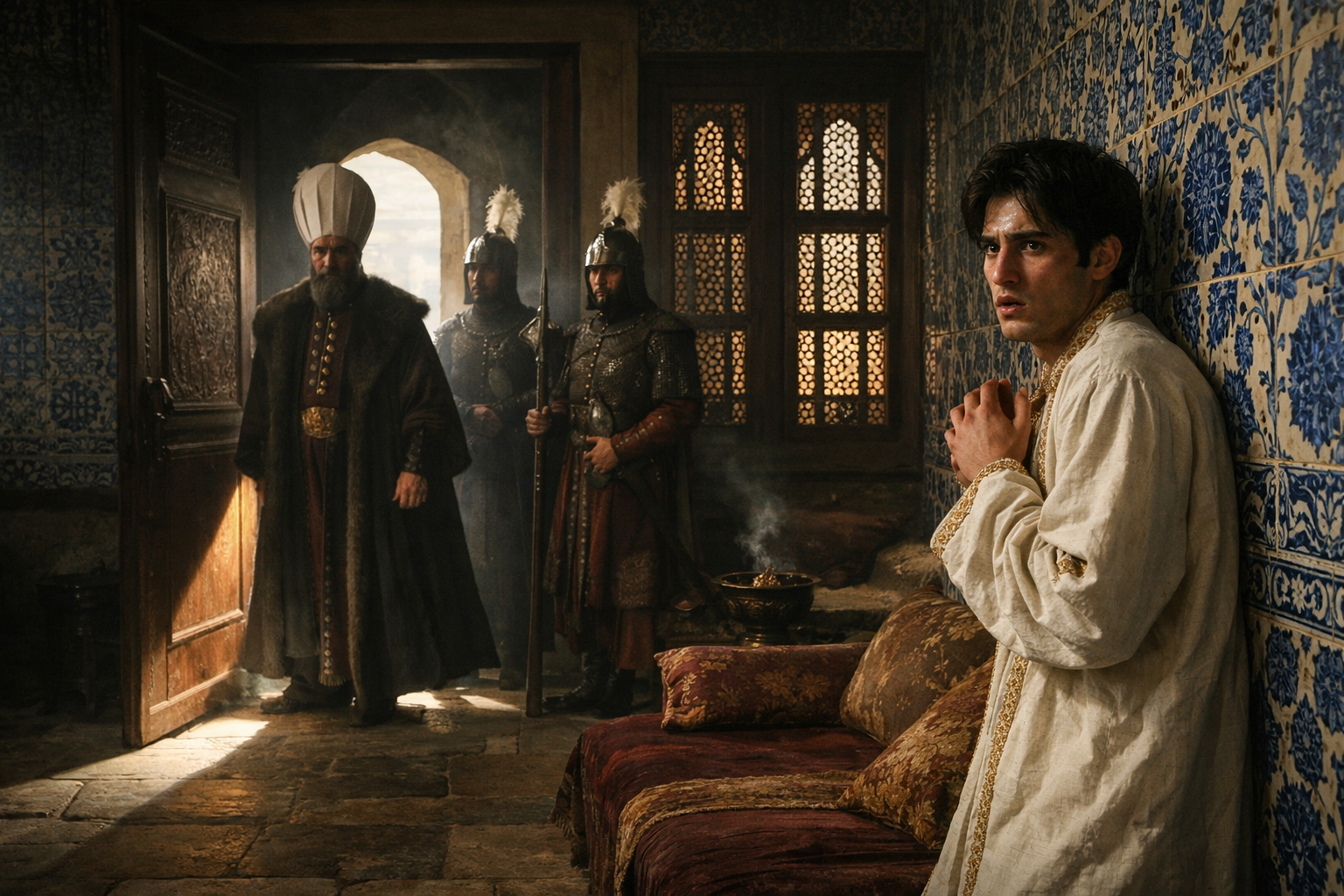
The Golden Cage, Topkapi Palace, 1640
The heavy wooden door creaked open, and a thin shaft of light cut into the perpetual gloom of the kafes, the "Golden Cage." Ibrahim, pale and trembling, pressed himself against the far wall of his prison-apartment. He was certain the entering guards had come to execute him, just as he had watched his brothers strangled in the years before.
"Your Highness," the Grand Vizier Kemankeş Kara Mustafa Pasha called out softly, "Sultan Murad IV, your brother, has passed into Allah's grace. You are now the Sultan of the Ottoman Empire."
Ibrahim was twenty-five years old and had spent twenty-three of those years confined in this gilded prison. He wept and shook his head. "You are deceiving me," he cried. "My brother still lives and wishes to test my loyalty. I will not fall for this trap!"
It took hours of coaxing, the testimony of his mother Kösem Sultan, and finally the sight of his brother's corpse before Ibrahim believed his imprisonment had ended. As he stepped out into the bright sunlight of the palace courtyard for the first time in decades, he squinted and swayed, overwhelmed by the open sky above him.
The gathered dignitaries watched with growing concern as their new ruler, the last surviving male of the House of Osman, struggled to hold himself together. Ibrahim's hands shook as he received the sword of Osman in the traditional coronation ceremony, his eyes darting between the faces of those assembled. None could know then that this moment marked the beginning of one of the most turbulent and strange reigns in Ottoman history.
The Ottoman Empire of 1640 was still one of the world's great powers, though it was showing early signs of the strain and transformation that later historians would debate under various labels. Sultan Murad IV, Ibrahim's predecessor, had been a strong but brutal ruler who restored order through strict discipline and frequent executions. He recaptured Baghdad from the Safavids and pushed through sweeping reforms, but his early death at age 27 from cirrhosis left the empire in a precarious position.
The practice of royal fratricide and the kafes system had been introduced by Sultan Ahmed I to prevent the civil wars that had previously erupted between rival claimants to the throne. Princes were now confined to the kafes, a secure section of the palace where they lived in luxury but complete isolation, supervised only by mute guards and selected servants.
Ibrahim had entered the kafes at age two. He watched as his brothers were taken out one by one for execution under Murad IV's paranoid rule, and his own survival owed entirely to being the youngest and least threatening. The imprisonment left deep marks. Modern historians believe he developed a combination of depression and paranoid tendencies, along with chronic anxiety that never fully released its grip.
The empire Ibrahim inherited stretched from Hungary to Iraq, from the Crimea to Yemen. Its bureaucracy was sophisticated, its military still formidable, and its economy sat at the center of east-west trade. Even so, Murad IV's Persian campaigns had strained the treasury badly, and corruption was becoming endemic among the provincial governors.
Main Narrative
Ibrahim's early reign showed genuine promise. His mother Kösem Sultan provided steady guidance, and the capable Grand Vizier Kemankeş Kara Mustafa Pasha kept the machinery of state turning. The new Sultan's first acts included distributing generous gifts to the Janissaries and reducing taxes on essential goods, which won him real popularity among both the military and ordinary people.
The trauma of his imprisonment, though, soon surfaced in erratic behavior. Ibrahim developed an obsession with luxury. He ordered the palace furnished entirely in sable furs, adorned his barges with silver-gilt decorations, spent enormous sums on perfumes, and had the palace fountains filled with rose water.
Venetian envoys reported that Ibrahim increasingly left matters of state to his mother and viziers while pursuing personal indulgences, and that his moods were dangerously unpredictable. His deteriorating mental state became a subject of concern among foreign observers and the Ottoman court alike.
The harem became the center of political intrigue, with Ibrahim's favorites wielding unprecedented influence. The most notorious was Şivekar Sultan, a woman said to be so large that gold coins could be placed in the folds of her flesh. Ibrahim ordered all his concubines to weigh at least 150 pounds and sent officers throughout the empire to find suitably plump women.
Grand Vizier Kemankeş attempted to maintain fiscal discipline but was executed in 1644 after crossing the Sultan's mother. More moderate voices were silenced one by one after that. Ibrahim ordered the entire harem of his deceased brother drowned in the Bosphorus and became convinced that Polish spies were hiding inside the palace walls.
The crisis sharpened when Ibrahim grew obsessed with the infant daughter of the Grand Mufti and demanded her for his harem. The act was sacrilegious enough to unite the religious establishment against him. At the same time, the costly and unsuccessful siege of Crete, begun in 1645, was draining both the treasury and military morale.
By 1648, a coalition of the ulema (religious scholars), the Janissaries, and even his own mother Kösem Sultan had concluded that Ibrahim's rule threatened the empire's survival. In a carefully orchestrated coup, they confined him back to the kafes and elevated his six-year-old son Mehmed IV to the throne.
Consequences and Lasting Impact
Ibrahim's deposition and subsequent execution marked a significant shift in Ottoman political dynamics. It established a precedent that a sultan could be removed not only for military failure or incompetence, but for mental instability and moral turpitude. Future sultans would never again hold quite the same absolute authority.
The period also saw the emergence of the valide sultan (queen mother) as a critical power broker. Kösem Sultan effectively ruled as regent for both her son Ibrahim and her grandson Mehmed IV. This "Sultanate of Women" would shape Ottoman politics for several generations to come.
Ibrahim's reign accelerated the empire's financial difficulties through excessive spending and neglect of administration. The Cretan War he initiated dragged on for twenty-four years, becoming one of the longest conflicts of the era. It also marked the beginning of Venice's decline as a maritime power.
When the six-year-old Mehmed IV ascended to the throne, the empire entered a period of regency under his grandmother Kösem Sultan and his mother Turhan Sultan. Their bitter rivalry produced more palace intrigue and political instability. The empire would soon face its greatest test yet: the failed siege of Vienna and the beginning of the territorial losses that signaled the end of Ottoman expansion in Europe.
Editor's Context
Read this episode as a study in imperial administration as much as conquest. Ottoman power depended on frontier politics, fiscal systems, elite bargains, and the ability to absorb local complexity. The date markers (150, 1642) are included because chronology is one of the easiest places for narrative history to become misleading. The episode's themes (history, empire, power) are the editorial lens for weighing cause and consequence rather than treating the story as isolated trivia.
Reviewed under the EmpiresDiary editorial workflow by Obadiah.
Drafted with AI. Accuracy review and corrections are ongoing — if you spot an error, please report it. See our workflow and editorial policy.