The Dance of Death: The Great Plague Strikes Istanbul
A City Under Siege
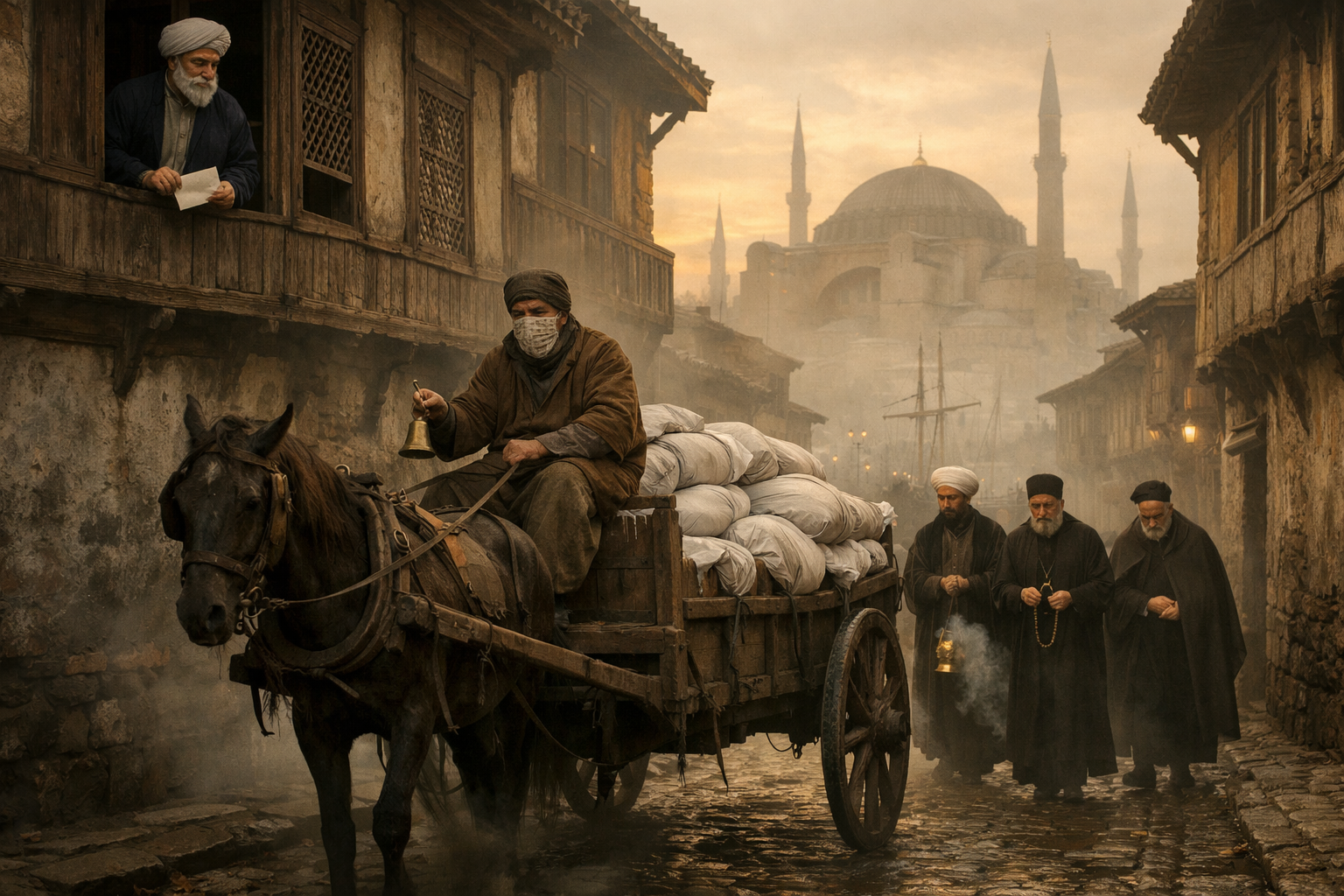
The early morning fog rolled off the Bosphorus and into the crowded streets of Constantinople, now Istanbul, in the spring of 1467. A physician stood at his window overlooking the bustling districts of the city, named for the conquering Sultan Mehmed II who had taken the city just fourteen years earlier. Something was wrong. The usual cacophony of street vendors' calls and children's laughter was muted, replaced by an eerie quiet broken only by the occasional wail of mourning.
He had seen the signs building over the past weeks: first the dead rats in the streets, then the sudden illnesses striking down the poor in the crowded quarters near the harbor. Now the telltale black swellings, the buboes that gave the plague its name, were appearing on victims throughout the city. The disease showed no respect for wealth or status. Yesterday, one of the Sultan's own advisors had succumbed after just three days of fever.
Through his window, he watched a cart piled high with shrouded bodies make its way down the narrow street. The driver wore a cloth across his face and rang a small bell to warn others away. Behind the cart walked a group of men in dark robes, swinging censers of burning herbs and chanting prayers from both the Quran and Bible. It was a grim reminder that death united all faiths in this cosmopolitan capital.
He had spent the morning composing a letter to Sultan Mehmed II, who was away on campaign, describing the scale of the catastrophe and urging the Sultan's return. As he sealed it, another sound rose above the morning haze. The powerful voice of a muezzin called the faithful to prayer from the Hagia Sophia, converted to a mosque after the conquest. But today, the call seemed to carry a different weight, more a plea for divine mercy than a celebration of faith.
The plague that struck Istanbul in 1467 was not the first to afflict the city, nor would it be the last. Since the infamous Black Death of 1347-1351, which killed perhaps a third of Europe's population, the disease had returned in waves across the Mediterranean world. The Ottoman Empire, with its extensive trade networks and bustling ports, was particularly vulnerable to these outbreaks.
Sultan Mehmed II's conquest of Constantinople in 1453 had transformed the city into the capital of a rapidly expanding empire. Under Ottoman rule, the city was experiencing a renaissance, with new mosques, markets, and neighborhoods rising amid the ancient Byzantine structures. The population had grown from a low of perhaps 50,000 in 1453 to over 100,000 by 1467, as the Sultan actively encouraged migration from across his domains.
This rapid growth created conditions ripe for disease. The city's ancient water systems, dating to Roman times, struggled to serve the expanding population. Crowded neighborhoods, especially in the poorer districts near the ports, became breeding grounds for rats and the fleas that carried the plague bacterium.
The Ottoman medical system of the time combined Islamic medical traditions with Greek and Roman knowledge preserved through Arabic translations. Hospitals, known as bimaristans, operated throughout the city. The true cause of the plague remained unknown, though. Theories ranged from "bad air" to divine punishment for moral failings. When outbreaks struck, the most common responses were flight from the city, isolation of the sick within their homes, and intensified prayer.
The Plague Strikes
The epidemic spread through the summer and autumn of 1467, moving from the harbor districts into the cramped streets of the Jewish quarter and the Greek neighborhoods along the Golden Horn.
The Ottoman response reflected competing approaches to the crisis. The Grand Vizier, Mahmud Pasha, advocated measures to restrict movement and seal infected households, a practice that drew on examples from other cities. This met resistance from both religious authorities and merchants, who feared economic devastation.
Religious leaders organized mass prayer gatherings despite warnings from physicians that such assemblies spread the disease. The tension between medical and religious responses would persist throughout the epidemic.
Jewish and Christian communities developed their own coping mechanisms. Muslim, Jewish, and Christian communities each organized efforts to care for the sick while trying to limit the spread of disease among their own members. These parallel efforts highlighted both the division and cooperation between Ottoman communities under pressure.
By midsummer the plague had reached even the grand mansions along the Bosphorus. Several high-ranking officials died, and parts of the palace complex were abandoned. Sultan Mehmed II, receiving increasingly desperate reports, cut short his military campaign and returned to the capital, though he maintained a safe distance by residing in his hunting lodge outside the city.
His return marked a turning point. He ordered the implementation of public health measures, backed by the full authority of the state. Markets were temporarily closed, public baths were shut down, and movement in and out of heavily affected districts was restricted. Most controversially, he ordered the temporary suspension of large religious gatherings, including Friday prayers in major mosques.
Consequences and Impact
The plague of 1467 was devastating. The contemporary historian Kritovoulos of Imbros recorded that it killed roughly a third of the city's population. The demographic impact would take years to recover from, but the epidemic's legacy extended far beyond the death toll.
The crisis prompted changes in Ottoman public health thinking. Sultan Mehmed II invested in new hospitals and took steps to address the urban conditions that allowed disease to spread so rapidly. The experience also influenced Ottoman urban planning, with future city expansions incorporating more open spaces and improved water systems. It is worth noting that a formal, systematic quarantine apparatus of the kind practiced in Venice and other Western European cities did not take hold in the Ottoman Empire until the nineteenth century, when it was adopted under European pressure.
The plague also demonstrated both the strengths and weaknesses of Ottoman society. The empire's diverse communities showed remarkable resilience and cooperation in the face of disaster, while the central government proved capable of implementing emergency measures across a complex urban environment.
As Istanbul recovered from the plague of 1467, Sultan Mehmed II turned his attention back to expansion. The next episode will explore his ambitious campaign to secure control of the Black Sea coast, beginning with the conquest of the Genoese colony of Caffa in 1475, ironically the same port through which the Black Death had first entered Europe more than a century earlier.
Editor's Context
Read this episode as a study in imperial administration as much as conquest. Ottoman power depended on frontier politics, fiscal systems, elite bargains, and the ability to absorb local complexity. The date markers (1453, 1351) are included because chronology is one of the easiest places for narrative history to become misleading. The episode's themes (history, empire, power) are the editorial lens for weighing cause and consequence rather than treating the story as isolated trivia.
Reviewed under the EmpiresDiary editorial workflow by Obadiah.
Drafted with AI. Accuracy review and corrections are ongoing — if you spot an error, please report it. See our workflow and editorial policy.