The Siege of Malta: Islam and Christendom's Greatest Naval Battle
The Dawn of Battle
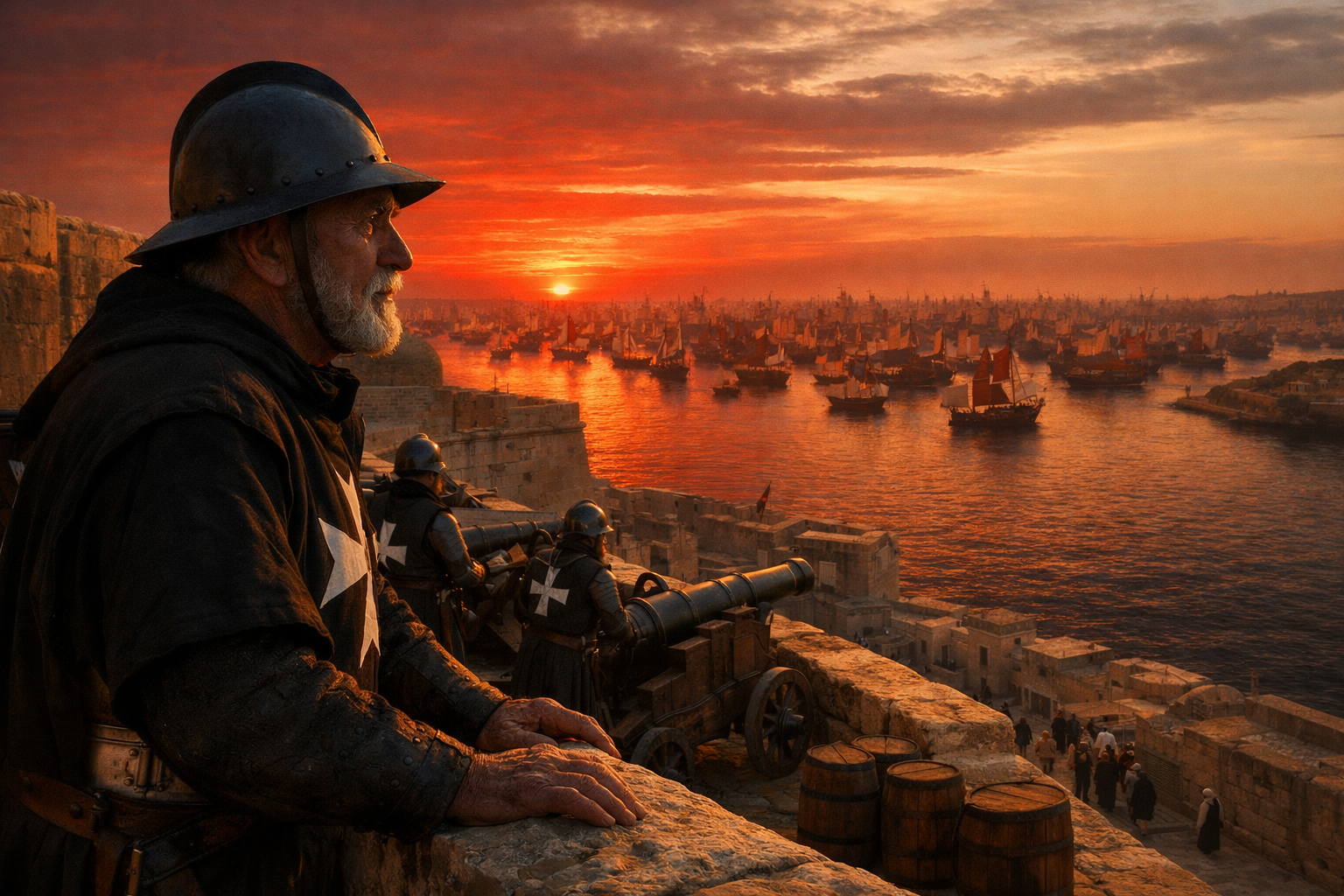
The morning sun rose blood-red over Malta's Grand Harbor on May 18, 1565, as Jean Parisot de La Valette stood atop the battlements of Fort St. Angelo. The 71-year-old Grand Master of the Knights Hospitaller gazed out at a sight that made even his battle-hardened heart skip a beat: the horizon was dark with Ottoman sails. Nearly 200 ships carrying 40,000 of Sultan Suleiman's finest warriors had arrived to crush the Christian stronghold that had long been a thorn in the Ottoman Empire's side.
La Valette gripped the stone parapet, his weathered hands bearing the scars of countless battles. He had spent his entire adult life fighting the Ottomans, even surviving eighteen months as their prisoner in his younger years. Now, as leader of the Knights of St. John, he knew this would be their greatest test. The Ottoman force approaching was one of the largest assembled in the 16th century, more than six times the size of Malta's defenders.
Below him, the narrow streets of Birgu buzzed with activity as soldiers and civilians made final preparations. Women and children carried supplies to the fortifications, while knights in their distinctive black surcoats with white crosses directed the placement of artillery. The air was thick with the smell of gunpowder as barrels were rolled into position and matchlocks were distributed to arquebusiers.
La Valette had spent months preparing for this moment. The harbors were chained off, wells were stockpiled, and every able-bodied man between 15 and 60 had been armed and trained. He commanded just 700 knights and about 8,000 soldiers, a mix of professional troops, Maltese militia, and civilians pressed into service. Against them stood the might of the Ottoman Empire: thousands of elite Janissaries, experienced sipahi cavalry, and the most powerful navy in the Mediterranean.
As the Ottoman fleet drew closer, La Valette gathered his knights in St. Angelo's chapel. "A formidable army composed of audacious barbarians is descending on this island," he declared. "These are the enemies of the Holy Cross. This is the moment to show our faith and our courage. God is watching us, and if He is with us, who can be against us?"
The Siege of Malta marked a crucial turning point in the centuries-long struggle between the Ottoman Empire and Christian Europe. By 1565, Suleiman the Magnificent had expanded Ottoman power to its greatest extent, controlling most of southeastern Europe, the Middle East, and North Africa. The Mediterranean had become virtually an Ottoman lake, with only a few Christian strongholds remaining.
The Knights Hospitaller had been a particular irritant to Ottoman expansion. Originally founded to protect Christian pilgrims in Jerusalem, they had evolved into a powerful military order. After being driven from Rhodes in 1522, they settled in Malta and transformed the island into a formidable naval base from which they launched raids on Ottoman shipping and Muslim ports.
Sultan Suleiman, now in his 70s, saw the conquest of Malta as the key to controlling the central Mediterranean and launching future campaigns against Italy. He assembled a massive invasion force under the command of Mustafa Pasha, an experienced general, and Piyale Pasha, his most successful admiral. The fleet carried siege guns capable of demolishing medieval walls, along with enough supplies to sustain a long campaign.
The strategic importance of Malta went far beyond its size. Whoever controlled the island could dominate the narrow shipping lanes between Sicily and North Africa. For Spain's Philip II, Malta was a crucial buffer protecting his Italian territories. For the Ottomans, it was the last major obstacle to complete naval supremacy in the Mediterranean.
The Main Battle Unfolds
The Ottoman assault began with an attack on Fort St. Elmo, the smallest but most strategically positioned of Malta's fortifications. Mustafa Pasha expected it to fall within days. Instead, the defenders fought with remarkable determination. Every night, reinforcements would swim across the harbor to replace casualties, while during the day the knights and soldiers endured constant bombardment and repeated assaults.
From his command post in Fort St. Angelo, La Valette received desperate messages from St. Elmo's defenders begging permission to abandon the fort. He refused, knowing that every day they held out weakened the Ottoman army. The garrison fought to the last man, holding out for 31 crucial days before being overwhelmed. That Ottoman victory came at a terrible cost: 6,000 men lost, including the famous corsair Dragut Reis, all to take a position they had expected to capture in less than a week.
The main siege then focused on the towns of Birgu and Senglea, defended by Fort St. Angelo and Fort St. Michael. The Ottomans launched coordinated attacks by land and sea while their artillery pounded the fortifications day and night. The defenders countered with their own cannons and fought off repeated attempts to scale the walls. Underground, a desperate battle raged as both sides dug tunnels to place explosive charges beneath enemy positions.
In August, Mustafa Pasha launched what he hoped would be the final assault. Thousands of Janissaries attacked Birgu's walls while Ottoman galleys hammered Fort St. Michael from the harbor. The situation became so desperate that La Valette himself took up arms and joined the defense. At one point the Ottomans breached Birgu's walls, but a counterattack led by the knights drove them back.
The turning point came on September 7, when a relief force of 8,000 men arrived from Sicily. The Ottoman army, already weakened by casualties and disease, was forced to retreat. After four months of continuous fighting, the great siege was over. Defenders had suffered around 2,500 casualties. Ottoman losses exceeded 25,000 men.
Consequences and Impact
The failure to capture Malta was the first major defeat of Ottoman arms in more than a century, and it signaled the beginning of a long, slow decline in Ottoman naval power. The empire would never again mount such an ambitious amphibious operation in the Mediterranean. The victory gave Christian Europe new confidence and contributed to the later formation of the Holy League that defeated the Ottoman fleet at Lepanto in 1571.
For the Knights Hospitaller, the siege brought renewed prestige and support from across Christian Europe. They would remain in Malta for another two centuries, building the new city of Valletta, named after their heroic Grand Master. The siege became legendary throughout Europe, inspiring countless artworks, poems, and histories celebrating the defenders' courage.
The battle's influence on military history was also significant. It demonstrated the effectiveness of well-designed fortifications against artillery, and the importance of naval power in supporting land operations. A smaller force, properly led and supplied, could resist a much larger army if it maintained high morale.
As Malta celebrated its deliverance, the Ottoman Empire was forced to reassess its Mediterranean strategy. Sultan Suleiman, now nearing the end of his long reign, would turn his attention eastward in his final years. Our next episode will explore his last campaign against Habsburg Austria, where the aging sultan would meet his fate outside the walls of Szigetvár in 1566, marking the end of an era for the Ottoman Empire.
Editor's Context
Read this episode as a study in imperial administration as much as conquest. Ottoman power depended on frontier politics, fiscal systems, elite bargains, and the ability to absorb local complexity. The date markers (1565, 200) are included because chronology is one of the easiest places for narrative history to become misleading. The episode's themes (history, empire, power) are the editorial lens for weighing cause and consequence rather than treating the story as isolated trivia.
Reviewed under the EmpiresDiary editorial workflow by Obadiah.
Drafted with AI. Accuracy review and corrections are ongoing — if you spot an error, please report it. See our workflow and editorial policy.