The Coffee Rebellion of 1730
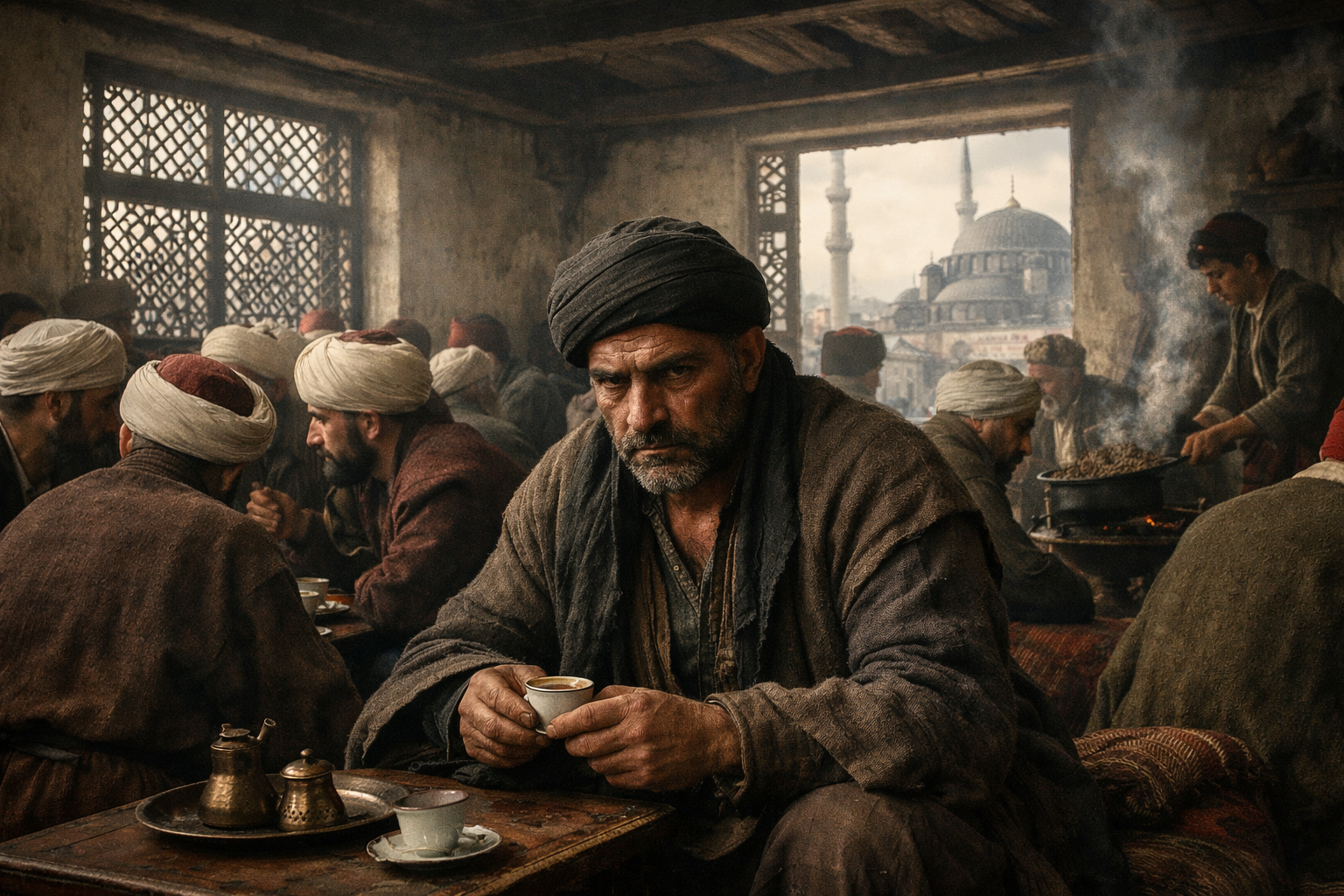
A Coffeehouse in Constantinople
On the morning of September 28, 1730, a crowded coffeehouse in Istanbul's Beyazıt district was unusually full. The air carried the smell of freshly roasted beans and the low murmur of men who didn't want to be overheard. Patrons pressed around small tables, talking in near-whispers about imperial decrees and rising taxes. In one corner sat Patrona Halil, a former janissary turned small-time merchant, his weathered face half-hidden beneath his turban as he worked through the grievances being aired around him.
The coffeehouse, like hundreds of others across the capital, had become something well beyond a place to drink the bitter black beverage that had gripped Ottoman society for two centuries. It had turned into a forum, a place where merchants, craftsmen, religious students, and off-duty janissaries could say plainly what they thought about Sultan Ahmed III's extravagance and Grand Vizier Ibrahim Pasha's policies.
Through the latticed windows, the minarets of the Beyazıt Mosque rose against the morning sky while street vendors and shopkeepers went about their usual business below. But there was a tension in the air that morning, something close to breaking. Bread prices had doubled in recent months. News of the sultan's latest construction project, another ornate palace along the Bosphorus, had sharpened the anger of people who couldn't afford to eat.
Patrona Halil sipped his coffee and watched the room fill. The conversation turned to military defeats against Persia and the heavy taxes raised to fund both the war and the sultan's extravagant "Tulip Period" court. As the morning wore on, quiet grumbling hardened into open declarations of resistance. Nobody in that room could have known this gathering would set off one of the most significant popular uprisings in Ottoman history.
The Tulip Period and Growing Discontent
The early eighteenth century brought a striking transformation to Ottoman society. The years 1718-1730, known as the "Tulip Period" (Lale Devri), saw the empire embrace new forms of artistic expression and architecture shaped by European influence. Under Sultan Ahmed III and his grand vizier, Nevsehirli Damat Ibrahim Pasha, Constantinople changed visibly and fast.
The elite built pleasure palaces along the Bosphorus, threw lavish festivals around tulip cultivation, and devoted themselves to poetry and music. It was a genuine cultural flowering. It was also ruinously expensive for everyone outside the palace walls. Building projects, military campaigns, and court luxuries were paid for through taxes levied on a population already stretched thin.
The empire's military record during this period made things worse. The Treaty of Passarowitz in 1718 had stripped away important Balkan territories to the Habsburgs. Campaigns against Persia had since proven costly and inconclusive, draining the treasury and exhausting public patience in equal measure.
The coffeehouses, which had spread across the city since their introduction in the sixteenth century, absorbed all of this frustration. Authorities had tried periodically to control or shut them down, but they kept opening. They were where news traveled, where opinions formed, and where the distance between the ruling class and everyone else became impossible to ignore.
The Rebellion Unfolds
The spark came when word spread through the coffeehouses that the sultan intended to impose new taxes for yet another Persian campaign. Patrona Halil had spent months quietly building a network of supporters among the janissaries and craft guilds. He decided the moment had arrived.
On September 28, 1730, a small protest in the Beyazıt district grew into a full rebellion within hours. Halil and his followers shut the Grand Bazaar, the traditional signal of civil unrest, and their numbers swelled as they pushed toward Topkapi Palace. Their demands were specific: dismiss the grand vizier, end excessive taxation, and restore traditional Ottoman values.
Ahmed III sent the Grand Mufti to negotiate. The rebels wouldn't hear it. They wanted Ibrahim Pasha and other key officials handed over, and they wouldn't accept anything less. As the standoff dragged on, the Ottoman state apparatus began to fracture along predictable lines:
- The Janissaries, the sultan's elite infantry, were divided. Many sided with the rebels, seeing a chance to reclaim their traditional influence, while others held to their palace loyalties.
- The ulema (religious scholars) largely backed the rebellion, regarding the Tulip Period's westernization as a departure from Islamic principles.
- The merchant class split between those who had done well under the Tulip Period's prosperity and those crushed by its costs.
After three days of violence and mounting disorder, Ahmed III accepted that his position was gone. He surrendered Ibrahim Pasha and the other demanded officials to the rebels, who executed them immediately. Shortly afterward, Ahmed III abdicated in favor of his nephew, who took the throne as Sultan Mahmud I.
Consequences and Lasting Impact
The Patrona Halil Rebellion ended the Tulip Period abruptly and sent ripples through Ottoman society for years. In the immediate aftermath, the new government pulled back from westernizing policies and adopted a more conservative posture.
What the rebellion proved, concretely, was that popular movements could topple a sultan. The coffeehouses had served not just as places of complaint but as genuine nodes of political organization, and that fact wasn't lost on anyone watching. The uprising also sharpened a conflict between traditionalists and reformers that would keep resurfacing in Ottoman politics right through the empire's dissolution.
Mahmud I played his hand carefully. He appeared at first to honor the rebels' demands, then spent the following months consolidating power. He had Patrona Halil and his principal supporters executed once he felt secure enough to move against them. The lesson wasn't that the rebels had won permanently. It was that no sultan could simply ignore the urban population of the capital and expect to survive.
Future Ottoman rulers took note. Sweeping cultural change became a more cautious business, and the need to balance modernization against traditional expectations became a fixed feature of imperial politics.
In the next episode, we'll look at how Sultan Mahmud I handled the years after the rebellion and tried to hold together a court still shaken by what had happened. The choices he made, and the ones forced on him, show how the lessons of 1730 shaped Ottoman governance through the decades that followed, as the empire faced pressure from foreign enemies and from its own internal arguments about what it was supposed to be.
Editor's Context
Read this episode as a study in imperial administration as much as conquest. Ottoman power depended on frontier politics, fiscal systems, elite bargains, and the ability to absorb local complexity. The date markers (1718, 1730) are included because chronology is one of the easiest places for narrative history to become misleading. The episode's themes (history, empire, power) are the editorial lens for weighing cause and consequence rather than treating the story as isolated trivia.
Reviewed under the EmpiresDiary editorial workflow by Obadiah.
Drafted with AI. Accuracy review and corrections are ongoing — if you spot an error, please report it. See our workflow and editorial policy.