The Ottoman-Safavid War of 1623
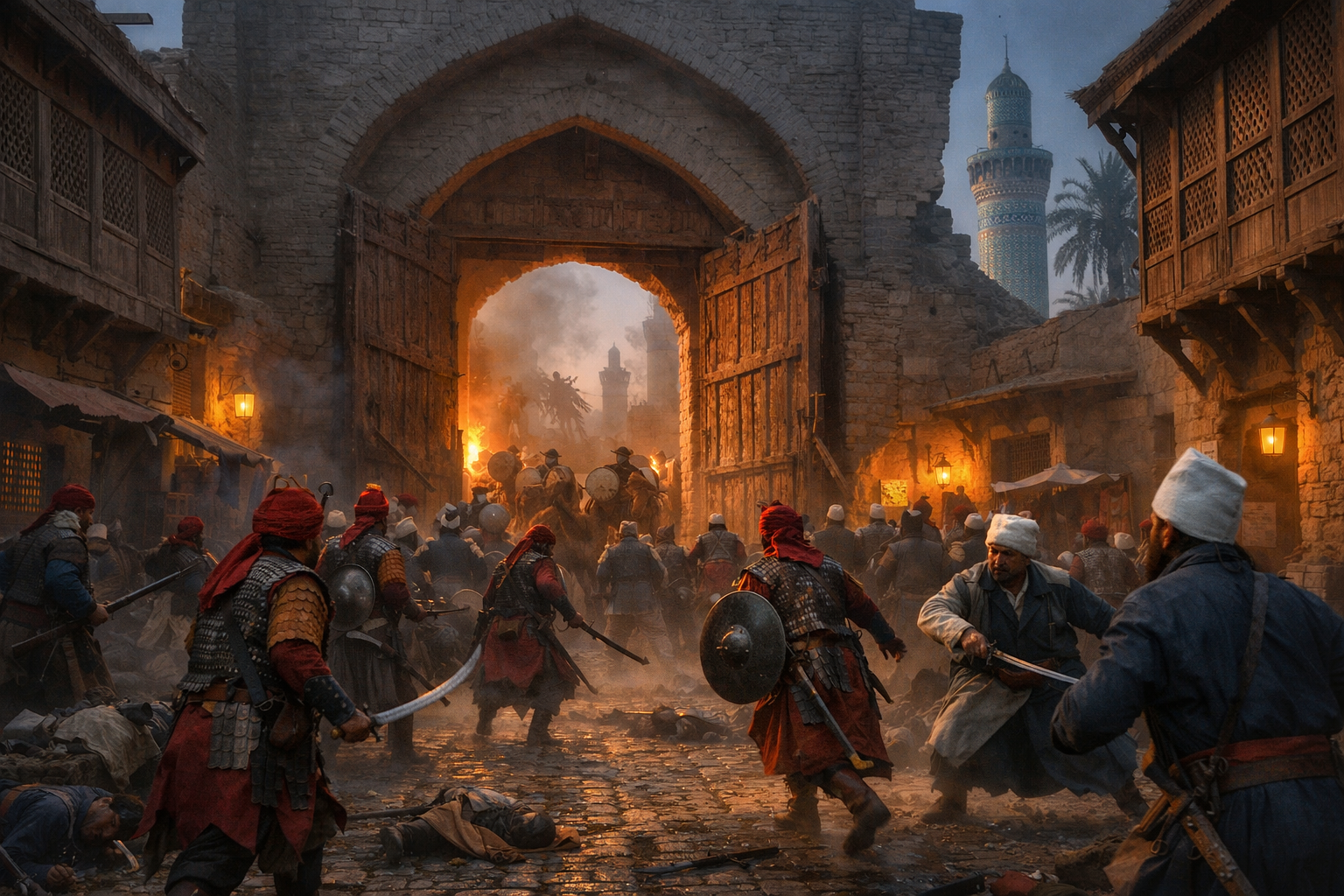
Baghdad, 1624
The pre-dawn air hung heavy over Baghdad's ancient walls as Persian soldiers moved against the city. The Ottoman garrison had been weakened by months of unrest and civil strife, and the situation inside the city was far from stable. Shah Abbas I's elite troops, led by his trusted general Qarčḡāy Khan, had spent weeks gathering intelligence and pressing the siege. Crucially, the city had been under the control of the rebel Janissary leader Bakr Subasi since 1621, and it was Bakr who had invited Safavid intervention, opening the door to the Persian advance.
Baghdad's population of nearly 100,000 (a mix of Arabs, Turks, and Persians, both Sunni and Shiite) lived under the shadow of this internal rebellion and the approaching Safavid army. The city's fate was shaped as much by the fractures within the Ottoman order as by Persian military strength.
As the siege reached its conclusion, Safavid war drums thundered across the city, and the battle cry "Ya Ali!", invoking the name of Shiism's first imam, echoed through the narrow streets. Persian forces pressed their advantage at multiple points, and chaos erupted as the remaining loyal Ottoman soldiers scrambled to mount a defense.
Bakr Subasi, the rebel leader whose invitation had helped bring the Safavids to Baghdad's gates, was captured in the aftermath and executed. By the time the fighting ended, on 14 January 1624, Baghdad had fallen to Safavid Persia. The city, which had been under Ottoman control since 1534, now passed to Persian hands, marking a dramatic shift in the balance of power in the Middle East.
The Ottoman-Safavid rivalry had deep roots, stretching back to the early 16th century when both empires emerged as the dominant powers in the Islamic world. Their conflict was not merely territorial but ideological. The Ottomans championed Sunni Islam, while the Safavids were the standard-bearers of Twelver Shiism.
Baghdad held particular significance for both empires. For the Ottomans, it represented their authority over the Arab lands and their claim to leadership of the Sunni Muslim world. For the Safavids, Baghdad was both a strategic prize and a spiritual center, home to important Shiite shrines and a symbol of Persian influence in Mesopotamia.
The timing of Shah Abbas I's campaign was carefully calculated. The Ottoman Empire was experiencing a period of instability known as the "Sultanate of Women," in which royal women wielded considerable influence over young or weak sultans. Sultan Murad IV was only 11 years old when he ascended to the throne in 1623, and the empire was plagued by janissary revolts, provincial rebellions, and economic crisis.
Shah Abbas I, by contrast, had spent decades modernizing the Safavid military and administration. He had created a standing army equipped with modern firearms and artillery, reformed the tax system, and established diplomatic relations with European powers to counter Ottoman influence.
The Main Narrative
The capture of Baghdad sent shockwaves through both empires. From multiple contemporary sources, we can piece together the complex aftermath of this momentous event.
According to the Ottoman chronicler Peçevi Ibrahim Efendi, the loss of Baghdad was seen as a catastrophic failure of leadership in Istanbul. The young Sultan Murad IV's mother, Kösem Sultan, who effectively ruled as regent, faced intense pressure to respond. The Ottoman court was divided between those advocating immediate military action and others counseling patience until the empire could rebuild its strength.
From the Safavid perspective, as recorded by the court historian Iskandar Beg Munshi, Shah Abbas I's victory was presented as divine providence: the restoration of Baghdad to Shiite control. The Shah ordered the restoration of Shiite shrines and implemented policies favoring the city's Shiite population, while generally maintaining tolerance toward its Sunni inhabitants.
The local Arab population's experience reveals a more nuanced reality. While some Shiite Arabs welcomed Persian rule, many Sunni Arabs felt threatened by the change in power. Baghdad's merchants faced uncertainty as commercial networks were reconfigured under the new administration.
The occupation brought significant changes to Baghdad's administrative structure. Shah Abbas appointed Safi Quli Khan as governor, who implemented Safavid administrative practices while maintaining some Ottoman institutions. The city's defenses were strengthened, and new Persian artillery units were stationed permanently within its walls.
The Ottoman Empire, however, would not accept this loss permanently. The young Sultan Murad IV, as he grew into his role, became obsessed with recapturing Baghdad. He spent years rebuilding the Ottoman military, crushing internal rebellions, and preparing for what would become his defining campaign.
Consequences and Impact
The Safavid conquest of Baghdad in January 1624 had far-reaching consequences that would shape Middle Eastern politics for generations. It demonstrated the vulnerability of Ottoman power in the east and emboldened other potential challengers to Ottoman authority.
The loss of Baghdad contributed to significant reforms within the Ottoman Empire. Sultan Murad IV, driven partly by this humiliation, would emerge as one of the empire's most forceful rulers. His subsequent military reforms and campaigns would eventually lead to Baghdad's recapture in 1638.
The period of Safavid control (1624-1638) left lasting marks on Baghdad's religious and cultural landscape. The restoration and expansion of Shiite shrines during this period created enduring centers of pilgrimage and learning. The episode also deepened the sectarian divisions within the city, creating patterns of religious geography that would persist for centuries.
As we move into our next episode, we will follow the young Sultan Murad IV's transformation from a puppet ruler into the "Conqueror of Baghdad." His obsession with recapturing the city would drive him to reshape the Ottoman military and administration, leading to one of the most remarkable sieges in military history. The story of Baghdad would continue to unfold, with consequences that echo into modern times.
Editor's Context
Read this episode as a study in imperial administration as much as conquest. Ottoman power depended on frontier politics, fiscal systems, elite bargains, and the ability to absorb local complexity. The date markers (1534, 000) are included because chronology is one of the easiest places for narrative history to become misleading. The episode's themes (history, empire, power) are the editorial lens for weighing cause and consequence rather than treating the story as isolated trivia.
Reviewed under the EmpiresDiary editorial workflow by Obadiah.
Drafted with AI. Accuracy review and corrections are ongoing — if you spot an error, please report it. See our workflow and editorial policy.