The Rise of Orhan: Building an Empire
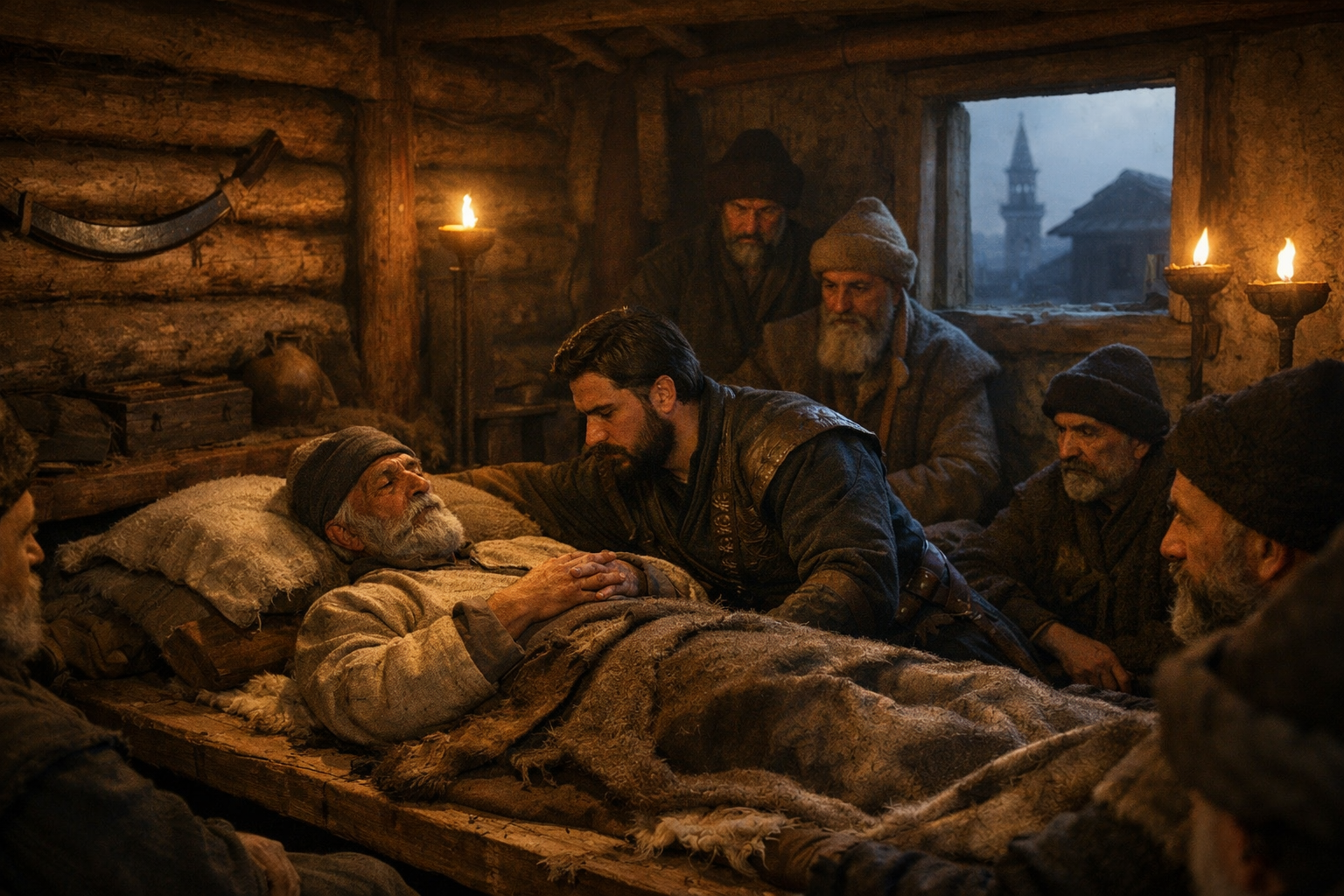
A Father's Final Words
The year was 1324, and in a modest wooden structure within the frontier town of Söğüt, Osman I lay on his deathbed. The aging warrior-chief, who had given his name to what would become one of history's greatest dynasties, beckoned his son Orhan closer. Oil lamps filled the room with smoke as tribal leaders and warriors pressed in to witness their leader's final moments.
Later Ottoman tradition holds that Osman urged his son to rule with justice, protect his people, avoid cruelty, and always serve Islam. These were the values of a frontier leader who understood that conquest alone could not hold a people together. The scene itself belongs more to legend than to documented record, but the principles it conveys shaped how later Ottomans remembered and legitimized their origins.
This was nothing like the grand imperial deathbeds that would later characterize Ottoman succession. Here, on a frontier wedged between the declining Byzantine Empire and the Turkic beyliks of Anatolia, the transfer of power was intimate and direct. Orhan, already a proven military commander, was at his father's side as the old warrior passed from the world.
Through the window came the sounds of the growing settlement: the clash of metal from the blacksmiths' forges, the calls to prayer from the modest wooden mosque, and the multilingual chatter of merchants in the bazaar. This was the inheritance Orhan would receive. Turkish warriors, Byzantine peasants, Christian townspeople, and Muslim traders were already learning to coexist under Ottoman rule, and that dynamic frontier society was now his to lead.
As Osman drew his final breath, none present could have fully grasped how profoundly their world was about to change. Under Orhan's leadership, what had begun as a small principality would transform into the foundations of an empire.
The World of 1324
The early 14th century was a time of profound transition in the Eastern Mediterranean. The Byzantine Empire, once the dominant power in the region, had become a shadow of its former self. Civil wars had weakened its grip on Asia Minor, while Serbian expansion pressed hard against its European territories. That power vacuum created openings for the various Turkish beyliks (principalities) that had emerged in Anatolia following the decline of the Seljuk Sultanate.
The Ottomans under Osman I had distinguished themselves through military success combined with pragmatic governance. Unlike many contemporaries, they had built a reputation for relatively tolerant rule, generally allowing conquered populations to maintain their customs and religious practices in exchange for tribute. That approach attracted Turkish warriors seeking glory and local populations tired of Byzantine mismanagement alike.
The political landscape was crowded. To the east lay other Turkish beyliks, some more powerful than the Ottomans. To the west, fragmenting Byzantine territories offered both opportunity and danger. To the north, the Black Sea remained a vital trading route controlled by the Genoese and Venetians, while the Mongol Ilkhanate's influence in Anatolia was waning, opening new possibilities for expansion.
What Orhan inherited was modest in size but strategically well-positioned. The principality sat between Europe and Asia, drew military manpower and economic resources from a mixed population, and operated through a flexible political system capable of adapting to rapid growth.
Main Narrative: Orhan's Transformation of the Ottoman State
Orhan's 38-year reign (1324-1362) marked the crucial transition from tribal confederation to empire. His approach combined military expansion with serious state-building across three areas:
Military Innovation: Orhan recognized that traditional tribal warfare would not sustain prolonged conquest. He established the Yaya corps, the first regular paid infantry in Ottoman history, recruiting primarily from Turkish peasants. These forces proved decisive in capturing the Byzantine cities of Bursa (1326) and Nicaea (1331), giving the Ottomans their first major urban centers. The development of a standing slave-soldier system, including the Kapikulu and the Janissary corps, would come under his successor Murad I, building on the foundations Orhan had laid.
Administrative Development: Holding those cities required new forms of governance. Orhan established the first formal Ottoman bureaucracy, appointing kadis (judges) and other officials to administer urban areas. He began minting the first Ottoman coins and introduced a regular system of taxation. Crucially, he preserved much of the existing Byzantine administrative infrastructure and incorporated Greek officials directly into his government.
Cultural and Religious Policy: Orhan pursued a careful balance between Islamic and secular authority. He built mosques and religious schools while maintaining protection for Christian subjects. His marriage to Theodora, daughter of Byzantine emperor John VI Cantacuzenus, demonstrated his political pragmatism and set a precedent for Ottoman-Byzantine diplomatic marriages.
The reactions to his rule varied sharply depending on who was watching. John VI Kantakouzenos, whose own writings lament the devastation Ottoman forces inflicted on Byzantine territories and the suffering of his subjects, nonetheless found himself drawn into alliance and family ties with Orhan, a testament to the complex and often painful realities of Byzantine-Ottoman relations. Islamic scholars praised Orhan's patronage of religious institutions. Turkish tribal leaders, for their part, sometimes complained about the increasing centralization of power. Local Greek populations often found Ottoman rule preferable to Byzantine taxation, though some cities resisted fiercely before surrendering.
Consequences and Lasting Impact
Orhan's reign established patterns that would define Ottoman rule for centuries:
- The fusion of Turkish, Islamic, and Byzantine administrative traditions
- A pragmatic approach to religious and cultural differences
- The development of professional military forces
- The establishment of a centralized bureaucracy
His conquests in northwestern Anatolia provided the secure base from which the Ottomans would later launch their expansion into Europe. The institutions he built, particularly in military organization and urban administration, formed the foundation for the empire's later success.
What Orhan accomplished, in the end, was a transformation of the Ottoman polity from a frontier principality into a legitimate state capable of competing with the major powers of the region. His careful balance of innovation and tradition gave his successors something durable to build on.
As Orhan's life drew to a close in 1362, his son Murad I prepared to take power. The foundation was laid for Ottoman expansion into Europe, beginning with their first permanent foothold in Gallipoli. The next chapter would see the Ottomans move from regional power to true empire as they began their dramatic conquest of the Balkans. The stage was set for the Ottoman golden age, but first they would need to prove themselves on the battlefields of Europe.
Editor's Context
Read this episode as a study in imperial administration as much as conquest. Ottoman power depended on frontier politics, fiscal systems, elite bargains, and the ability to absorb local complexity. The date markers (1324, 1362) are included because chronology is one of the easiest places for narrative history to become misleading. The episode's themes (history, empire, power) are the editorial lens for weighing cause and consequence rather than treating the story as isolated trivia.
Reviewed under the EmpiresDiary editorial workflow by Obadiah.
Drafted with AI. Accuracy review and corrections are ongoing — if you spot an error, please report it. See our workflow and editorial policy.