The Siege of Rhodes: Final Clash of Cross and Crescent
Dawn at the Gates of Rhodes
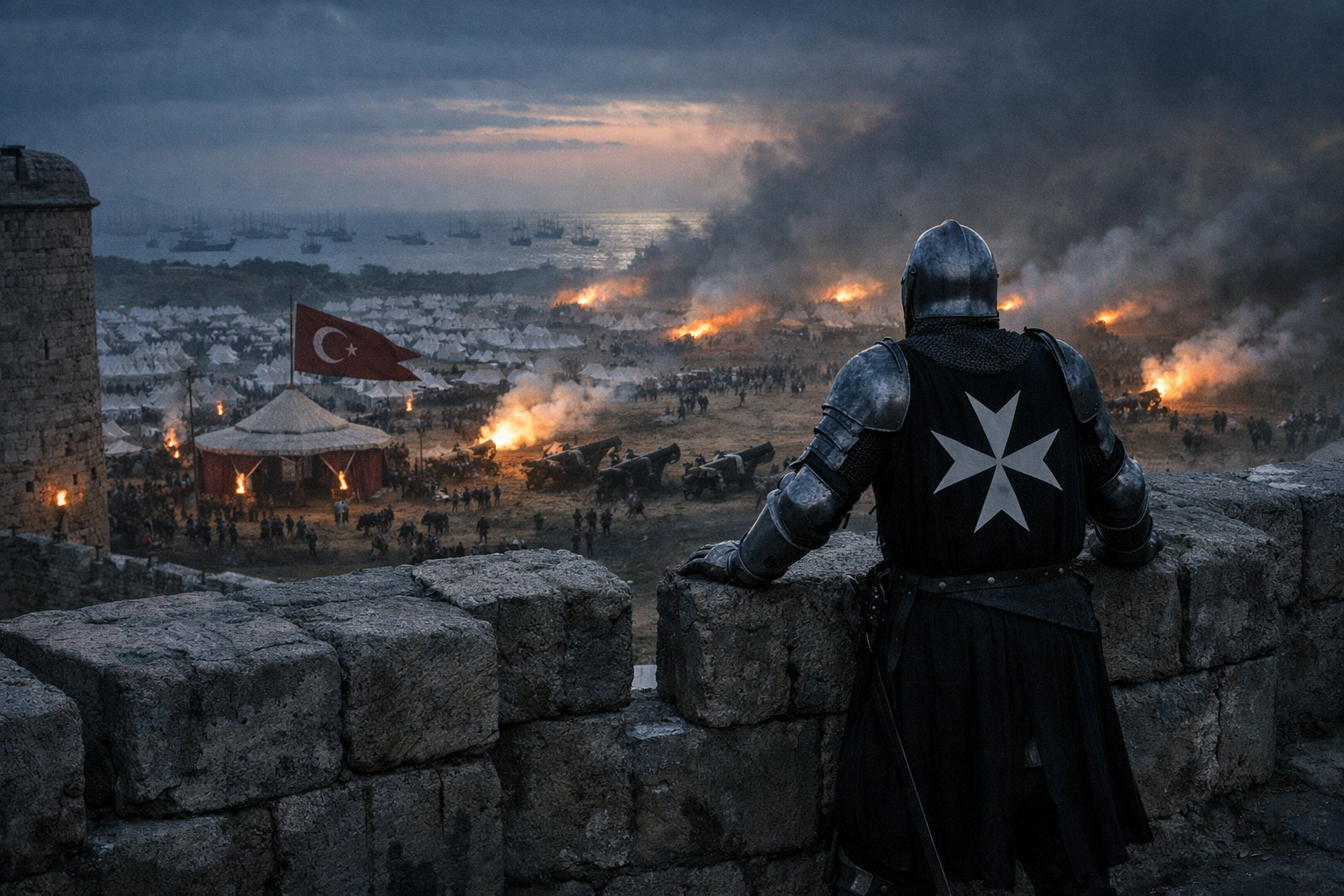
The pre-dawn silence of late June 1522 broke apart under Ottoman cannon fire. Grand Master Philippe Villiers de L'Isle-Adam stood atop the walls of Rhodes and watched as Sultan Suleiman's artillery lit the darkness with deadly precision. The Knights Hospitaller had long known this day was coming. The young Ottoman sultan, eager to prove himself worthy of the title "The Magnificent," had assembled the largest invasion force the eastern Mediterranean had ever seen.
What stretched before L'Isle-Adam was staggering: over 400 ships had delivered more than 100,000 Ottoman troops to the island's shores. Siege engineers had spent weeks preparing their positions, and their massive bombards, some capable of hurling stone balls of roughly 260 kilograms, were arranged in a deadly arc around the city's defenses.
As the light grew, the Grand Master could make out the Ottoman camp stirring across the landscape. Countless tents spread in every direction, their pennants and standards catching the morning breeze. The distinctive red flag bearing the white crescent moon flew above Suleiman's command pavilion. Along the siege lines, sappers and miners were already at work, attempting to tunnel beneath the city's walls.
Inside Rhodes, approximately 6,700 defenders (including around 700 knights from across Europe) prepared for what they knew would be the fight of their lives. The city's Greek civilian population of about 30,000 had spent months helping strengthen fortifications and stockpile supplies. The Knights had successfully resisted a major Ottoman siege in 1480, but this time was different. Suleiman was personally commanding the operation, and he had sworn not to return to Constantinople until the Christian stronghold fell.
The Knights and the Ottomans
The Knights Hospitaller had controlled Rhodes since 1309, transforming it into one of the most heavily fortified islands in the world. Originally founded to protect Christian pilgrims in Jerusalem during the Crusades, they had evolved into a powerful maritime force that frequently disrupted Ottoman shipping and commerce in the eastern Mediterranean. Their raids on Muslim merchants and pilgrims had long been a thorn in the side of Ottoman rulers.
For the Ottomans, Rhodes was the last significant Christian stronghold in the eastern Mediterranean. After Mehmed II's conquest of Constantinople in 1453, the empire had steadily expanded its control over the region, yet Rhodes remained defiant. Its strategic position allowed the Knights to threaten vital Ottoman sea lanes running between Constantinople and Egypt.
Suleiman, who had ascended to the throne in 1520, saw the conquest of Rhodes as both a strategic necessity and a matter of personal honor. His great-grandfather Mehmed II had failed to take the island in 1480, and his father Selim I had been too preoccupied with eastern campaigns to attempt it. Fresh from his conquest of Belgrade in 1521, the young sultan turned his full attention to eliminating this persistent Christian threat.
The Knights had spent years preparing for the confrontation. Under Grand Master Fabrizio del Carretto, they had modernized Rhodes' fortifications to withstand the latest developments in siege warfare. Multiple rings of thick walls were reinforced with earthen banks to better absorb cannon fire, while a network of underground galleries allowed defenders to move safely between positions.
The Great Siege Unfolds
The initial Ottoman bombardment focused on the southern walls, where the heaviest guns could be brought closest to the fortifications. Day after day, massive stone balls crashed against the defenses while Ottoman miners attempted to tunnel beneath them. The Knights responded with counter-mines, and brutal underground battles broke out as the two sides clashed in the darkness below the city.
By August, the situation had grown desperate. The constant bombardment was taking its toll despite the sturdy fortifications. The Bastion of England had been severely damaged, and Ottoman forces had captured the critical Tower of St. Nicholas after fierce fighting.
The combat was relentless. Ottoman assault waves struck the walls repeatedly, each push larger than the last, while the defenders fought to hold every breach. The roar of cannon fire was nearly continuous, and the smoke of battle hung over the city for days at a time. The dead accumulated before the walls on both sides as neither force was willing to yield ground easily.
Suleiman, frustrated by the slow progress, ordered a major assault on September 24. Ottoman janissaries stormed the breaches in the walls while thousands of other troops attacked multiple sections at once. Defenders poured burning oil and Greek fire onto the attackers as crossbow bolts and arquebus shots filled the air. The fighting was close and savage.
The Knights held, though at terrible cost. Grand Master L'Isle-Adam personally led counterattacks, rallying his men to hold the lines as the Ottoman assault was repelled. The siege engineer Gabriele Tadino da Martinengo, who organized the critical countermining and counter-battery defense throughout the siege, was among the key figures keeping the city's underground defenses intact. Neither side emerged from September unscathed.
The Final Days
Six months of continuous combat had brought Rhodes to its breaking point by December. Food and gunpowder were running low. Many of the best defenders were dead or wounded, disease had begun spreading through the crowded city, and the civilian population was suffering badly.
Suleiman, recognizing the Knights' valor, offered surprisingly generous terms. The Knights would be allowed to leave with their weapons, religious relics, and archives. The civilian population would be protected and permitted to practice their Christian faith.
On December 22, 1522, Grand Master L'Isle-Adam formally surrendered the city. The Knights were given twelve days to prepare for departure. During that period, Suleiman reportedly remarked to his grand vizier that it grieved him to drive so brave a man from his home at such an age.
Consequences and Legacy
The fall of Rhodes marked a crucial turning point in Mediterranean history. The Ottoman Empire now controlled virtually the entire eastern Mediterranean, securing vital shipping routes and cementing its position as a naval power. The Knights Hospitaller, after briefly seeking refuge in various Italian ports, were granted the island of Malta by Holy Roman Emperor Charles V in 1530.
The siege exposed both the strengths and the limits of sixteenth-century fortress warfare. The Knights' modernized defenses had allowed them to resist one of history's largest siege armies for six months, yet they could not outlast the Ottoman Empire's superior resources and determination. Six months was remarkable. It was not enough.
The generous surrender terms became a model of Ottoman pragmatism, enhancing Suleiman's reputation as a magnanimous ruler. The Greek population of Rhodes, now under Ottoman control, retained many of their religious and cultural rights under the empire's millet system.
With Rhodes secured, Suleiman turned his attention westward. His next great challenge would be Hungary, where the death of King Louis II had created a power vacuum in Central Europe. The stage was set for the Ottoman Empire's expansion into the heart of Christian Europe, leading to the momentous Siege of Vienna in 1529.
Editor's Context
Read this episode as a study in imperial administration as much as conquest. Ottoman power depended on frontier politics, fiscal systems, elite bargains, and the ability to absorb local complexity. The date markers (000, 400) are included because chronology is one of the easiest places for narrative history to become misleading. The episode's themes (history, empire, power) are the editorial lens for weighing cause and consequence rather than treating the story as isolated trivia.
Reviewed under the EmpiresDiary editorial workflow by Obadiah.
Drafted with AI. Accuracy review and corrections are ongoing — if you spot an error, please report it. See our workflow and editorial policy.