The Siege Within: Janissary Revolts and Reform
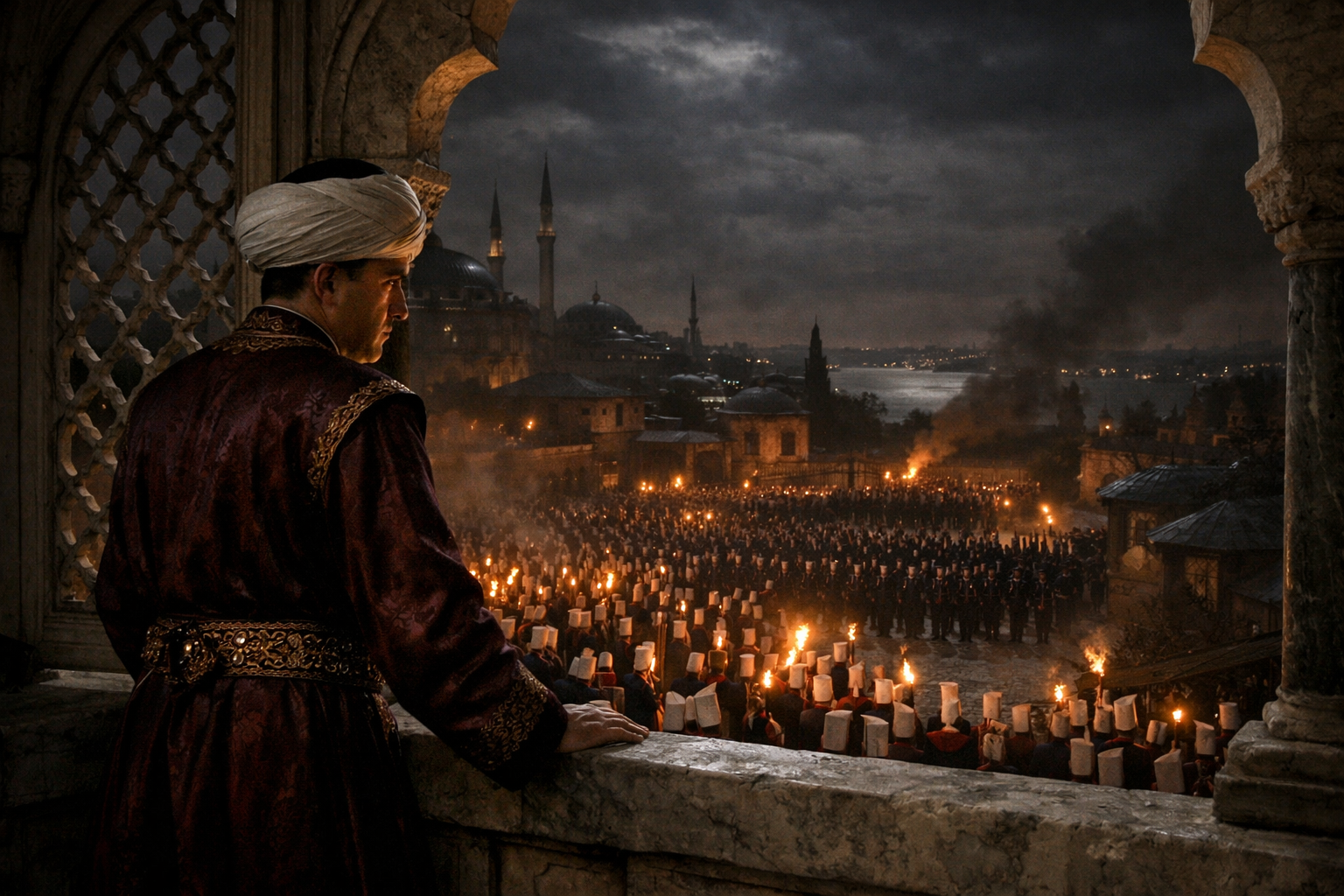
The Night of Revolution
The night of May 29, 1807, settled over Istanbul with a particular kind of dread. Through the narrow streets of the capital, groups of armed men moved with purpose, their faces lit by flickering torches. These were Janissaries, the once-elite infantry corps of the Ottoman Empire, now a privileged but militarily obsolete class clinging hard to their traditional ways.
At the Topkapı Palace, Sultan Selim III received increasingly alarming reports. The Janissaries, joined by conservative religious scholars (ulema) and disgruntled craftsmen, had gathered in the Hippodrome, their numbers swelling into the thousands. Their demands were plain: they wanted an end to the Nizam-ı Cedid (New Order), Selim's military modernization program that threatened everything they had built their livelihoods around.
In his private chambers, Selim III could hear the distant roar of angry voices. The 45-year-old sultan, known for his poetry and musical compositions as much as his reformist ideas, stood by a window overlooking the Bosphorus. He had long argued that the empire could not survive if it remained frozen in the past while the world moved forward, yet the forces arrayed against change were proving formidable.
Outside, the rebels' torches dotted the darkness like angry fireflies. The sultan's loyal Nizam-ı Cedid troops, trained in modern European military tactics and armed with the latest weapons, stood ready to defend their reformist ruler. They were vastly outnumbered, though. Conservative forces had united against change, and the numbers kept growing.
The Need for Reform
The Ottoman Empire of 1807 was a shadow of its former glory. Once the terror of European powers, it had suffered a string of military defeats throughout the 18th century, and its traditional military system, centered on the Janissary corps, had failed to keep pace with European innovations in warfare.
The Janissaries were originally created as an elite slave-soldier force in the 14th century. Over time they evolved into a hereditary military caste, and by the late 18th century many were not soldiers in any practical sense. They had become shopkeepers, craftsmen, and traders who collected military salaries while running civilian businesses. They guarded their privileges jealously but refused to adopt modern training or weapons.
Selim III ascended to the throne in 1789 and witnessed firsthand how badly the Ottoman military lagged behind its European counterparts. The French Revolution and the subsequent Napoleonic Wars demonstrated what modern armies could do. Inspired by European military advisers and his own study of Western advances, Selim launched the Nizam-ı Cedid reforms in 1796.
The reforms went well beyond military reorganization. They included the establishment of permanent Ottoman embassies in European capitals and the creation of new technical schools, along with attempts to overhaul the tax system. The centerpiece, however, was a new army corps trained in modern tactics and equipped with contemporary weapons.
The political cost was steep. New taxes levied to fund the modern army bred resentment across the population. The Janissaries saw the new force as a direct threat to their position, while conservative religious leaders viewed Western-style reforms as an affront to Islamic traditions. Selim had made enemies on multiple fronts before the revolt even began.
The Revolt Unfolds
The uprising of 1807 was not spontaneous. It was the culmination of years of simmering tension, and the immediate spark came from the deployment of Nizam-ı Cedid troops to defend the Dardanelles against a possible British attack. The Janissaries refused to serve alongside the new troops, reading the deployment as a deliberate attempt to expose their own obsolescence.
Kabakçı Mustafa, a Janissary leader, emerged as the public face of the rebellion. He gathered supporters from the Janissary corps, conservative religious scholars, and guild members who felt threatened by modernization. The rebels framed their cause as a defense of Islamic tradition against dangerous Western innovations, which gave the movement a broader appeal than a simple military grievance would have managed.
The sultan's supporters were divided. Some advised immediate military action against the rebels; others counseled negotiation. As the rebellion gained momentum, many of Selim's supposed allies abandoned him. The ulema, led by the Şeyhülislam Ataullah Efendi, issued a fatwa on May 29 declaring Selim unfit to rule. That fatwa marked a point of no return, stripping the sultan of religious legitimacy and accelerating the collapse of his position. Even some of his modernized troops proved unreliable, with several units refusing to fire on fellow Muslims.
There was nowhere left to maneuver. On May 29, 1807, the rebels breached the palace defenses. Selim III was forced to abdicate in favor of his cousin Mustafa IV, who promised to abolish the reforms and restore traditional privileges.
Consequences and Legacy
The overthrow of Selim III was a critical turning point. In the immediate aftermath, the Nizam-ı Cedid reforms were dismantled, reform-minded officials were executed, the new army was disbanded, and the Janissaries reasserted their traditional privileges.
Their victory did not hold. The empire's military weakness became even more apparent in the years that followed, producing territorial losses and declining international influence. Selim's cousin and eventual successor, Mahmud II, succeeded where Selim had failed, abolishing the Janissary corps entirely in 1826 in a bloody purge known as the Auspicious Incident.
Selim's reforms, though defeated in his own lifetime, laid the groundwork for the more extensive Tanzimat reforms of the 19th century. His reign marked the beginning of a long and painful modernization process that would reshape the Ottoman Empire through its final century.
The next episode covers the aftermath of Selim III's deposition and the dramatic events that followed: his tragic death in 1808 and the rise of Mahmud II, who finally broke the power of the Janissaries and pushed through sweeping reforms. The struggle between tradition and modernization would keep shaping Ottoman history until the empire's final days.
Editor's Context
Read this episode as a study in imperial administration as much as conquest. Ottoman power depended on frontier politics, fiscal systems, elite bargains, and the ability to absorb local complexity. The date markers (1789, 1807) are included because chronology is one of the easiest places for narrative history to become misleading. The episode's themes (history, empire, power) are the editorial lens for weighing cause and consequence rather than treating the story as isolated trivia.
Reviewed under the EmpiresDiary editorial workflow by Obadiah.
Drafted with AI. Accuracy review and corrections are ongoing — if you spot an error, please report it. See our workflow and editorial policy.