The Forgotten Siege: Diu 1538
A Naval Clash in Foreign Waters
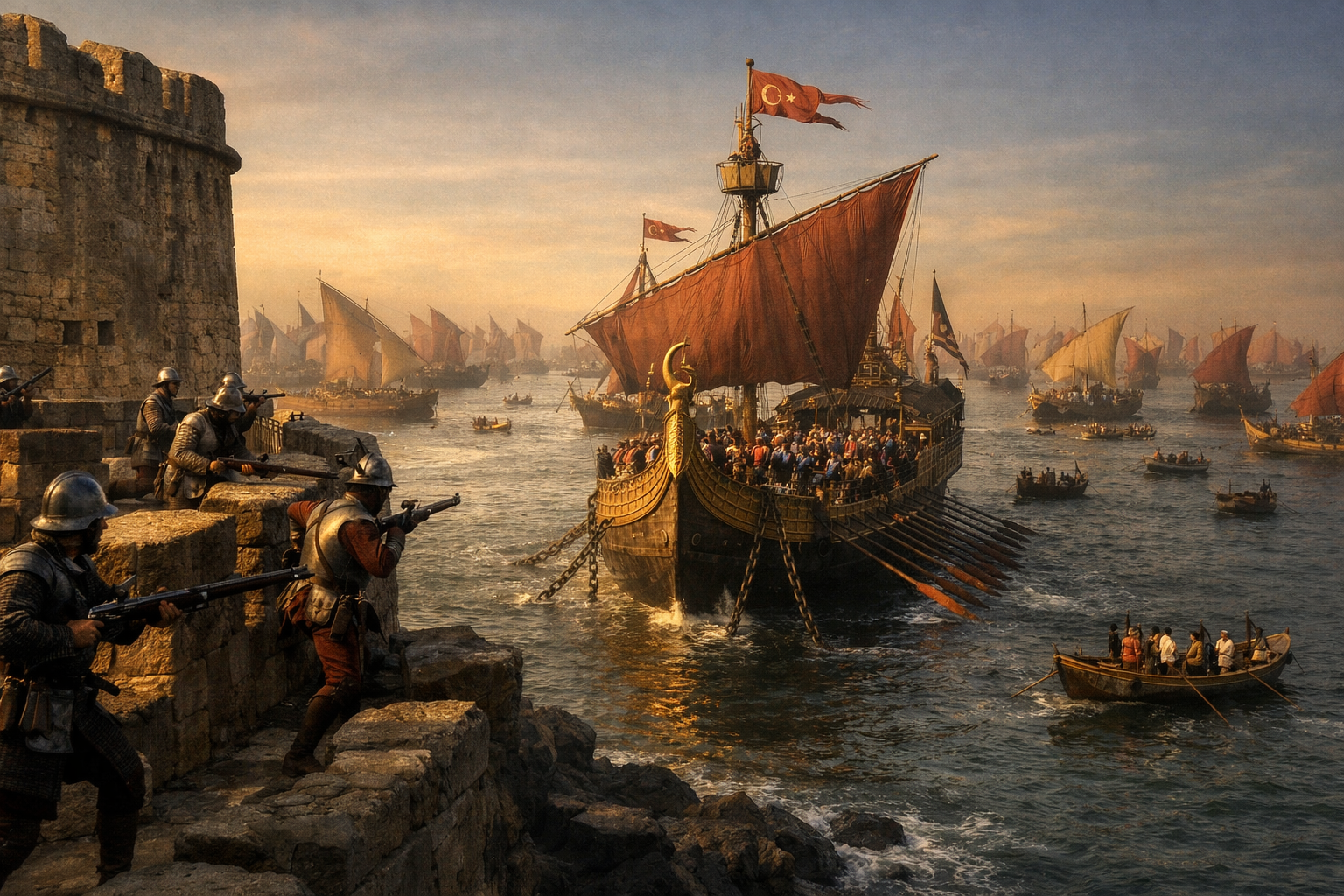
Dawn on September 4, 1538 revealed an imposing sight off the coast of Diu, a fortress-island on India's western shore. The Ottoman fleet, led by the experienced admiral Hadım Süleyman Pasha, had arrived with roughly 80 ships. They were joined by a large Gujarat Sultanate army under Khadjar Safar, together fielding a combined force of around 22,000 men: approximately 6,000 Ottoman troops and some 16,000 Gujarati soldiers. The galleys' distinctive sails caught the morning breeze as the allied force prepared to move against the Portuguese stronghold.
Standing on the deck of his flagship, Süleyman Pasha surveyed the Portuguese fortress. The fortress of Diu, its thick stone walls rising directly from the rocky coastline, represented everything that threatened Ottoman ambitions in the Indian Ocean. For decades, Portuguese ships had dominated these trade routes, controlling access to the lucrative spice trade the Ottomans badly wanted for themselves.
Inside the fortress, Portuguese captain António da Silveira had only 600 men at his disposal. Their determination was iron. They had spent months strengthening Diu's defenses, knowing the confrontation was coming. The fortress's massive walls housed over 100 heavy cannon, and local fishermen had been warning of the approaching fleet for days, giving the defenders precious time to prepare.
As the morning progressed, the Ottoman ships began methodically positioning themselves for the bombardment. Chains rattled, anchors splashed into the water, and Portuguese soldiers hurried to their positions, checking ammunition stores and ensuring their cannon were properly aimed. Both sides understood that this battle would decide far more than the fate of a single fortress. It would determine who controlled the maritime trade routes between Europe and India.
The Battle for Indian Ocean Supremacy
The joint Ottoman-Gujarat attempt to seize Diu was the culmination of decades of growing tension in the Indian Ocean. Since Vasco da Gama's arrival in India in 1498, Portuguese expansion had produced a network of trading posts and fortified ports stretching from Mozambique to Malacca. By the 1530s, they had effectively established a monopoly over the spice trade, requiring all merchant vessels in the region to carry Portuguese passes.
This dominance cut directly against Ottoman economic interests and their claim to leadership of the Islamic world. Sultan Süleyman the Magnificent, at the height of his power, had received numerous appeals for help from Indian Muslim rulers, particularly the Sultan of Gujarat, who watched their traditional trading networks come apart under Portuguese control.
The Ottoman Empire had already demonstrated its naval capabilities in the Mediterranean under the famous admiral Barbarossa Hayreddin Pasha. Projecting power into the Indian Ocean, though, was a different problem entirely. The distances were vast, the logistics complex, and the environment unfamiliar. The 1538 expedition was the Ottoman Empire's most ambitious attempt yet to break Portuguese control of the Indian Ocean trade routes.
The fortress of Diu itself had only recently come under Portuguese control. In 1534, Sultan Bahadur Shah of Gujarat had concluded the Treaty of Bassein, granting the Portuguese permission to build a fortress there, hoping to gain their support against the expanding Mughal Empire. Construction began in 1535. That decision proved controversial, producing conflict between Gujarat and the Portuguese, and creating the opening for Ottoman intervention.
The Siege Unfolds: A Battle of Wills
The siege began with a thunderous Ottoman bombardment. Süleyman Pasha's fleet had brought some of the largest siege guns ever seen in the Indian Ocean, and they pounded the fortress walls without pause. The Portuguese defenders responded in kind, their well-positioned artillery causing significant damage to several Ottoman ships. Meanwhile, Khadjar Safar's Gujarati forces pressed the landward approaches, making this a combined land-and-sea operation rather than a purely naval assault.
The Portuguese eyewitness Lopo de Sousa Coutinho, who participated in the defense and was wounded during the siege, left an account describing the desperate conditions inside the fortress. The defenders worked through the nights to repair damage, carefully rationing their supplies as the weeks wore on.
The Ottoman and Gujarati forces attempted several assaults. The rocky coastline and strong defenses made each attempt extremely costly. The besieging commanders faced mounting frustration as the fortress absorbed blow after blow and the garrison refused to yield.
By October, the situation had grown more complicated. Disease spread through the besieging camp, supplies ran low, and the local climate proved punishing for troops accustomed to Mediterranean conditions. Rumors of Portuguese reinforcements sailing from Goa added to the pressure on Süleyman Pasha.
He faced a difficult decision. His instructions from Istanbul had been clear: take the fortress and establish an Ottoman presence in the Indian Ocean. But the resistance was fiercer than expected, and his forces were wearing down. The Portuguese defenders, though severely tested, showed no sign of surrendering.
In early November 1538, after roughly four months of siege, Süleyman Pasha ordered a withdrawal. The fleet departed on November 5-6. The Ottoman and Gujarati forces had lost several ships and thousands of men, with nothing to show for it. As they sailed away, the Portuguese celebrated what felt like a miracle. They had held out against one of the most powerful combined forces in the world.
Consequences: A Turning Point in Naval History
The failed siege had far-reaching consequences. It marked the effective end of Ottoman attempts to challenge Portuguese dominance in the Indian Ocean. Ottoman ships would continue to operate in the Red Sea and Arabian Sea, but they never again mounted a large-scale expedition to the Indian subcontinent.
For the Portuguese, the successful defense of Diu became legendary, reinforcing their position as the dominant European power in the Indian Ocean. The fortress would withstand another major siege in 1546, and Portuguese influence in the region continued for another century.
The battle also exposed the limits of Ottoman power projection. Their success in the Mediterranean had not translated to the Indian Ocean, where the logistical challenges proved too great. That lesson shaped Ottoman strategic thinking for generations.
As the Ottoman Empire absorbed what had happened at Diu, attention shifted back to more familiar waters. The struggle with European powers would increasingly focus on the Mediterranean, where the next great clash came at the Battle of Preveza in 1538. The dream of Ottoman dominance in the Indian Ocean was finished, but new challenges awaited closer to home.
Editor's Context
Read this episode as a study in imperial administration as much as conquest. Ottoman power depended on frontier politics, fiscal systems, elite bargains, and the ability to absorb local complexity. The date markers (1538, 000) are included because chronology is one of the easiest places for narrative history to become misleading. The episode's themes (history, empire, power) are the editorial lens for weighing cause and consequence rather than treating the story as isolated trivia.
Reviewed under the EmpiresDiary editorial workflow by Obadiah.
Drafted with AI. Accuracy review and corrections are ongoing — if you spot an error, please report it. See our workflow and editorial policy.