The Crescent and the Cross Collide
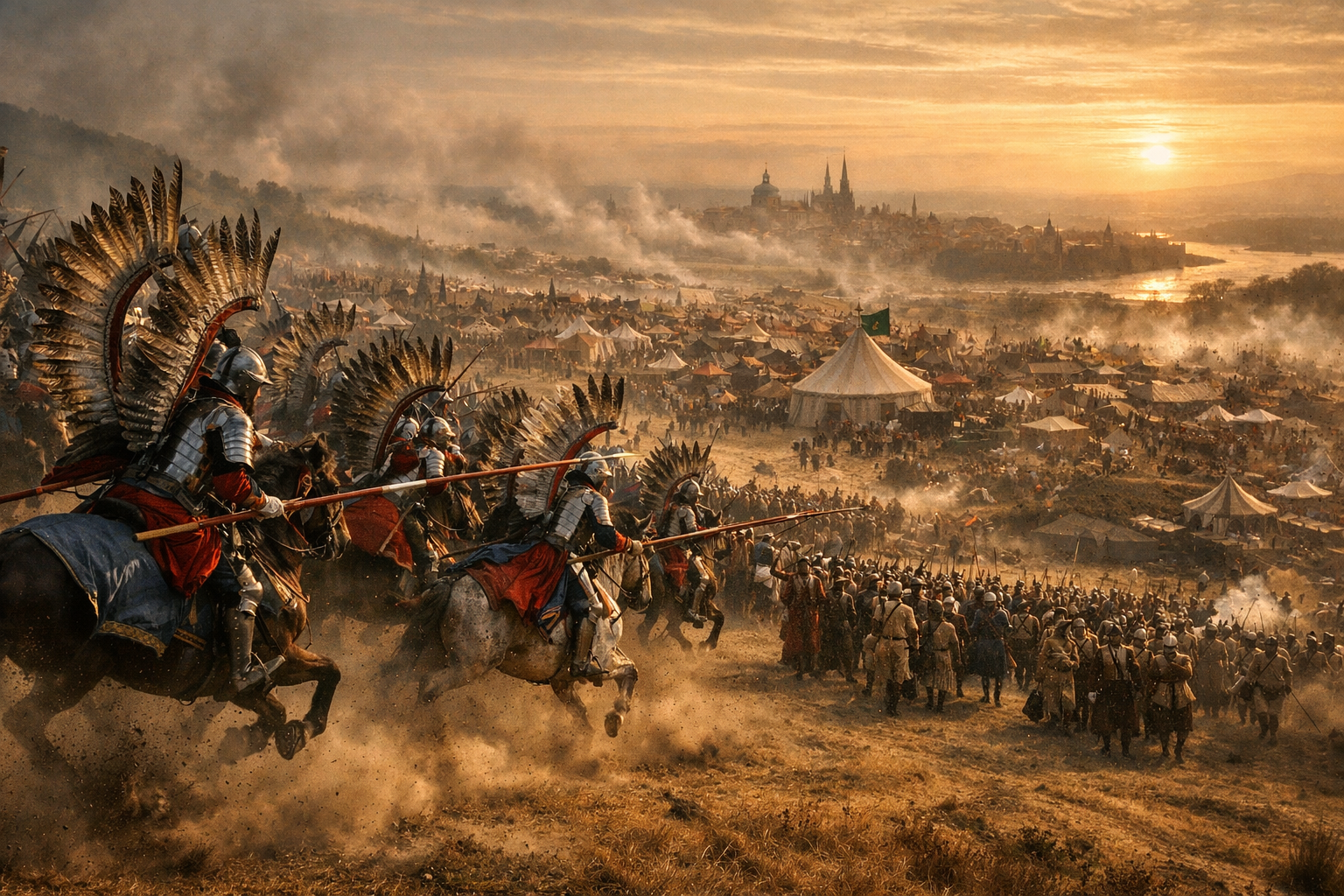
Vienna, September 12, 1683
The pre-dawn air hung heavy with smoke as Grand Vizier Kara Mustafa Pasha paced inside his luxurious tent outside Vienna's walls. For two months his massive Ottoman army, numbering over 150,000 men, had laid siege to the Habsburg capital, yet the city stubbornly refused to fall. Through his spyglasses he could still see desperate defenders manning the crumbling walls, their numbers diminished but their resolve unbroken.
What troubled him more was the dust cloud on the horizon. Scouts had reported a massive relief force approaching: a combined Christian army led by Polish King John III Sobieski and Charles V, Duke of Lorraine. As the morning sun rose, its rays caught countless lances, pikes, and armored cavalry advancing toward his position.
Kara Mustafa had made a fatal miscalculation. He had allowed his troops to spread out across the countryside, looting villages and hunting for spoils, when he should have pressed the assault weeks earlier while Vienna was at its weakest. Now his forces were dispersed and the elite Janissary corps was exhausted from weeks of trench warfare and mining operations beneath the city walls.
As the allied army drew closer, the famous Winged Hussars of Poland came into view. Their distinctive feathered wings created an otherworldly sight as they prepared to charge. The moment that would determine not just the fate of Vienna but the future of Ottoman expansion into Central Europe was almost at hand.
A Century and a Half of Conflict
The Ottoman-Habsburg rivalry had begun in earnest with Suleiman the Magnificent's first siege of Vienna in 1529. That failed attempt marked the furthest extent of Ottoman expansion into Central Europe, though it was far from the end of the conflict. For the next 150 years these two great empires clashed repeatedly across Hungary, the Balkans, and the Mediterranean.
The Habsburgs, ruling from Vienna, saw themselves as the defenders of Christian Europe against Islamic expansion. Their Spanish and Austrian branches controlled vast territories stretching from the Netherlands to Hungary, effectively surrounding Ottoman territories on multiple fronts. The Ottomans, for their part, viewed the Habsburgs as the main obstacle to their divinely ordained mission of expanding the Dar al-Islam (House of Islam).
Between 1529 and 1683, the frontier between these empires shifted back and forth across Hungary. Cities changed hands multiple times, with local populations caught between the competing powers. Across Europe, other states either aligned with one side or tried to play them against each other, and the rivalry shaped diplomatic calculations for generations.
The long conflict also drove military innovation on both sides. The Ottomans perfected their siege techniques and developed new artillery, while the Habsburgs built elaborate systems of frontier fortresses and modernized their armies with the latest firearms and tactics.
The Main Narrative: Clash of Empires
The 1683 siege of Vienna represented the culmination of Ottoman ambitions in Central Europe. Encouraged by Hungarian Protestant nobles who opposed Habsburg rule, Kara Mustafa Pasha launched the campaign with the largest Ottoman army ever assembled for European operations.
The defending forces, led by Count Ernst Rudiger von Starhemberg, numbered only about 15,000 men when the siege began in July. They faced the Ottoman army and their Hungarian allies under Imre Thokoly simultaneously. Constant bombardment, mining operations beneath the walls, and dwindling supplies ground the defenders down week by week.
Pope Innocent XI worked tirelessly to assemble a relief force, mediating between Christian powers who normally viewed each other with suspicion. The arrival of John III Sobieski's Polish army proved particularly crucial. Sobieski was renowned as a brilliant cavalry commander and veteran of many battles against Ottoman forces, and his presence gave the allied effort a credible offensive edge.
The Battle of Vienna on September 12 opened with an artillery duel, followed by infantry attacks to secure key high ground. The decisive moment came in the late afternoon. Sobieski led the largest cavalry charge in military history: 18,000 horsemen, including his Winged Hussars, descending upon the Ottoman flanks. The sight of those feathered wings and the thunder of so many horses bearing down at once sent panic rippling through Ottoman ranks, and men began to flee before the charge had even reached their lines.
The Ottoman army collapsed. Kara Mustafa barely escaped capture and abandoned his vast camp, leaving behind the official Ottoman seal, hundreds of cannon, and priceless treasures. Among the spoils were the first coffee beans to reach Vienna, a windfall that would eventually seed the city's famous coffeehouse culture.
Consequences and Lasting Impact
The failed siege marked a turning point. The Ottomans would never again threaten Central Europe, and a long period of territorial losses followed. The Habsburg-led Holy League reconquered Hungary and parts of the Balkans over the next 16 years.
The victory also cemented the Habsburg Empire's standing as a great power and defender of Christianity. Poland, despite its crucial role in the battle, began a long decline in the years that followed, while the Habsburgs consolidated their grip on Central Europe.
Culturally, the ripple effects were just as striking. The croissant pastry was supposedly invented in Vienna to celebrate the victory, its crescent shape mocking the Ottoman symbol. Coffeehouses spread across Europe and transformed social and intellectual life. The image of the "Turkish threat" remained powerful in European art and literature for centuries afterward.
In a later episode we'll explore the Treaty of Karlowitz (1699), which formally ended the Great Turkish War and recorded the first major territorial losses in Ottoman history. The balance of power had shifted decisively. The Ottomans would increasingly find themselves on the defensive against European powers, and the age of Ottoman expansion was over.
Editor's Context
Read this episode as a study in imperial administration as much as conquest. Ottoman power depended on frontier politics, fiscal systems, elite bargains, and the ability to absorb local complexity. The date markers (000, 1529) are included because chronology is one of the easiest places for narrative history to become misleading. The episode's themes (history, empire, power) are the editorial lens for weighing cause and consequence rather than treating the story as isolated trivia.
Reviewed under the EmpiresDiary editorial workflow by Obadiah.
Drafted with AI. Accuracy review and corrections are ongoing — if you spot an error, please report it. See our workflow and editorial policy.