The Battle That Never Was: Mehmed IV's Failed Siege of Vienna
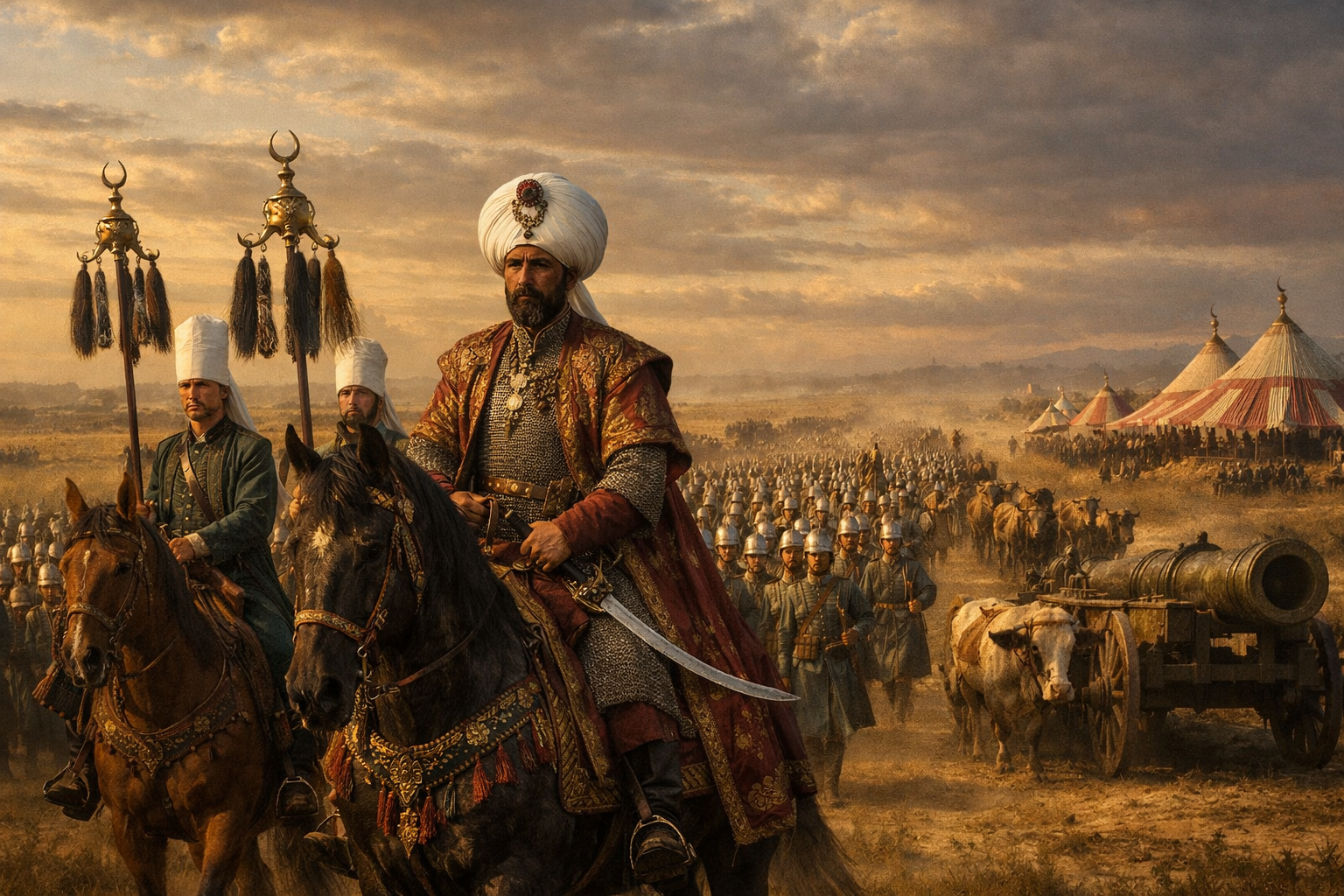
The 1663 Campaign: Köprülü Fazıl Ahmed and the Ottoman Drive into Hungary
Summer 1663
The late summer sun beat down on the vast Ottoman army as it snaked through the Hungarian plains. At its head rode Grand Vizier Fazıl Ahmed Köprülü, commanding the largest force the Ottoman Empire had assembled in decades. Nearly 120,000 men, accompanied by hundreds of siege cannons and supply wagons, kicked up clouds of dust as they marched northward.
Each evening in his opulent tent, Köprülü pored over maps of the region by candlelight. The Grand Vizier was confident. He had timed this advance carefully, unlike his predecessor's autumn campaign. It was only July, leaving plenty of time before winter to press deep into Habsburg territory and claim fortresses that had long resisted Ottoman arms.
The planned 1663 campaign came at a crucial moment in Ottoman-Habsburg relations. The Long Turkish War (1593-1606) had ended in stalemate, and the subsequent Peace of Zsitvatorok marked the first time the Ottomans had treated with the Habsburgs as equals. By the 1660s, though, the Ottoman Empire had experienced a remarkable revival under the Köprülü family of Grand Viziers.
Mehmed Köprülü had restored order and military discipline during his brief but effective tenure (1656-1661). His son and successor Fazıl Ahmed Köprülü sought to capitalize on those reforms with a bold campaign to push deep into Central Europe and extend Ottoman dominance. The timing seemed perfect. The Habsburg Empire was distracted by tensions with France. The Ottoman army had been thoroughly modernized, particularly its artillery corps, and the empire's finances were the healthiest they had been in decades. The Ottomans had also secured their eastern frontier through peace with Persia and consolidated control over Transylvania, providing a secure base for operations.
They had also studied the lessons of earlier campaigns. By launching in high summer 1663, Köprülü believed he had allowed ample time to reduce fortresses and press the campaign before weather became a factor. The stage seemed set for a campaign that would reshape the balance of power in Europe.
The Campaign Advances
As the Ottoman army moved through Hungary, it demonstrated the effectiveness of Köprülü's reforms. The columns were well-supplied, the artillery well-organized, and the march disciplined. Habsburg commanders watched with alarm as the force advanced, recognizing that it represented a serious and capable threat.
Raimondo Montecuccoli, commanding the Habsburg field army, faced a difficult situation. The Ottoman force significantly outnumbered his own, and he could not risk a pitched battle on unfavorable terms. Habsburg alarm was genuine: the Ottoman army was larger and better equipped than anything seen in the region for many years, and the question was not whether it would strike but where.
The answer came at Érsekújvár (Nové Zámky), a strategically vital fortress in present-day Slovakia. Köprülü laid siege to it with his full force, bringing his modernized artillery to bear on its defenses. The garrison resisted, but the weight of the Ottoman assault was overwhelming. On 13 September 1663, Érsekújvár surrendered to the Ottomans. It was a significant victory, opening the road deeper into Habsburg territory and demonstrating that the empire's military revival under the Köprülüs was no illusion.
The fall of Érsekújvár sent shockwaves through Christian Europe. The fortress had been considered a key bulwark of Habsburg defenses, and its loss prompted urgent calls for a coordinated response. Emperor Leopold I appealed to the princes of the Holy Roman Empire and to other European powers for assistance.
Into 1664
The war continued into the following year. In January 1664, the Croatian-Hungarian commander Miklós Zrínyi launched a bold winter campaign against Ottoman supply lines, most famously destroying the strategically important bridge at Eszék (Osijek) on the Drava River. The raid disrupted Ottoman logistics and demonstrated that the Habsburgs and their allies were capable of striking back effectively.
As spring arrived, both sides prepared for a decisive confrontation. Montecuccoli, now reinforced by contingents from German princes and French volunteers, maneuvered to block further Ottoman advances. The two armies met at the Battle of Saint Gotthard on 1 August 1664. Montecuccoli's forces won a clear victory, halting the Ottoman advance and inflicting significant casualties.
Yet the outcome of the war was not determined solely on the battlefield. Just ten days after Saint Gotthard, on 10 August 1664, Emperor Leopold I concluded the Peace of Vasvár with the Ottomans. The terms surprised many in Europe: despite the victory at Saint Gotthard, the Habsburgs allowed the Ottomans to retain Érsekújvár and made other concessions. Leopold, facing pressures elsewhere and unwilling to commit to a long war, accepted terms that many of his allies considered far too generous to a defeated enemy.
Consequences and Impact
The 1663-64 war had far-reaching consequences for both empires. For the Ottomans, the capture of Érsekújvár and the favorable terms of Vasvár represented a genuine success, even if Saint Gotthard had shown that their armies were not invincible in the field. The campaign demonstrated both the strengths and the limits of the Köprülü reforms.
For the Habsburgs, the war was a mixed experience. The victory at Saint Gotthard showed that Ottoman armies could be beaten, and it contributed to a changing European perception of Ottoman power as something that could be checked through coordinated resistance and capable field commanders. But the Peace of Vasvár left a bitter taste, and the loss of Érsekújvár remained a strategic wound.
The campaign also reinforced how heavily logistics and supply shaped early modern warfare. Zrínyi's winter raid on the Eszék bridge had shown that disrupting an enemy's supply lines could be as valuable as battlefield success.
The 1663-64 war would not be the last major Ottoman push into Central Europe. Nearly twenty years later, under different leadership, the Ottomans would mount their famous 1683 siege of Vienna itself, a campaign that would prove disastrous and mark the beginning of Ottoman military decline in Europe. But that is a story for our next episode, as we examine how the empire's greatest ambition became the catalyst for its long retreat from Europe.
Editor's Context
Read this episode as a study in imperial administration as much as conquest. Ottoman power depended on frontier politics, fiscal systems, elite bargains, and the ability to absorb local complexity. The date markers (1663, 1529) are included because chronology is one of the easiest places for narrative history to become misleading. The episode's themes (history, empire, power) are the editorial lens for weighing cause and consequence rather than treating the story as isolated trivia.
Reviewed under the EmpiresDiary editorial workflow by Obadiah.
Drafted with AI. Accuracy review and corrections are ongoing — if you spot an error, please report it. See our workflow and editorial policy.