The Coup That Failed: Osman II's Tragic End
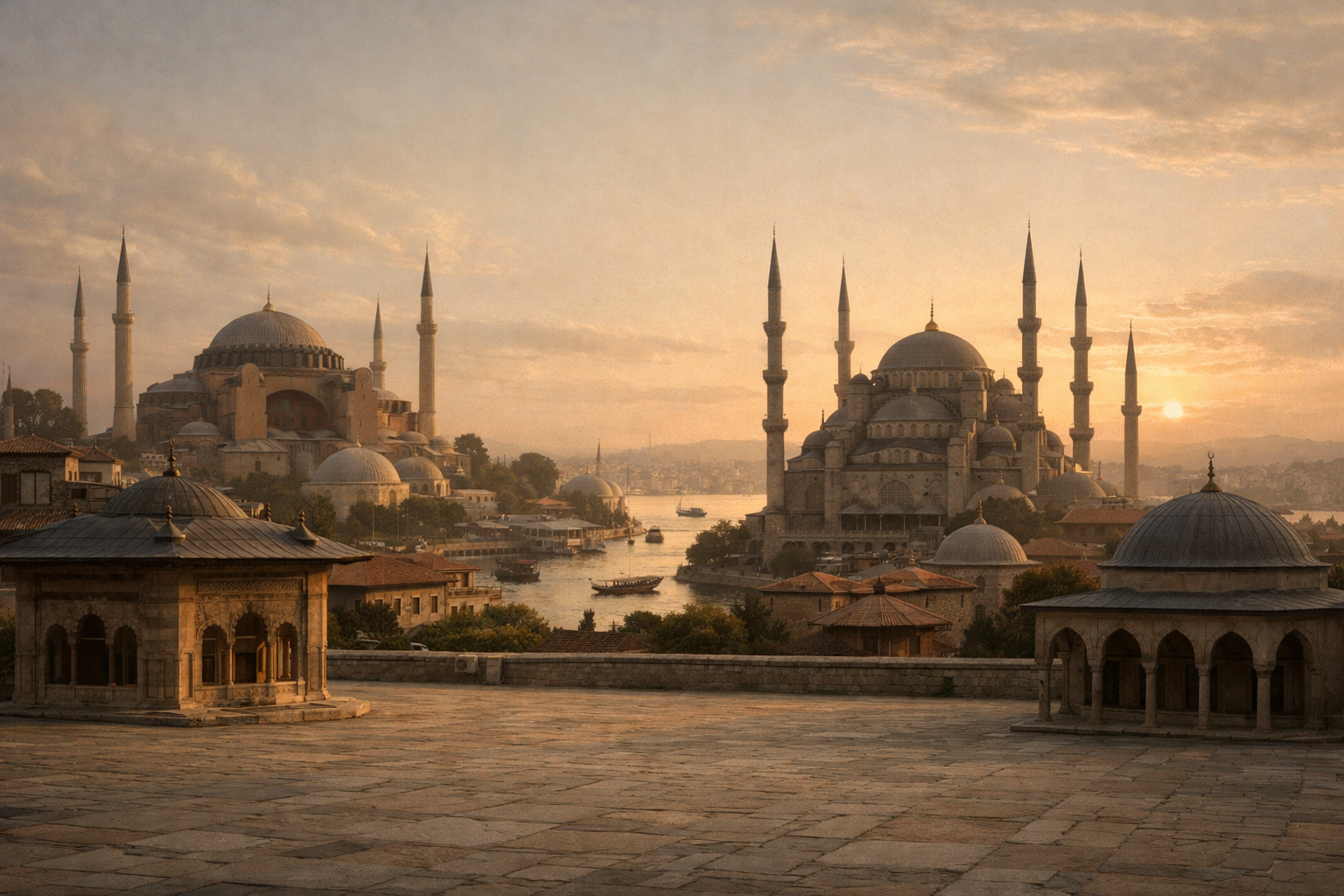
A Sultan in Chains
The cold stones of Yedikule Fortress echoed with unfamiliar footsteps on the night of May 19, 1622. Through dim corridors of Istanbul's notorious prison, a group of men led their unprecedented prisoner: Sultan Osman II, the 17-year-old ruler of the Ottoman Empire, now in chains. Just days earlier he had commanded one of the world's most powerful empires. Now he was at the mercy of rebellious Janissaries, the elite military corps that had once been the empire's greatest strength.
Young Osman's face, normally bearing the confident expression that had earned him the nickname "Genç" (The Young), was drawn with fear and disbelief. His elaborate kaftan, symbol of imperial authority, was torn and soiled. The golden threads that once gleamed in the palace now caught the meager light of torch flames, a final mockery of his fallen status.
Built by Mehmed the Conqueror to guard the ancient Golden Gate at the southern end of Istanbul's land walls, near the Sea of Marmara, the fortress had held many prisoners but never a reigning sultan. As Osman was pushed into a dank cell, his mind must have raced through the events that had brought him here: his ambitious military reforms, the failed Polish campaign, his plan to replace the Janissaries with a new army, and the violent uprising that erupted when word of his planned pilgrimage to Mecca reached his enemies.
Outside the fortress walls, Istanbul was in chaos. The narrow streets echoed with the shouts of rebellious soldiers and the cries of citizens caught in the turmoil. Fires blazed in several quarters, their orange glow reflecting off the waters of the Bosphorus. In Topkapi Palace, a new sultan was being installed on the throne for the second time: Osman's mentally unstable uncle Mustafa I. The empire's power brokers scrambled to adjust to the unprecedented situation of a deposed reigning sultan.
The Empire at a Crossroads
The early 17th century marked a critical period for the Ottoman Empire. The golden age of Suleiman the Magnificent (1520-1566) had given way to mounting challenges. The "Price Revolution" caused by the influx of American silver had devastated the Ottoman economy, and military technology was evolving rapidly. The once-invincible Ottoman armies were struggling to maintain their superiority against European powers.
The Janissary corps, originally created as an elite slave-soldier force, had become a privileged and hereditary class resistant to change. Their military effectiveness had declined while their political power grew enormously. They had embedded themselves in the empire's economic life, operating businesses and trades despite their nominal military role.
Osman II had ascended to the throne in 1618 at just 14 years of age, following the deposition of his uncle Mustafa I. Despite his youth, he showed remarkable independence of mind and a clear vision for reform. He was the first Ottoman sultan since Suleiman to personally lead his armies on campaign, commanding the Polish expedition of 1621. Its failure convinced him that the military needed dramatic change.
His reform plans were ambitious but dangerous. He sought to create a new army recruited from the Turkish population of Anatolia, a move that directly threatened the Janissaries' privileged position. He also aimed to reassert sultanic authority over the military and religious establishments, both of which had gained considerable autonomy during the preceding decades.
The Path to Crisis
The main narrative unfolds through multiple perspectives.
From Osman's view, the empire needed urgent reform to survive. His experiences in the Polish campaign had shown him the Janissaries' limitations. He had watched them refuse direct orders and retreat from battle, behavior unthinkable in the corps' glory days. His proposed new army would be loyal directly to him and trained in modern warfare techniques.
The Janissaries saw things differently. To them, Osman's plans threatened not just their military role but their entire way of life. Many had established businesses and families in Istanbul despite their theoretical status as slave-soldiers, and they viewed their privileges as earned through centuries of service.
The ulema (religious scholars) were initially divided. Some supported Osman's efforts to restore imperial authority. Others saw him as dangerously innovative. The decisive moment came when Osman announced his intention to make the Hajj pilgrimage to Mecca. While seemingly pious, this unprecedented move by a reigning sultan was widely read as a cover for recruiting his new army from Anatolia.
The crisis exploded in May 1622. The Janissaries, joined by students from religious schools, rose in revolt. They stormed the palace, freed Mustafa I from confinement, and forced Osman to abdicate. His attempts to rally support from the population failed. The Janissaries controlled the streets.
The Fatal Consequences
Osman's imprisonment in Yedikule lasted only a day. On May 20, 1622, he was strangled with a bowstring, the traditional method of executing Ottoman princes. His death marked the first regicide of a sultan in Ottoman history, shattering a centuries-old taboo.
The immediate aftermath was chaos. Mustafa I's second reign lasted only a year before he was deposed again, and the empire entered a period of instability that would persist for decades. The Janissaries' power grew stronger, making future reform attempts harder still.
The long-term consequences were profound. Osman's death established a dangerous precedent that would be repeated several times in the following centuries. The failure of his reforms delayed necessary military modernization, contributing to the empire's gradual decline relative to European powers.
In the next episode, we'll examine how Osman's younger brother Murad IV eventually assumed power and attempted his own reforms, this time with more success but equal brutality. The trauma of Osman's death would shape Ottoman politics for generations, as subsequent sultans weighed the need for change against the dangers of challenging entrenched interests.
Editor's Context
Read this episode as a study in imperial administration as much as conquest. Ottoman power depended on frontier politics, fiscal systems, elite bargains, and the ability to absorb local complexity. The date markers (1520, 1566) are included because chronology is one of the easiest places for narrative history to become misleading. The episode's themes (history, empire, power) are the editorial lens for weighing cause and consequence rather than treating the story as isolated trivia.
Reviewed under the EmpiresDiary editorial workflow by Obadiah.
Drafted with AI. Accuracy review and corrections are ongoing — if you spot an error, please report it. See our workflow and editorial policy.