The Rise of Suleiman the Magnificent
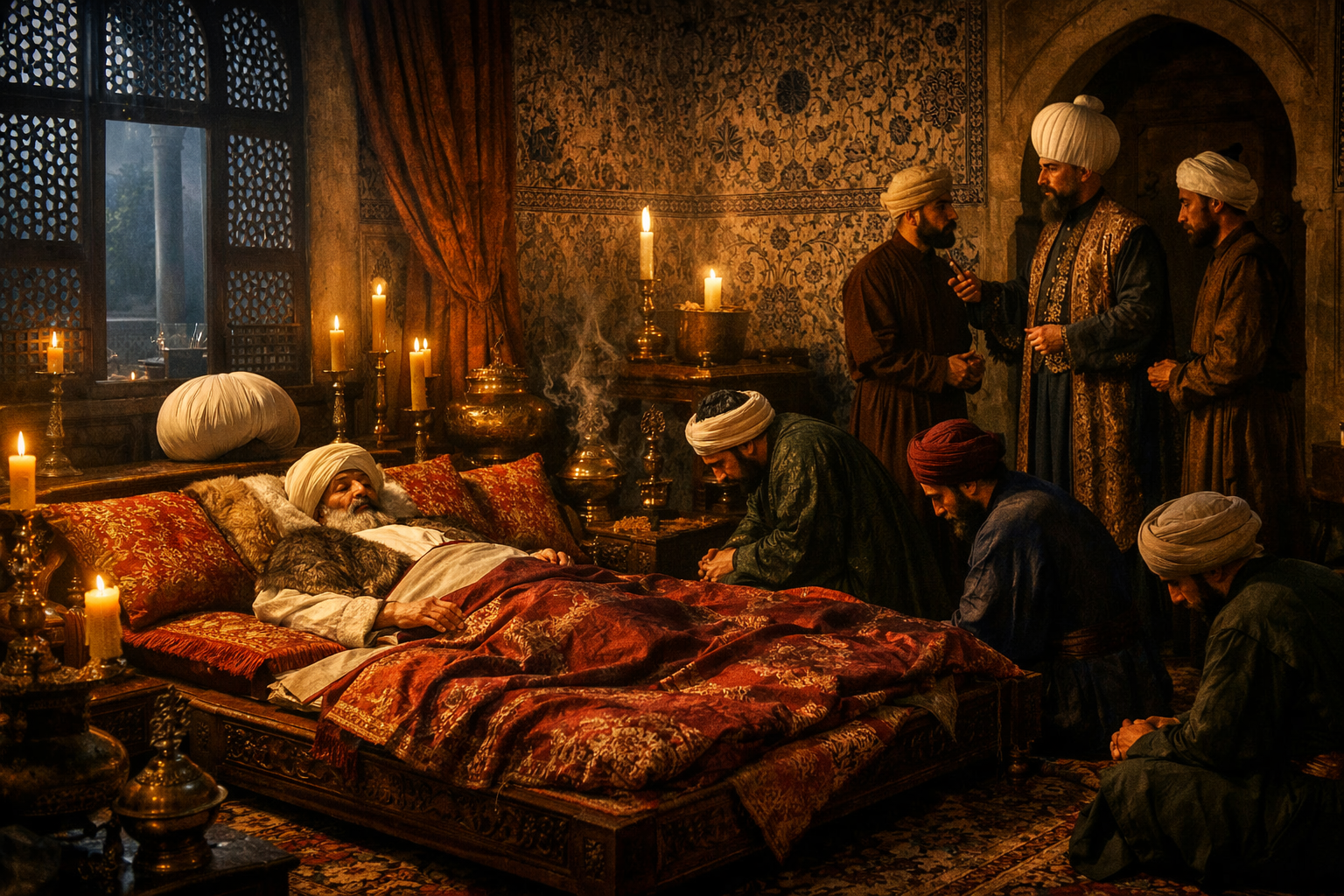
A Father's Final Moments
The chambers of Topkapi Palace fell silent on September 22, 1520, as Sultan Selim I drew his final breaths. Known as "Selim the Grim," he had expanded the Ottoman Empire dramatically during his short eight-year reign, conquering Syria, Egypt, and the holy cities of Mecca and Medina. Now fever consumed him, and his thoughts turned to his only son and heir: the 26-year-old Prince Suleiman.
Messengers moved swiftly through the ornate palace corridors, but quietly. In Manisa, where Prince Suleiman served as provincial governor, the news would soon arrive. The young prince had been groomed for this moment since birth, educated in literature, science, and warfare. His father's path to power had been soaked in blood, including the execution of his own brothers. Suleiman faced none of that. He was the uncontested heir, the only surviving son of Selim I.
In the palace's private garden, where Selim had fallen ill while preparing for yet another military campaign, the empire's highest officials gathered. Grand Vizier Piri Mehmed Pasha took charge, ensuring a smooth transition. As custom dictated, Selim's death was kept secret until Suleiman could arrive in Constantinople. The empire could not risk even a moment of uncertainty.
When the news reached Suleiman in Manisa, he moved fast. His journey to Constantinople took thirteen days, each mile bringing him closer to assuming command of an empire that stretched from the Danube to the Euphrates, from the Crimea to the Nile.
An Empire at its Crossroads
The Ottoman Empire Suleiman inherited in 1520 was already formidable, but it stood at a genuine turning point. His great-grandfather Mehmed II had conquered Constantinople in 1453, transforming the Ottoman state from a frontier principality into an empire. His grandfather Bayezid II consolidated those gains through diplomatic finesse, while his father Selim I nearly doubled the empire's size through aggressive expansion.
The world of 1520 was changing fast. In Europe, Charles V Habsburg had just become Holy Roman Emperor, ruling territories that included Spain, the Netherlands, and vast holdings in the New World. The Protestant Reformation was beginning to crack the foundations of Catholic Europe. To the east, the Safavid Empire under Shah Ismail threatened Ottoman interests in Anatolia and Mesopotamia.
The Ottoman state itself was evolving. No longer simply a warrior state, it had developed sophisticated administrative systems that drew on Turkish, Persian, and Byzantine traditions. The empire's population was a complex mosaic: Muslims, Christians, and Jews living alongside Turks, Arabs, Greeks, Slavs, and many others.
The challenges facing the new sultan were serious. Vast frontiers needed defending while internal stability had to be maintained. The administration required modernization. The Janissary corps needed to adapt to changing warfare technologies, and commerce and culture both demanded attention.
Main Narrative: The First Years of Power
Suleiman's initial actions as sultan revealed the leadership style that would define his reign. He projected an image of justice and mercy, a deliberate contrast to his stern father. His first decree freed hundreds of Egyptian merchants imprisoned by Selim I, and he ordered compensation for properties his father had seized unjustly.
He wasted little time proving himself on the battlefield. In 1521, he led his first major campaign and captured Belgrade, a fortress that had repelled even Mehmed the Conqueror. The victory secured the empire's northern frontier and opened the road into Central Europe. A year later, his forces took the island of Rhodes from the Knights Hospitaller, eliminating a persistent threat to Ottoman maritime trade.
Suleiman was more than a soldier, though. He launched an ambitious program of legal reform that earned him the title "Kanuni," meaning the Lawgiver. He personally presided over the Imperial Council twice weekly, hearing petitions from subjects of all faiths and social classes. His chief judge, Ebussuud Efendi, worked to harmonize secular law with Islamic Sharia, producing a legal framework that would last centuries.
His private life shaped his reign in ways no one could have predicted. He fell deeply in love with Hurrem Sultan, known in Europe as Roxelana, a slave girl he eventually took as his legal wife. That decision broke Ottoman tradition outright. Their partnership challenged long-standing conventions and would influence Ottoman governance for generations.
Ibrahim Pasha, Suleiman's childhood friend and Grand Vizier, became his closest advisor. Their relationship reshaped Ottoman administration: Ibrahim wielded unprecedented power for a non-royal, and together they patronized art, literature, and architecture, driving a genuine cultural renaissance at the imperial court.
Not everyone welcomed these changes. In 1525, the Janissaries staged their first major rebellion, demanding higher payment. Suleiman handled the crisis skillfully. He increased their wages while making clear that his authority was not up for negotiation. The episode illustrated the tension between innovation and tradition that would run through his entire reign.
Consequences: Setting the Stage for the Golden Age
The first decade of Suleiman's reign established patterns that would define the Ottoman Empire's golden age. His combination of military success, legal reform, and cultural patronage created a model of Islamic kingship that later sultans would strive to copy.
Belgrade and Rhodes were more than battlefield trophies. They demonstrated Ottoman military superiority, secured key strategic positions, and set the stage for further expansion into Europe and the Mediterranean.
The legal reforms proved even more enduring than the conquests. Suleiman's systematization of Ottoman law gave administrators a workable framework for governing a diverse empire, and his emphasis on justice earned loyalty across religious and ethnic lines. The systems he built outlasted him by generations.
The cultural flowering that began under his patronage transformed Constantinople into one of the world's great cities. Construction of magnificent monuments, particularly the work of the architect Sinan, gave the city its distinctive skyline and spread Ottoman architectural styles throughout the Islamic world.
The Road to Vienna
As Suleiman consolidated power and reformed his empire, his attention turned increasingly westward. The Habsburg Empire under Charles V presented both a challenge and an opportunity. The coming campaign against Hungary would test Ottoman military strength against Christian Europe's most powerful rival, leading to the first siege of Vienna and defining the outer limits of Ottoman expansion. But that is a story for our next episode.
Editor's Context
Read this episode as a study in imperial administration as much as conquest. Ottoman power depended on frontier politics, fiscal systems, elite bargains, and the ability to absorb local complexity. The date markers (1520, 1453) are included because chronology is one of the easiest places for narrative history to become misleading. The episode's themes (history, empire, power) are the editorial lens for weighing cause and consequence rather than treating the story as isolated trivia.
Reviewed under the EmpiresDiary editorial workflow by Obadiah.
Drafted with AI. Accuracy review and corrections are ongoing — if you spot an error, please report it. See our workflow and editorial policy.