Abdul Hamid II Takes the Throne, 1876-1877
A Palace in Turmoil
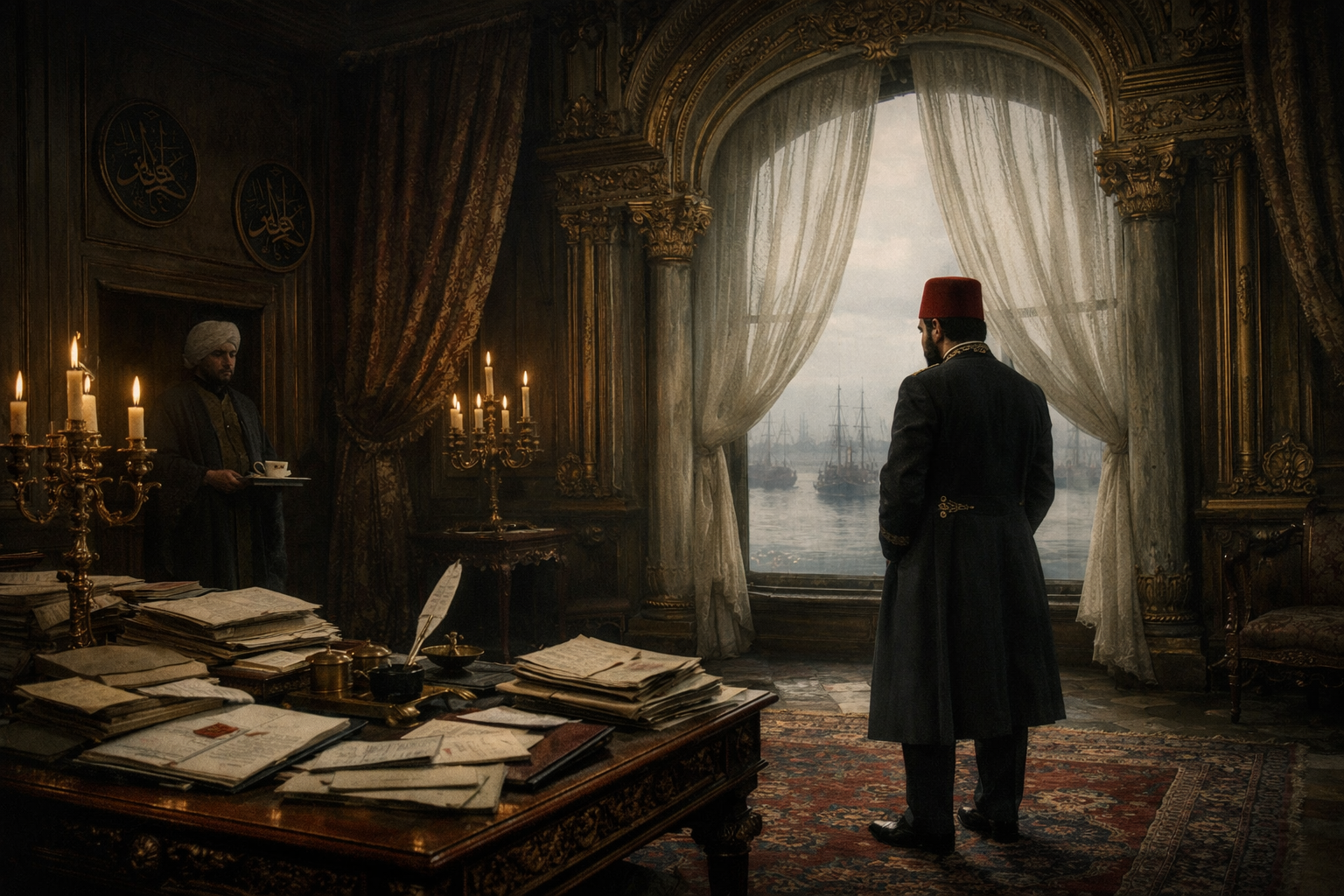
On a crisp February morning in 1877, the grand halls of Dolmabahçe Palace in Constantinople echoed with urgent footsteps. Sultan Abdülhamid II, newly ascended to the Ottoman throne, stood at the ornate windows overlooking the Bosphorus, his face etched with concern. Before him lay diplomatic dispatches bearing grave news: Russia was mobilizing along the empire's northern frontiers. European creditors were pressing after the empire's 1875 default on its foreign loans. Internal reforms threatened to tear the empire apart.
The 34-year-old sultan's dark eyes scanned the waters where Ottoman warships lay anchored, their presence a reminder of his empire's fading naval power. In his private chambers, elaborate Persian carpets and gilded furniture spoke of centuries of Ottoman wealth and influence. The mounting stack of papers on his desk told a different story, one of mounting debt, territorial losses, and growing unrest among his subjects.
Abdülhamid had inherited an empire in crisis. His predecessor and brother, Murad V, had been deposed after just 93 days due to mental illness. Before him, their uncle Abdülaziz had met a controversial end, either by suicide or assassination. The atmosphere in the palace was thick with paranoia. Abdülhamid knew that even the walls had ears, and every servant could be an informant for either the reformists or the conservatives.
That morning, as he prepared to meet with his Grand Vizier, Midhat Pasha, the sultan was about to make decisions that would reshape the Ottoman Empire's final decades. The promulgation of the first Ottoman constitution lay before him, a document that promised to modernize the empire but also threatened to diminish the sultan's absolute power. Outside the palace walls, the streets of Constantinople buzzed with anticipation, as newspapers debated the future of the empire and coffee house discussions turned to politics and reform.
An Empire at the Crossroads
The Ottoman Empire of 1876 was a shadow of its former glory. Once stretching from the gates of Vienna to the Persian Gulf, from the Crimea to North Africa, the empire had been steadily losing territory and influence throughout the nineteenth century. The Tanzimat reforms (1839-1876) had attempted to modernize the state along European lines, but had achieved mixed results.
Greece had won its independence in 1832, Serbia and Romania were increasingly autonomous, and Egypt operated with virtual independence under its own dynasty. The empire was derisively known as the "Sick Man of Europe," burdened by capitulations (special privileges granted to European powers), a crippling public debt, and an inefficient bureaucracy.
The Young Ottomans, a group of reformist intellectuals, had been pushing for constitutional monarchy since the 1860s. They believed that only by adopting European-style political institutions could the empire survive in the modern world. Their ideas had found support among some officials, including Midhat Pasha, who saw constitutionalism as a way to prevent European intervention and unite the empire's diverse populations.
The international situation was equally precarious. The Russian Empire, the Ottomans' traditional enemy, was pursuing an aggressive pan-Slavic policy in the Balkans. Britain, long a supporter of Ottoman territorial integrity as a buffer against Russia, was becoming less reliable. The 1875 rebellion in Herzegovina and Bosnia had already destabilized the Balkans, with Serbia and Montenegro on the brink of war.
Main Narrative: The Sultan's Gambit
Abdülhamid II's early reign appeared promising. In December 1876, he promulgated the first Ottoman constitution, establishing a parliament and guaranteeing basic rights to all Ottoman subjects regardless of religion. The empire seemed poised for a new era of reform and modernization.
The Russian-Ottoman War of 1877-78 shattered these hopes. As Russian forces advanced through the Balkans and eastern Anatolia, Abdülhamid used the crisis to suspend the parliament in February 1878. This began what historians would later call the "Hamidian era," 30 years of autocratic rule marked by censorship, surveillance, and centralized power.
From Abdülhamid's own perspective, this autocracy was necessary for survival. He established a vast network of spies and informants, censored the press, and exiled dissidents. Yet he also modernized the empire in selective ways, establishing the empire's first modern universities, building railways, and introducing telegraph lines across Ottoman territories.
The sultan's rule drew different reactions from various groups:
- Senior bureaucrats such as Said Pasha, who served as Grand Vizier multiple times, found the sultan's micromanagement stifling yet saw centralized order as a hedge against chaos.
- The religious scholars (ulema) generally supported Abdülhamid's emphasis on Islamic unity and his claim to the Caliphate, seeing him as a defender of tradition against Western encroachment.
- Among the rising educated officer class, which would later include Mustafa Kemal, frustration with palace surveillance and censorship grew steadily as European rivals appeared to advance while the empire stagnated.
Meanwhile, new opposition groups formed. The Young Turks, organizing in Paris and other European cities, began plotting against the regime. Their Committee of Union and Progress (CUP) gradually infiltrated the military and civil service.
Consequences: The Price of Autocracy
Abdülhamid's reign had lasting consequences for the Ottoman Empire and modern Turkey. His emphasis on Islamic unity influenced political movements throughout the Muslim world, while his modernization efforts created the foundations for many of Turkey's modern institutions.
His autocratic rule also contributed to the empire's collapse. The suppression of reform movements drove many talented individuals into opposition, and censorship and surveillance created an atmosphere of fear and stagnation.
When the Young Turk Revolution finally forced Abdülhamid to restore the constitution in 1908, and deposed him in 1909, the empire had lost much of its capacity to reform effectively. The centralized bureaucracy he created would ironically become a tool for the Young Turks' own authoritarian rule.
As Abdülhamid departed for exile in Thessaloniki, the empire entered its final phase. The Young Turks would soon face their own challenges: Balkan Wars, World War I, and the empire's dissolution. In our next episode, we'll explore how the Committee of Union and Progress led the Ottoman Empire into its final decade, making decisions that would reshape the Middle East for centuries to come.
Editor's Context
Read this episode as a study in imperial administration as much as conquest. Ottoman power depended on frontier politics, fiscal systems, elite bargains, and the ability to absorb local complexity. The date markers (1839, 1877) are included because chronology is one of the easiest places for narrative history to become misleading. The episode's themes (history, empire, power) are the editorial lens for weighing cause and consequence rather than treating the story as isolated trivia.
Reviewed under the EmpiresDiary editorial workflow by Obadiah.
Drafted with AI. Accuracy review and corrections are ongoing — if you spot an error, please report it. See our workflow and editorial policy.