The Siege That Changed History
May 29, 1453
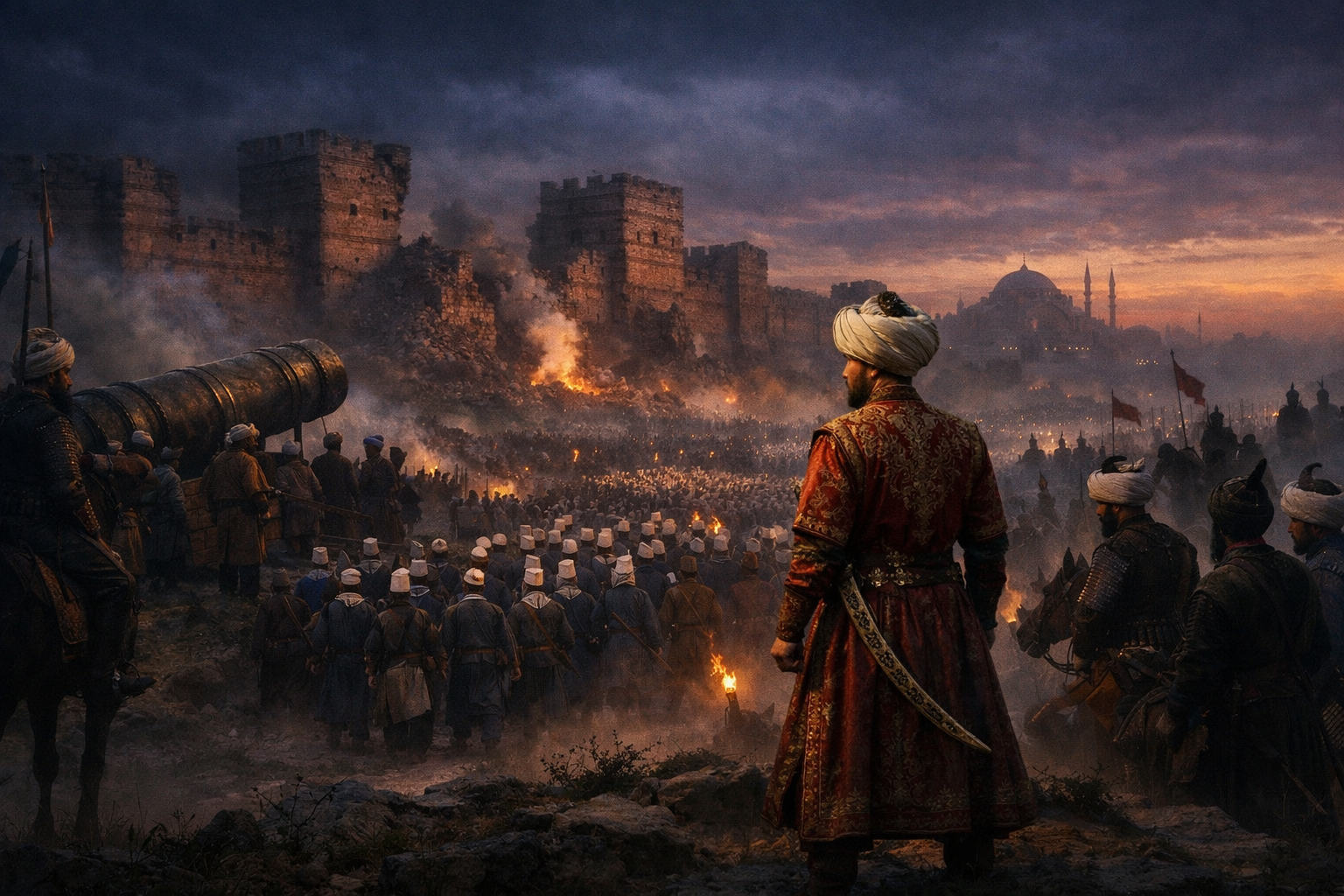
The pre-dawn air hung heavy with smoke. Sultan Mehmed II stood atop a hill overlooking Constantinople's walls, his dark eyes fixed on the greatest prize in Christendom. For fifty-three days, his army had battered these ancient defenses, and still they held. This morning would be different. He could feel it.
The young sultan, barely twenty-one years old, watched as his massive bronze cannon fired another round at the walls near the Gate of St. Romanus. The thunderous boom echoed across the battlefield, followed by the crack of stone giving way. Through the settling dust, sections of the outer wall had finally crumbled.
Inside the city, Emperor Constantine XI Palaeologus knelt in prayer at the Hagia Sophia. He'd just received word that the Ottoman forces were preparing their final assault. Around him, the vast dome echoed with the prayers of priests and civilians who had sought sanctuary there. They all knew what was coming.
In the darkness before dawn, the muezzin's call to prayer rang out across the Ottoman camp, joined by war drums and trumpets. Mehmed gave the signal. Thousands of troops began moving forward: first the irregular auxiliaries, then the Anatolian forces, and finally his elite Janissary corps, their white caps catching the growing light.
The ancient Roman Empire, which had endured for over a millennium in its eastern form, was facing its last hours. A young sultan's dream of transforming his Turkish kingdom into a true empire was about to be tested in blood and fire.
The Road to 1453
The siege of Constantinople was the culmination of a centuries-long struggle between the Ottoman Turks and the Byzantine Empire. Since their emergence as a power in Anatolia in the late thirteenth century, the Ottomans had steadily expanded their territory, gradually encircling the once-mighty Byzantine state until Constantinople stood as an island in a Turkish sea.
The city had survived numerous sieges throughout its history, shielded by the massive walls built by Emperor Theodosius II in the fifth century. Those defenses, a triple line of walls fronted by a moat, had repelled countless armies, including an earlier Ottoman siege in 1422 under Murad II, Mehmed's father.
By 1453, the Byzantine Empire was a shadow of its former self. Once ruling territories stretching from Spain to the Euphrates, it now controlled little more than Constantinople and a few outposts in Greece. The empire had never fully recovered from the Fourth Crusade's sack of Constantinople in 1204, when Western Christians captured and looted the very city they claimed to protect.
Mehmed II had ascended to the Ottoman throne in 1451 after his father's death. Previous sultans had accepted the status quo with Constantinople. Mehmed had no such patience. He spent his first years as sultan preparing meticulously for the siege, building a fortress on the Bosphorus to control maritime traffic and commissioning massive cannons from the Hungarian engineer Urban, who had originally offered his services to the Byzantines but was turned away for lack of funds.
Mehmed also assembled the largest army the Ottomans had ever fielded, estimated at 80,000 troops, supported by a fleet of over 120 ships. Against this force, Constantinople could muster only about 7,000 defenders, including 2,000 foreign volunteers, mainly Genoese and Venetian.
The Final Battle
The assault began before sunrise on May 29, 1453. Wave after wave of Ottoman troops hurled themselves at the breached sections of wall while Greek fire and arrows rained down on them. The first two attacks, led by irregular troops and Anatolian forces, were repelled with heavy losses.
Giovanni Giustiniani, the Genoese commander responsible for the land walls, organized the resistance with skill and courage. Constantine XI moved along the battlements, encouraging his men and coordinating the defense. But the defenders were exhausted after nearly two months of constant combat, and their numbers kept shrinking.
The turning point came when a small gate, the Kerkoporta, was found open, possibly left unlocked by fleeing civilians. Ottoman troops poured through this unexpected entrance. Simultaneously, the Janissaries launched their assault on the weakened section near the St. Romanus Gate. Giustiniani was mortally wounded during the attack, and his removal from the field demoralized the men around him.
As Ottoman forces breached the walls in multiple locations, Constantine XI made his final decision. He stripped off his imperial regalia and led a last charge against the invaders. He was never seen again. Legends would later speak of the "marble emperor" who would one day return to reclaim his city.
Inside Constantinople, chaos took hold. Many civilians fled to the Hagia Sophia, trusting an ancient prophecy that angels would descend from heaven to save the city when enemies reached the column of Constantine. No angels appeared. The church's bronze doors couldn't hold back the tide.
Mehmed II entered the conquered city that afternoon, riding a white horse to the Hagia Sophia. He dismounted and bent to pick up a handful of earth, sprinkling it over his turban as an act of humility before God. Once inside, he ordered an immediate end to looting and declared the building would become a mosque.
The sultan was determined to preserve Constantinople as his new capital. He allowed his troops the traditional three days of looting, but he moved quickly to prevent the city's complete destruction. He invited people to return to their homes and began planning the restoration and repopulation of what would soon be known as Istanbul.
Consequences and Lasting Impact
The fall of Constantinople ended the Byzantine Empire and extinguished the last remnant of the Roman Empire that had shaped European civilization for over two millennia. It also completed the Ottoman state's transformation from a regional power into an empire that would dominate the Eastern Mediterranean for centuries.
Mehmed II, now called "the Conqueror," made Constantinople his capital and launched an ambitious program of reconstruction. He built the Grand Bazaar, established religious schools, and shaped a cosmopolitan city that became one of the world's great centers of culture and commerce.
The consequences for Europe were sweeping. Greek scholars fled west carrying ancient manuscripts, and their arrival helped fuel the Renaissance revival of classical learning. The loss of this Christian stronghold in the east also sharpened European fears of Ottoman expansion, feeding centuries of conflict between Christian Europe and the Muslim Ottoman Empire.
The conversion of the Hagia Sophia into a mosque said something plainly about the new order: the Ottoman Empire had inherited the Byzantine Empire's position as the dominant civilization of the Eastern Mediterranean, and it intended to hold that position.
In our next episode, we'll explore how Mehmed II consolidated his conquest and transformed Constantinople into the capital of a new empire. He established the systems of government and society that would define the Ottoman state for centuries to come. The young sultan who took Constantinople would go on to earn his title "the Conqueror" many times over, but no victory would ever carry the weight of that morning in May 1453.
Editor's Context
Read this episode as a study in imperial administration as much as conquest. Ottoman power depended on frontier politics, fiscal systems, elite bargains, and the ability to absorb local complexity. The date markers (1453, 1422) are included because chronology is one of the easiest places for narrative history to become misleading. The episode's themes (history, empire, power) are the editorial lens for weighing cause and consequence rather than treating the story as isolated trivia.
Reviewed under the EmpiresDiary editorial workflow by Obadiah.
Drafted with AI. Accuracy review and corrections are ongoing — if you spot an error, please report it. See our workflow and editorial policy.