The Lion's Last Roar
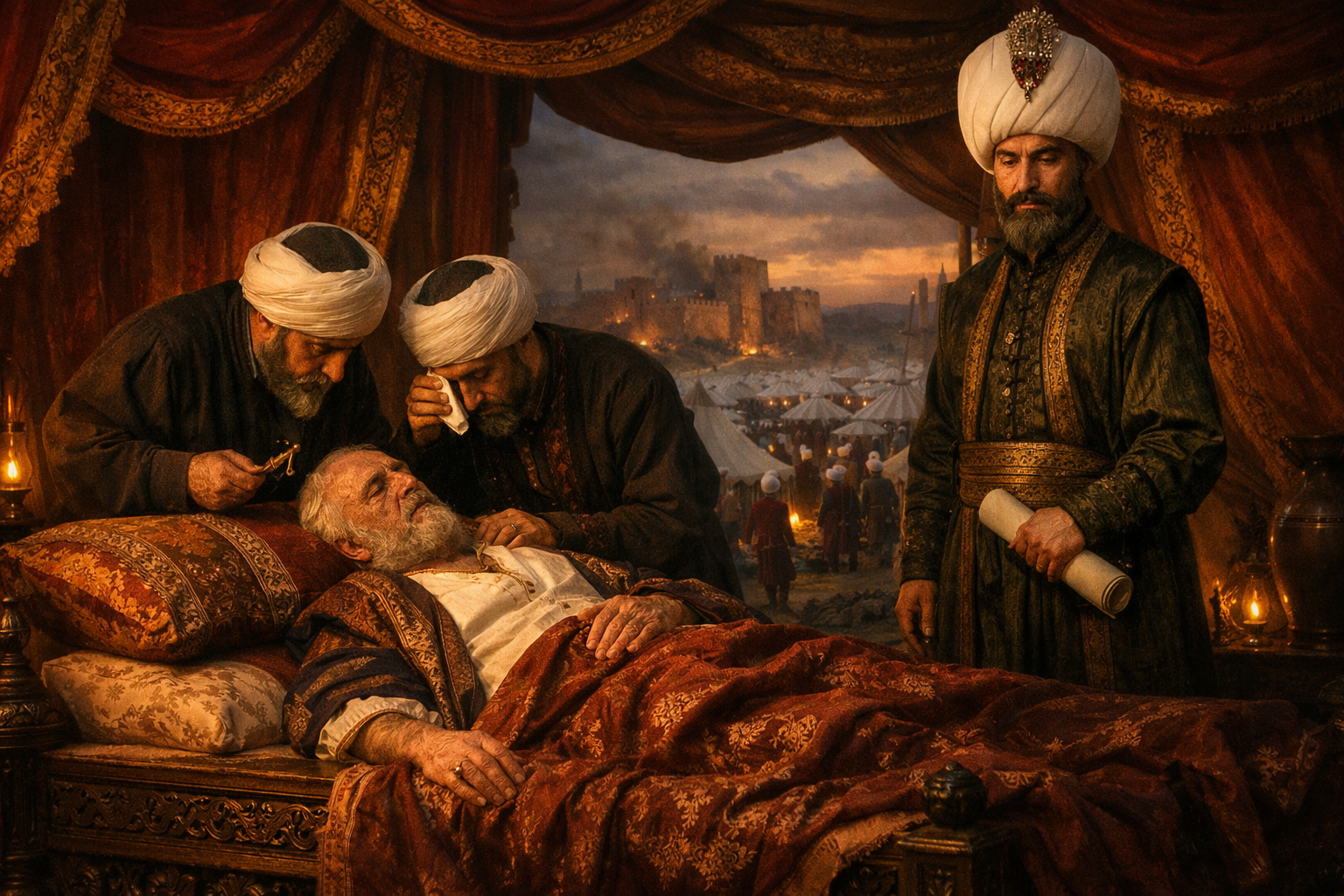
September 6, 1566, Outside Szigetvár Fortress
The late summer air hung heavy over the Ottoman siege camp, thick with gunpowder smoke and the metallic tang of blood. Inside the grand imperial tent, physicians huddled around the massive frame of Sultan Suleiman the Magnificent, their whispered consultations drowned out by the distant thunder of cannon fire. At seventy-one years old, the Lion of Islam lay dying, his breath labored and skin ashen.
Yet even as death approached, Suleiman refused to abandon his final campaign. For nearly six weeks, his army of 100,000 men had besieged the Croatian fortress of Szigetvár, defended by barely 2,300 Croatian and Hungarian soldiers under Nikola Šubić Zrinski. The Sultan's grand vizier, Sokollu Mehmed Pasha, stood vigilant by his master's bedside, carefully maintaining the fiction that the greatest Ottoman ruler still lived and commanded.
Outside, siege towers loomed against the fortress walls while trenches snaked through the marshy ground toward Szigetvár's defenses. The stench of decomposing bodies mixed with smoke from countless campfires. Turkish sappers worked tirelessly to undermine the fortress walls, and Janissary marksmen picked off any defender foolish enough to show himself above the ramparts.
In his final moments of consciousness, Suleiman gestured weakly for paper and pen. His last written orders were characteristically clear: the siege must continue, and news of his death must be concealed until his son Selim could be summoned from Constantinople to secure the succession. As the Sultan's eyes closed for the final time, Sokollu Mehmed Pasha began the elaborate deception that would maintain the illusion of Suleiman's continued presence for the crucial weeks ahead.
By 1566, Suleiman had ruled the Ottoman Empire for forty-six years, transforming it into the most powerful state in the world. Ottoman territories stretched from Algeria to the Persian Gulf, from the Crimea to Yemen. His armies had reached the gates of Vienna, and his navies dominated the Mediterranean. The empire's population had grown to nearly 15 million people, and Constantinople had become the world's largest city.
Beneath this golden facade, though, worrying cracks had begun to appear. The cost of maintaining such a vast empire strained even the Ottomans' considerable resources. The Safavid Empire in Persia remained a constant threat to the east, while Habsburg power grew steadily in Central Europe. Perhaps most pressing was the question of succession. Suleiman's beloved wife Hurrem Sultan had died in 1558, and bitter rivalry had since emerged between his surviving sons.
The siege of Szigetvár represented more than just another campaign against the Habsburgs. It was Suleiman's attempt to secure his empire's northern frontier and achieve one final decisive victory before passing the throne to his chosen heir, Selim. The fortress guarded the road to Vienna and served as a potent symbol of Hungarian resistance to Ottoman rule, which made its capture a matter of prestige as much as strategy.
The Siege's Dramatic Conclusion
In the days following Suleiman's death, Sokollu Mehmed Pasha orchestrated an extraordinary performance. The Sultan's personal physician continued to enter and exit the imperial tent at regular intervals, and orders were still issued in Suleiman's name. His personal standard flew above the camp. Even the military band played at the traditional hours, keeping alive the illusion that their ruler breathed and commanded.
Inside Szigetvár, conditions had become desperate. Nikola Zrinski's forces had been reduced to fewer than 800 men, and supplies were running dangerously low. The outer walls had been breached, forcing the defenders to withdraw to the inner castle. Still, they fought on with remarkable determination, knowing they were buying precious time for Vienna to prepare its defenses.
On September 7th, the Ottomans launched their final assault. Their sappers had packed the foundations of the inner castle with gunpowder, and the resulting explosion tore a massive hole in the defenses. As Turkish troops poured through the breach, Zrinski gathered his remaining men for one last charge.
He went out dressed in fine clothes rather than armor, having placed one hundred gold ducats in his pocket as a reward for whichever enemy soldier killed him. Zrinski fell in the ensuing battle, pierced by multiple musket balls and arrows. His heroic last stand would become legendary throughout Christian Europe.
Impact and Legacy
The fall of Szigetvár marked both the end of an era and a turning point in Ottoman history. When news of Suleiman's death finally became public, his son Selim II ascended to the throne. Selim would prove a pale shadow of his father. The empire Suleiman had built continued to expand for another century, but it never again reached the heights of power and cultural achievement it had known under the Magnificent Sultan.
The siege became deeply embedded in both Ottoman and European historical memory. For the Ottomans, it represented their last great victory under their greatest sultan. For Hungarians and Croatians, Zrinski's sacrifice became a powerful symbol of resistance against Ottoman expansion, celebrated in poems, songs, and paintings across generations.
In our next episode, we'll explore how Selim II, known as "the Sot" for his fondness for wine, handled the massive empire he inherited. We'll see how the Ottoman state began to change under less capable leadership, and how the seeds of both future expansion and eventual decline were sown in the years following Suleiman's death. The battle for the Mediterranean would soon reach its climax at Lepanto, marking another crucial turning point in Ottoman history.
Editor's Context
Read this episode as a study in imperial administration as much as conquest. Ottoman power depended on frontier politics, fiscal systems, elite bargains, and the ability to absorb local complexity. The date markers (1566, 100) are included because chronology is one of the easiest places for narrative history to become misleading. The episode's themes (history, empire, power) are the editorial lens for weighing cause and consequence rather than treating the story as isolated trivia.
Reviewed under the EmpiresDiary editorial workflow by Obadiah.
Drafted with AI. Accuracy review and corrections are ongoing — if you spot an error, please report it. See our workflow and editorial policy.