The Battle of Mohács, 1526
August 29, 1526
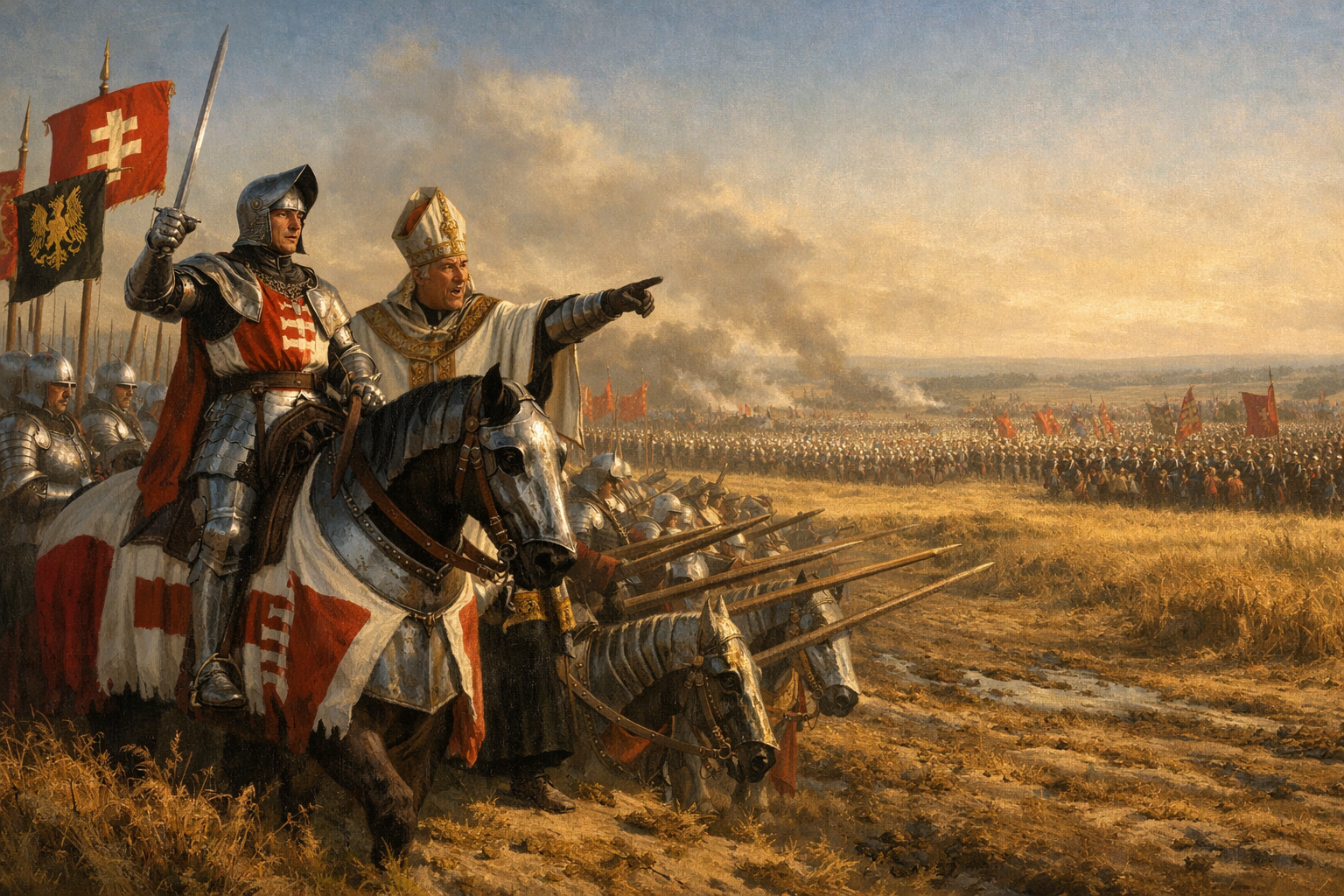
The summer sun beat down on the Hungarian plain near Mohács. Twenty-year-old King Louis II, encased in heavy plate armor, sat astride his warhorse and surveyed the field in front of him. To his left and right stretched the lines of Hungarian cavalry and infantry, nearly 25,000 men assembled to face an Ottoman force several times their size. The young king's heart pounded beneath his breastplate.
Across the muddy fields, the massive Ottoman army under Sultan Suleiman I had taken position. Artillery trains were being wheeled into place, while thousands of Janissaries (the elite infantry corps) formed their distinctive battle lines. The morning air filled with the thunder of Ottoman war drums and the shrill notes of military bands playing mehter martial music.
Archbishop Pál Tomori, the Hungarian commander, rode up to Louis with urgent news: Ottoman scouts had been spotted probing their flanks. Though the Hungarians still awaited reinforcements from Transylvania and Croatia, Tomori convinced the young king they had to attack immediately, before the Ottomans could fully deploy their superior numbers.
The Hungarian battle drums began their rhythmic beating. Louis II raised his sword and gave the order to advance. Thousands of heavily armored knights lowered their lances and moved forward, the ground trembling beneath the hooves of their warhorses. Behind them came ranks of infantry carrying long pikes and crossbows.
What no one in the Hungarian army yet realized was that Sultan Suleiman had prepared an elaborate trap. His forces had spent the previous night digging concealed positions for hundreds of artillery pieces. The Ottomans weren't simply arrayed for a frontal clash. They were poised to execute a sophisticated battle plan that would demonstrate why they had become Europe's most formidable military power.
The Road to Mohács
The Kingdom of Hungary had long served as a bulwark against Ottoman expansion into Central Europe. For over a century, Hungarian kings had fought to check Turkish advances, most notably under John Hunyadi and Matthias Corvinus. By the early 16th century, though, Hungary had fallen into serious decline. The death of Matthias Corvinus in 1490 led to weak royal authority under the Jagiellonian dynasty, and powerful nobles pursued their own interests at the expense of national defense.
The Ottoman Empire, by contrast, had reached new heights of power under Suleiman I (known as "the Magnificent" in Europe). After consolidating his rule following his accession in 1520, Suleiman began an aggressive campaign of expansion. In 1521 he captured the Hungarian fortress of Belgrade, long considered the key to Central Europe, and over the following years Ottoman forces systematically reduced Hungary's defensive frontier.
King Louis II had inherited the Hungarian throne as a child in 1516 and proved unable to unite the quarreling nobility against the growing threat. The royal treasury was depleted. Many nobles refused to contribute troops or money for the kingdom's defense. When Suleiman launched his massive invasion of Hungary in 1526 with an army of over 100,000 men, Louis could muster only about half that number.
The Protestant Reformation sweeping through Europe complicated matters further. Religious tensions between Catholics and Protestants hampered efforts to organize resistance to the Ottoman advance. Even as Suleiman's army crossed the Drava River into Hungary, many Hungarian nobles remained absorbed in their internal power struggles, seemingly blind to the existential threat bearing down on their kingdom.
The Battle Unfolds
As the Hungarian heavy cavalry charged forward, Suleiman's trap was sprung. Hundreds of Ottoman cannon opened fire from concealed positions, their iron balls tearing bloody gaps in the advancing Hungarian ranks. Still, the momentum of the charge carried the knights into the Ottoman lines, where fierce hand-to-hand combat erupted.
Initially the Hungarian attack achieved some success. Their heavily armored knights smashed through the first Ottoman ranks and drove toward the sultan's position, with infantry following up and engaging the Janissaries in brutal close-quarter fighting. For a brief moment it seemed the Hungarians might actually break through.
Suleiman had positioned his forces in depth, and that depth now told. As the Hungarian attack lost momentum, Ottoman sipahi cavalry swept in from both flanks. The Hungarian army found itself surrounded and subjected to devastating crossfire from Turkish artillery and arquebusiers. Panic spread through the ranks as men fell in growing numbers.
Archbishop Tomori was killed trying to rally his troops. Louis II, seeing his army crumbling, attempted to flee with a small group of bodyguards. In their haste they tried to cross a flooded stream. The young king's exhausted horse stumbled in the muddy water, and Louis, weighed down by his heavy armor, drowned.
The battle had lasted less than two hours. Over 14,000 Hungarian soldiers lay dead on the field, among them most of the kingdom's senior military and political leadership. Ottoman losses were minimal. Panic gripped Hungary as news of the disaster spread. Queen Mary fled Buda, and within weeks the Ottoman army occupied the Hungarian capital without resistance.
Consequences and Legacy
The Battle of Mohács marked a watershed moment in European history. The medieval Kingdom of Hungary, which had stood for over 500 years, effectively ceased to exist. The country was split into three parts: a Habsburg-controlled Royal Hungary in the west, an Ottoman-controlled central region, and the semi-independent Principality of Transylvania in the east.
This new political reality fundamentally altered the balance of power in Central Europe. The Habsburg Empire became the main Christian bulwark against Ottoman expansion, setting off centuries of Habsburg-Ottoman rivalry. The Ottoman Empire secured its position as the dominant power in southeastern Europe, controlling much of Hungary for the next 150 years.
The battle's cultural consequences were equally severe. Much of Hungary's medieval heritage was destroyed during the subsequent Ottoman occupation, and the loss of independence became a defining trauma in Hungarian national consciousness, remembered and commemorated down to the present day.
As Suleiman's armies consolidated their control over central Hungary, the Ottoman Empire reached its greatest territorial extent. New challenges were already forming on the horizon. The next episode explores the epic Siege of Vienna in 1529, where Ottoman expansion would finally meet its limits against the walls of the Habsburg capital. The stage was set for a centuries-long struggle between two great empires for control of Central Europe.
Editor's Context
Read this episode as a study in imperial administration as much as conquest. Ottoman power depended on frontier politics, fiscal systems, elite bargains, and the ability to absorb local complexity. The date markers (1526, 000) are included because chronology is one of the easiest places for narrative history to become misleading. The episode's themes (history, empire, power) are the editorial lens for weighing cause and consequence rather than treating the story as isolated trivia.
Reviewed under the EmpiresDiary editorial workflow by Obadiah.
Drafted with AI. Accuracy review and corrections are ongoing — if you spot an error, please report it. See our workflow and editorial policy.