The Siege of Baghdad, 1534: Suleiman's March East
Dawn at the Gates of Baghdad
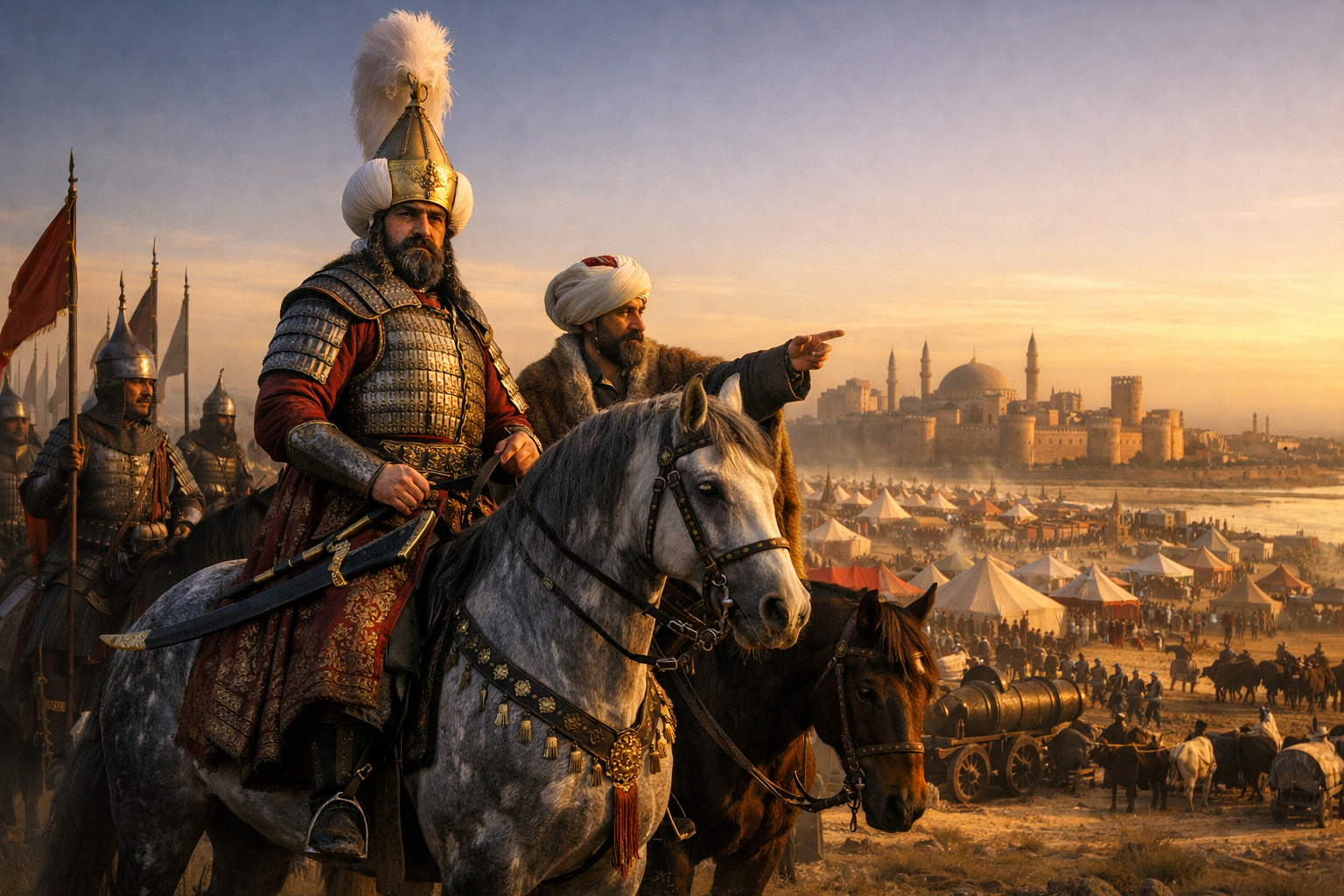
The first rays of sunlight crept over the ancient walls of Baghdad on a crisp autumn morning in 1534, casting long shadows across the Tigris. Sultan Suleiman the Magnificent sat astride his war horse, his distinctive tall ceremonial helmet gleaming in the early light. Before him stretched the legendary city of the Abbasid Caliphs, now held by his Persian rivals, the Safavids. The massive round towers and crenellated walls that had once repelled Mongol armies still stood proud, weathered by centuries of desert winds.
Two hundred thousand Ottoman soldiers spread across the plain. Their tents, colorful banners, and the smoke from thousands of cooking fires created a scene that would have been familiar to Hulagu Khan when he destroyed the city nearly three centuries earlier. But Suleiman had not come to destroy Baghdad. He had come to claim it as the rightful inheritance of his empire.
Across the plain, Suleiman could see that the walls were largely undefended. The city's population of nearly 100,000 waited anxiously, unsure whether to fear or welcome the approaching Ottoman forces. Among them were Sunni Arabs who resented Safavid Shi'ite rule and Jewish and Christian merchants who had prospered under the relative religious tolerance of both empires. Persian administrators who had made Baghdad their home rounded out a population with no clear stake in who won.
The Grand Vizier Ibrahim Pasha brought his sultan the latest intelligence: the Safavid governor Muhammad Sultan Khan Takkalu had departed the city on Shah Tahmasp's orders, withdrawing toward Basra and taking the garrison with him. Baghdad had been left undefended. Shah Tahmasp had refused a decisive battle and pulled his forces back, leaving the city open.
The Prize of Baghdad
Baghdad held both practical and symbolic significance that made it a crucial target. Founded in 762 CE by the Abbasid Caliph Al-Mansur, it had grown into the greatest city of the medieval Islamic world. The Mongol sack of 1258 ended its golden age, yet Baghdad remained a vital commercial center connecting trade routes between Persia, Arabia, and Anatolia.
Capturing the city would hand the Ottomans control of Mesopotamia's agricultural lands and its lucrative trade routes. More pressing was the symbolic weight. Since 1517, when Selim I conquered Egypt and acquired the title of Caliph, the Ottomans had positioned themselves as successors to the Abbasid legacy. Taking Baghdad from the Shi'ite Safavids would complete that transfer of authority in the most visible way possible.
The Ottoman-Safavid rivalry had been sharpening for decades. Both empires claimed to be the true inheritors of Islamic civilization while representing opposing branches of the faith. The Safavids had transformed Persia into a Shi'ite state; the Ottomans championed Sunni orthodoxy. Their competition played out on the battlefield, yes, but also through propaganda, architecture, and the patronage of religious scholars.
Previous Ottoman campaigns against the Safavids had achieved mixed results. Selim I won a decisive victory at Chaldiran in 1514, yet the Safavids proved resilient and kept control over most of Persia. Suleiman had already launched major campaigns in 1534-35, taking Tabriz and other cities without landing a knockout blow against Tahmasp's mobile army.
The Occupation of Baghdad
The Ottoman advance unfolded without resistance. Janissary infantry moved toward the gates while Sipahi cavalry patrolled the periphery. Suleiman's own pavilion rose on a small hill overlooking the eastern approaches, its red and gold banners visible across the plain.
Inside Baghdad, the Safavid governor had already gone. On Tahmasp's orders, he had withdrawn the garrison and departed for Basra before the Ottomans arrived, leaving the city's population to receive the conquerors on their own. The city's quarters were divided in their loyalties, with some residents openly welcoming Ottoman rule and others uncertain about what the change of power would bring. With no garrison remaining and no commander to direct a defense, there was nothing to prevent the Ottomans from walking in.
The city opened its gates without a fight. The Ottomans occupied Baghdad on November 18, 1534, and Suleiman made his formal ceremonial entry into the city around December 4, 1534. He rode directly to the shrine of Abu Hanifa, the founder of the main school of Sunni jurisprudence, where he prayed and ordered the shrine restored after years of Shi'ite neglect.
Ibrahim Pasha, who spoke Persian and understood Safavid court culture, helped manage the transition of authority. The terms extended to the population were measured: civilians were to be protected, and the change of administration was to proceed in an orderly fashion.
The Aftermath and Legacy
The Ottoman conquest of Baghdad shifted the balance of power across the Middle East. It secured Ottoman control over Mesopotamia for nearly four centuries and established a border with Persia that held largely stable until World War I. The city became the capital of a major Ottoman province and gradually recovered its prosperity under Ottoman administration.
Suleiman ordered extensive reconstruction: repairs to Baghdad's irrigation systems and the restoration of Sunni religious institutions. The conquest strengthened Ottoman claims to leadership of the Islamic world and demonstrated the effectiveness of Ottoman military logistics in conducting large-scale campaigns far from their power base.
The victory also revealed the practical limits of Ottoman expansion eastward. Clashes with the Safavids continued, but the Ottomans never managed to conquer Persia itself. Baghdad became a frontier fortress, guarding the empire's eastern approaches rather than serving as a springboard for further conquest. It was a ceiling as much as a prize.
As Suleiman consolidated his hold on Baghdad, new challenges were emerging elsewhere. In the Mediterranean, Ottoman naval power was reaching its zenith under the admiral Barbarossa Hayreddin Pasha. The next episode will explore how the Ottomans became a major maritime power, challenging European dominance of the Mediterranean and building an empire that spanned three continents.
Editor's Context
Read this episode as a study in imperial administration as much as conquest. Ottoman power depended on frontier politics, fiscal systems, elite bargains, and the ability to absorb local complexity. The date markers (100, 200) are included because chronology is one of the easiest places for narrative history to become misleading. The episode's themes (history, empire, power) are the editorial lens for weighing cause and consequence rather than treating the story as isolated trivia.
Reviewed under the EmpiresDiary editorial workflow by Obadiah.
Drafted with AI. Accuracy review and corrections are ongoing — if you spot an error, please report it. See our workflow and editorial policy.