The Walls Come Down
The night air was thick with smoke as flames licked the sky above Rome's Salarian Gate. The massive bronze doors, which had protected the Eternal City for centuries, lay broken and twisted. Through the ruined gateway poured thousands of Gothic warriors, their torches casting dancing shadows on the ancient walls. At their head rode Alaric, king of the Visigoths, his gilded armor reflecting the fires beginning to consume the greatest city in the Western world.
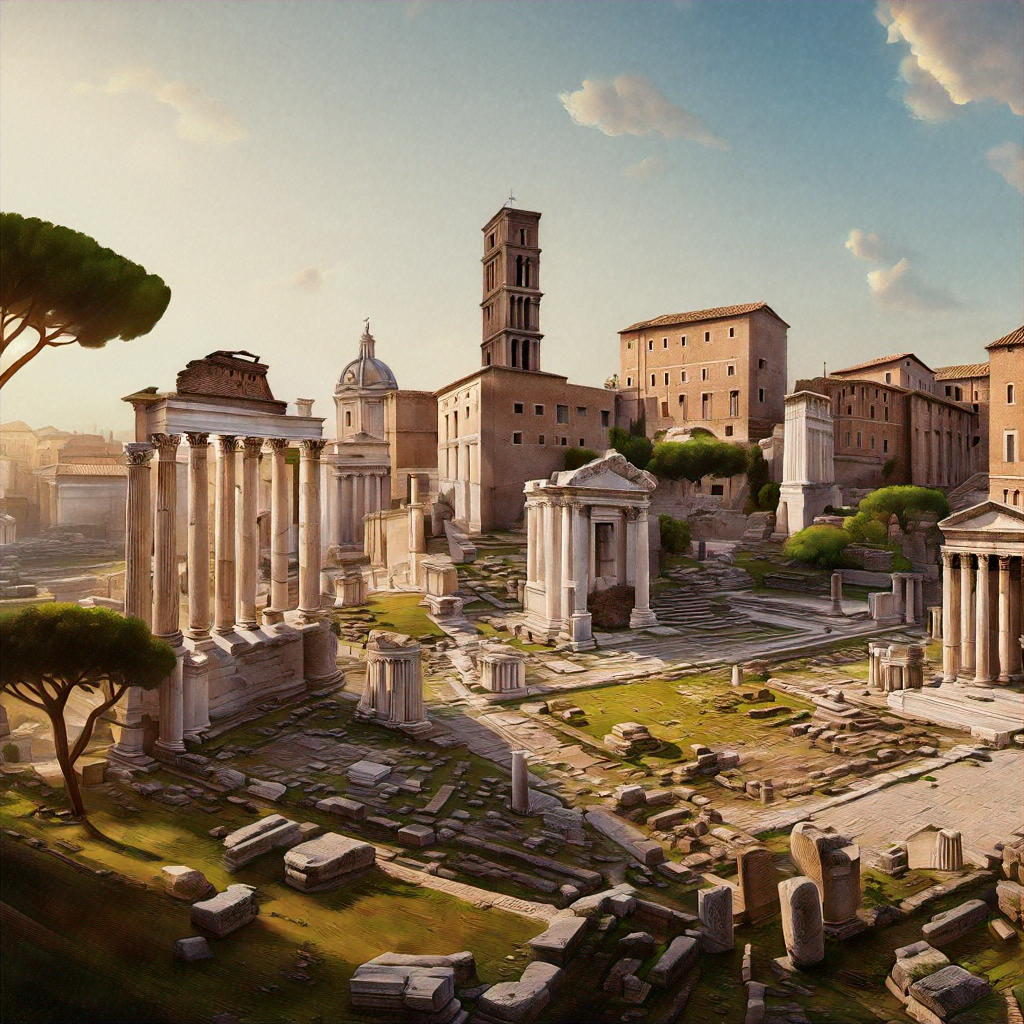
Inside Rome's walls, panic spread like a plague. Wealthy patricians fled their marble villas, clutching what treasures they could carry. The poor huddled in churches, praying to a Christian God that many believed had abandoned them. On the Caelian Hill, the noblewoman Anicia Faltonia Proba gathered her household and prepared to offer her considerable wealth to save their lives. In the Forum Romanum, centuries of Roman history lay silent under a growing pall of smoke: temples, basilicas, monuments to emperors who had once ruled the known world.
The sack of Rome had begun. For the first time in eight hundred years, foreign invaders walked the streets of the capital. The last time had been in 390 BCE, when Gallic warriors briefly occupied the city. But this was different. This was Rome at the height of its architectural glory, the Rome of a million inhabitants, the Rome that had proclaimed itself eternal.
As the night wore on, the sounds of destruction grew louder. The crash of falling columns, the splintering of wooden doors, the screams of citizens: all of it formed a terrible symphony. In the Palatine palace, abandoned by Emperor Honorius who cowered in Ravenna, Gothic soldiers tore purple silk hangings from walls and overturned golden tables. The unthinkable had happened.
The road to this catastrophe had been long. The seeds were planted decades earlier when the Huns' westward migration forced Germanic tribes toward Roman territories. In 376 CE, the Goths, fleeing Hun pressure, begged admission into the empire. Emperor Valens agreed, seeing an opportunity to gain military recruits and tax revenue. Roman officials' corruption and mistreatment of the Gothic refugees turned that opportunity into rebellion.
The situation exploded at the Battle of Adrianople in 378 CE, where the Goths annihilated a Roman army and killed Valens himself. That disaster forced the Empire to rely increasingly on Germanic foederati (allied troops) for defense, creating a dangerous dependency. Theodosius I temporarily stabilized things, but his death in 395 CE split the empire between his young sons: Arcadius in the East and Honorius in the West.
Alaric emerged during this period of weakness. Born around 370 CE to noble Gothic stock, he had served in Roman armies and understood Roman vulnerabilities intimately. When the Empire reneged on payments and promises to his people, he united the Visigoths under his leadership. His demands were initially modest: land for his people and recognition as a Roman military commander. Repeated betrayals by Roman authorities, particularly by Honorius's regime, transformed him from a potential ally into an implacable enemy.
Between 401 and 410 CE, Alaric repeatedly threatened Rome, each time negotiating and then being betrayed. The final straw came when Honorius, safe behind Ravenna's marshes, ordered the massacre of Gothic families serving in the Roman military. After that, Alaric's march on Rome became one of vengeance as much as necessity.
The three-day sack proved remarkably orderly by ancient standards. Alaric, a Christian (albeit an Arian one), ordered that churches be respected as sanctuaries. The great basilicas of St. Peter and St. Paul became refuges for thousands. He wanted to demonstrate that he was no mere barbarian but a sophisticated leader worthy of Roman respect.
Contemporary accounts let us piece together the events with some confidence. The Christian historian Orosius describes how certain Romans helped the Goths enter through the Salarian Gate, suggesting internal betrayal. The patrician Marcella, despite being tortured by Goths seeking her supposed hidden wealth, directed them to the sanctuary of St. Paul's basilica and saved many lives in doing so.
From the Gothic perspective, recorded later by Cassiodorus, this was a reluctant sacking. They had sought accommodation with Honorius for years, asking for land and legitimate status within the Empire. Only after those efforts collapsed did they resort to this extreme measure. Gothic soldiers were under strict orders to limit bloodshed and preserve key buildings.
Jerome, writing from Bethlehem, captured the Roman perspective in a single sentence: "The City which had taken the whole world was itself taken." For Romans, this wasn't merely a military defeat. It was a theological and existential crisis. How could God allow the Christian capital of the West to fall?
Procopius tells us of the fate of Rome's treasures, including the famous menorah taken from Jerusalem's Temple centuries earlier. Much of the portable wealth was loaded onto wagons bound for southern Italy. Alaric's forces also took thousands of high-status hostages, among them Galla Placidia, Honorius's half-sister.
The psychological impact reverberated across the Empire and through history. Augustine of Hippo wrote "City of God" in direct response, arguing that Christianity's spiritual Rome would endure even as the physical city fell. The sack definitively ended the myth of Roman invincibility and accelerated the Western Empire's decline.
Politically, the event exposed the fatal gap between the imperial court in Ravenna and the realities facing Roman citizens. Honorius's failure to protect Rome destroyed what remaining legitimacy the Western imperial office still commanded. It was a credibility the office never recovered.
Economically, though the physical damage was repaired, Rome never fully recovered its population or prominence. The wealthy families who fled rarely returned, taking their tax revenues with them. The city gradually transformed from the Western Empire's administrative capital into a primarily religious center under papal leadership.
As Rome smoldered, Alaric led his people south, seeking to establish a kingdom in Africa. Storms destroyed his fleet near Sicily, and he died shortly after. His successor Ataulf led the Visigoths to Gaul, establishing what would become the first successful post-Roman kingdom. The next episode explores how these Germanic kingdoms began carving up the Western Empire, creating the foundations of medieval Europe.
Editor's Context
Read this episode as part of a longer argument about institutional strain: Rome did not simply collapse because one battle, emperor, or migration went wrong. The important pattern is how military pressure, political legitimacy, taxation, and local survival choices reinforced each other. The date markers (376 CE, 378 CE) are included because chronology is one of the easiest places for narrative history to become misleading. The episode's themes (history, empire, power) are the editorial lens for weighing cause and consequence rather than treating the story as isolated trivia.
Reviewed under the EmpiresDiary editorial workflow by Obadiah.
Sources & Further Reading
Selected bibliography for this series
The Fall of the Roman Empire: A New History of Rome and the Barbarians
Peter Heather, The Fall of the Roman Empire: A New History of Rome and the Barbarians. Oxford University Press, 2005. (scholarly)
The Fall of Rome and the End of Civilization
Bryan Ward-Perkins, The Fall of Rome and the End of Civilization. Oxford University Press, 2005. (scholarly)
The World of Late Antiquity
Peter Brown, The World of Late Antiquity. Thames & Hudson, 1971. (scholarly)
Res Gestae
Ammianus Marcellinus, Res Gestae. Primary late Roman narrative source for the fourth century. (primary)
Drafted with AI. Edited and fact-checked by Obadiah before publication. See the workflow and editorial policy.