Alaric's Flames
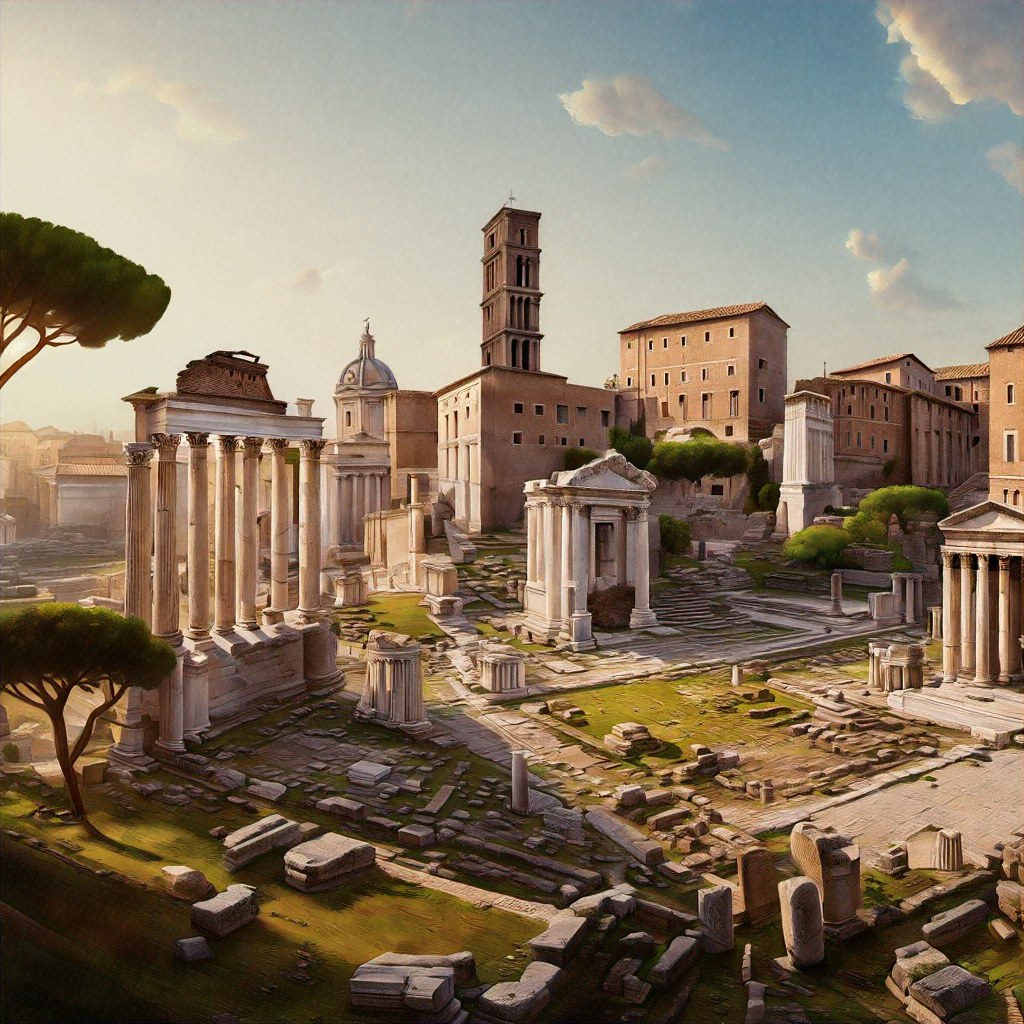
The night air was thick with smoke as flames licked the marble facades of Rome's ancient buildings. Alaric, king of the Visigoths, stood at the Salarian Gate, watching his warriors pour into the Eternal City. After three failed sieges, the unthinkable had finally happened. Rome had fallen. The heavy bronze doors lay broken, betrayed from within by slaves who had opened them in the dead of night.
Through the streets that had once witnessed triumphal processions, Gothic warriors now rampaged with torches and swords. The sounds of breaking glass and splintering wood mixed with screams of terror as wealthy Roman families fled their villas. Some sought sanctuary in Christian churches, clutching their valuables and praying that Alaric's proclaimed Christianity would spare them from the worst of the violence.
In her villa on the Caelian Hill, the noblewoman Anicia Faltonia Proba gathered her household. As one of Rome's wealthiest citizens, she knew they'd be targeted. Through the window, she could see the golden roof tiles of Nero's Domus Aurea reflecting the flames that consumed the city. The very symbols of Roman power, the Forum, the Senate House, the imperial palaces, now lay exposed to barbarian plunder.
"How has it come to this?" she whispered to herself, remembering the stories her grandmother had told of Rome's invincibility. For eight hundred years, no foreign army had breached these walls. Now, in a single night, the illusion of eternal Roman power had shattered.
The sack of Rome did not occur in isolation. For decades, the Western Roman Empire had been struggling with internal divisions and economic decline, while Germanic peoples pushed westward by the Hunnic migrations pressed hard against its borders. The death of Emperor Theodosius I in 395 CE had split the empire between his young sons: Honorius in the West and Arcadius in the East.
Alaric and his Visigoths had originally served as foederati (allied troops) for the Eastern Empire, but broken promises and political manipulation had turned them hostile. By 408 CE, they had entered Italy, demanding land and recognition. The weak Western Emperor Honorius, safely ensconced in Ravenna, repeatedly refused to negotiate seriously with Alaric.
The empire's military resources were stretched thin. Many of the best troops had been withdrawn from the frontier to fight in civil wars between rival claimants to the imperial throne. The traditional Roman system of citizen-soldiers had long since given way to professional armies increasingly staffed by Germanic mercenaries, some of whom had more loyalty to their own commanders than to Rome.
Rome itself had also ceased to be the actual seat of imperial power. Though still symbolically important, the city's practical political significance had diminished as emperors preferred to rule from more strategically located cities like Milan and Ravenna. This left Rome, despite its massive walls and centuries of fortification, surprisingly vulnerable.
The sack unfolded over three days that shook the Mediterranean world. Alaric's forces showed surprising restraint by the standards of ancient warfare, largely respecting the sanctuary of Christian churches and limiting wholesale slaughter. The psychological impact, though, was devastating.
From the perspective of Galla Placidia, sister of Emperor Honorius and taken hostage by the Goths, the scene was surreal. In her later writings, she described watching Gothic warriors wearing stolen senatorial togas, mockingly reenacting Senate proceedings in the abandoned Curia Julia. "They played at being Romans," she wrote, "while Rome herself lay bleeding."
The Roman general Quintus Aurelius Symmachus, attempting to organize resistance, found his efforts hampered by the complete breakdown of civil authority. "The city guards abandoned their posts without a fight," he recorded, "as if the very spirit had gone out of Rome's defenders." Many of those guards were themselves of Germanic origin, which only sharpened the empire's dangerous dependence on foreign troops.
In the Forum Romanum, centuries of accumulated wealth were systematically looted. The Gothic warriors were particularly interested in precious metals, melting down ancient artistic treasures for their bullion value. One Gothic chief, as recorded by the historian Procopius, expressed amazement at the solid gold statue of Virtus (Roman Valor). "Even their virtues are made of gold," he reportedly sneered.
The common people of Rome suffered differently than the elite. Marcella, an aristocratic woman who had founded a Christian ascetic community on the Aventine Hill, was tortured by Goths demanding treasure she didn't have. Yet some poor Romans actually joined the looters, seeing an opportunity to strike back at their wealthy neighbors.
The immediate aftermath saw a mass exodus from Rome. Many wealthy families fled to their estates in North Africa or to the relative safety of the Eastern Empire, and this flight of capital and talent accelerated the city's decline from imperial capital to medieval town.
The psychological impact resonated far beyond Rome's walls. Saint Jerome, in his monastery in Bethlehem, wrote: "The city which had taken the whole world was itself taken." The myth of Rome's eternal dominion, a cornerstone of imperial ideology, had been shattered. If Rome could fall, nothing was certain anymore.
The sack also accelerated changes in how Romans viewed themselves and their empire. Christianity, already the official religion, gained further strength as many interpreted the disaster as divine punishment for lingering paganism. Saint Augustine was prompted to write "The City of God" in response, arguing for a spiritual rather than earthly Roman Empire.
As news of Rome's fall spread across the empire, other Germanic peoples grew bolder in their challenges to Roman authority. The next episode will explore how the Vandals, inspired by Alaric's success, carved out their own kingdom in North Africa, further weakening Rome's grip on its vital grain supply. The twilight of empire was deepening, and the night would prove long indeed.
Editor's Context
Read this episode as part of a longer argument about institutional strain: Rome did not simply collapse because one battle, emperor, or migration went wrong. The important pattern is how military pressure, political legitimacy, taxation, and local survival choices reinforced each other. The date markers (408 CE, 410 CE) are included because chronology is one of the easiest places for narrative history to become misleading. The episode's themes (history, empire, power) are the editorial lens for weighing cause and consequence rather than treating the story as isolated trivia.
Reviewed under the EmpiresDiary editorial workflow by Obadiah.
Sources & Further Reading
Selected bibliography for this series
The Fall of the Roman Empire: A New History of Rome and the Barbarians
Peter Heather, The Fall of the Roman Empire: A New History of Rome and the Barbarians. Oxford University Press, 2005. (scholarly)
The Fall of Rome and the End of Civilization
Bryan Ward-Perkins, The Fall of Rome and the End of Civilization. Oxford University Press, 2005. (scholarly)
The World of Late Antiquity
Peter Brown, The World of Late Antiquity. Thames & Hudson, 1971. (scholarly)
Res Gestae
Ammianus Marcellinus, Res Gestae. Primary late Roman narrative source for the fourth century. (primary)
Drafted with AI. Edited and fact-checked by Obadiah before publication. See the workflow and editorial policy.